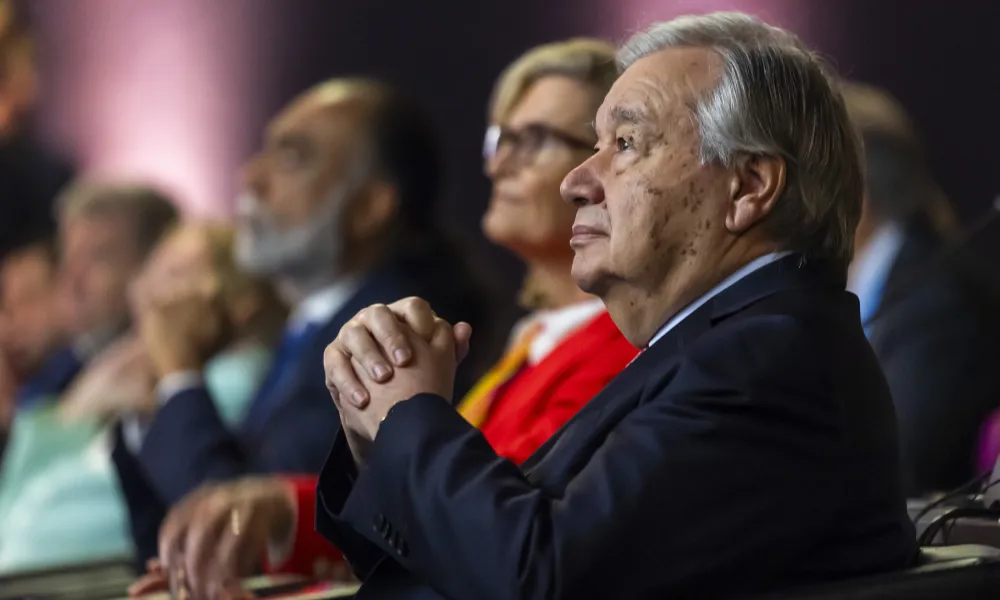

United Nations Secretary-General Antonio Guterres said the state of the world is worsening as conflicts multiply and become increasingly complex, warning that geopolitical divisions have paralysed the UN Security Council and left vulnerable populations facing severe hardship.
In an interview with Al Jazeera ahead of his final address to the UN General Assembly as secretary-general, Guterres said the involvement of “superpowers” and permanent Security Council members in ongoing conflicts had contributed to a broader crisis marked by repeated violations of international law.
Conflicts fuelling global instability
"That creates an environment of impunity, in which midsize powers believe that they can do whatever they want because nothing will happen to them," Guterres said.
He pointed to the impact of the Russia-Ukraine war and the US-Israel conflict with Iran, saying the combined effect of disruptions to food, fertiliser and energy supplies was affecting economies worldwide.
"The combination of the war in Ukraine with the problems of exports of foods, fertilisers, and energy through the Black Sea, if you combine it with the difficulties in the Strait of Hormuz, in the Bab al-Mandeb, and in the attacks [on] oil installations in several countries of the region, we are creating a situation that has a devastating impact on many economies around the world," Guterres said.
He said developed countries might ultimately be able to manage rising fuel costs and interest rates, but warned that developing nations faced far greater challenges.
People in poorer countries, he said, "are in a desperate situation" because of rising energy and food prices and shortages of fertilisers.
Call for United Nations reform
Guterres, who has served as UN secretary-general since January 2017, leaves office on 31 December 2026 at the end of his second term.
He said the organisation must undergo reforms if it is to remain effective in addressing global challenges, singling out the Security Council for criticism.
According to Guterres, the Council "still essentially represents the world of World War II".
His successor has yet to be chosen. Potential candidates cited in the report include International Atomic Energy Agency chief Rafael Grossi, former Senegalese president Macky Sall and Ecuadorian diplomat Maria Fernanda Espinosa.
Under UN procedures, a candidate for secretary-general must secure the support of at least nine of the Security Council's 15 members and avoid a veto from any of its five permanent members before being approved by the General Assembly.
Source: Al Jazeera