
By Nicholas Karides
Malta and Cyprus applied to join the European Community in 1990. When in 1993 the European Commission issued positive opinions for the start of their pre-accesion process, Cypriots, dreading the difficulties Turkey’s occupation would pose for their bid, would envy the Maltese for the easy ride they could expect on their path to full membership.
Both countries went through a grueling but cathartic process of raising their standards on a comprehensive range of technical fronts but none was more important than the political prerequisites the European Union had set. Its ‘Copenhagen Criteria’ demanded of candidate countries stable institutions that would guarantee democratic governance, a reliable and independent legal system and respect for fundamental human freedoms.
The European Commission was strict and uncompromising. Malta and Cyprus finally joined in 2004 by which time the Union itself had become a robust work-in-progress. It stood, at that point, both as an achievement and as an ongoing aspiration and served as the global standard. It was where every liberal, progressive European nation aspired to belong, where citizens saw their rights protected by institutions they could trust.
Their economies expanded, their civil societies were strengthened, their media were liberated by the shackles of insularity to be protected by that abstract blanket of ‘Europeanness’ supported by a supranational institutional framework based on the European Charter for Fundamental Rights.
Then, the Union itself faltered. The excesses of neo-liberalism and the financial crises they brought hit an astounding mediocrity of leadership to produce a perfect storm. By the time it recovered, Russia pounced on Crimea and Britain and the US began to implode giving rise to vulgar populism and corruption that eroded national and European political institutions, weakening the Union’s standing and authority.
Europe’s conception of the rule of law came under attack, oversight couldn’t keep up while citizens became distracted, mesmerised and then manipulated by their new found social toys. The media lost their footing often becoming themselves pawns of the new corporate culture.
Like the rest of the member states, Malta and Cyprus trotted along, as did, of course, worse cases like Hungary and Poland, but graft and corruption had already contaminated politics everywhere. Public Private Partnerships was the new mantra and the media, who were supposed to keep an eye, couldn’t keep up. Often they became part of the game, with only few -and much fewer individual journalists- remaining faithful to the hard work in the public interest.
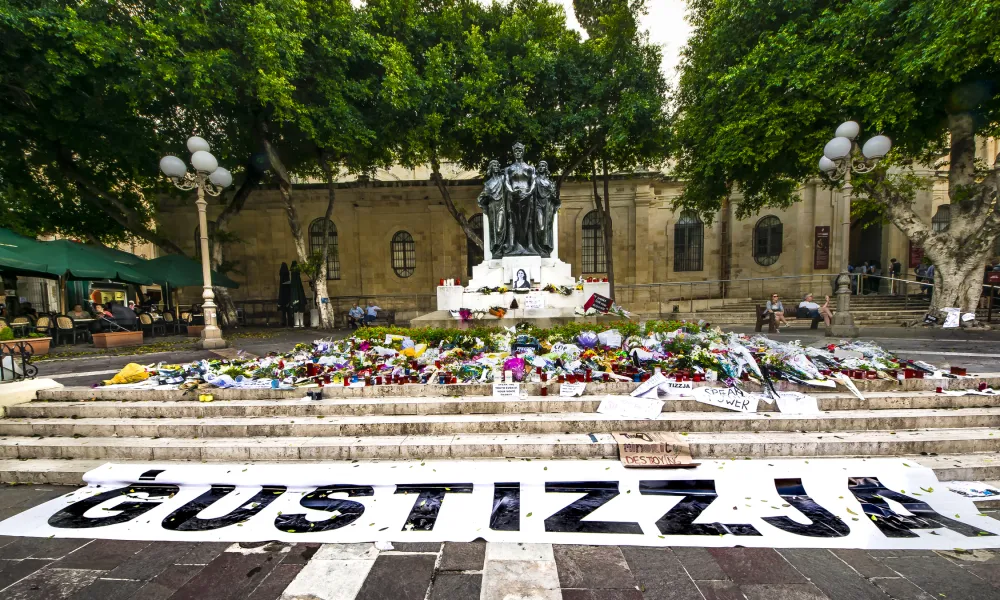
In October 2017, in Malta, the investigative journalist Daphne Caruana Galizia was brutally assassinated for her journalistic probing into corruption allegations and kickbacks linked to political and business figures over a large Maltese energy project deal. A public inquiry concluded that while the Maltese state had no direct involvement it bore responsibility for the murder. It had created a climate of impunity which stemmed from its highest ranks and had failed to take preventive measures to protect her life.
After years of dithering, a trial conducted under dubious conditions last month, acquitted the well connected Maltese businessman Yorgen Fenech of charges of masterminding Daphne’s murder. Malta has since come under severe international criticism. Twenty-two years after having seemingly fulfilled the Copenhagen Criteria, a dark culture of corruption continued to have a grip on the country. One that leaves journalists seeking the truth entirely unprotected and allows resulting criminal acts like Daphne’s murder go unpunished.
The president of the European Commission Ursula von der Leyen recently insisted that the pursuit of justice for Daphne must not end, stating that there can be no impunity from her murder. No one can dispute von der Leyen’s sincerity, or her role in the Daphne-inspired European Media Freedom Act to help promote media pluralism and the safety of journalists across the EU. Similarly, no one can underestimate the value of the European Parliament’s annual Daphne Caruana Galizia Prize for Journalism which awards and encourages outstanding journalism. But these gestures are not enough to wash away the fact that Malta’s embarrassing predicament is also a stain on the Union itself. Malta and Cyprus –where the state has recently worked uncharacteristically swiftly in dragging a journalist to court in its effort intimidate the media– are a reflection of the European Union.
The Commission may issue elaborate and overall useful annual Rule of Law reports on all its member states but these are toothless documents which, crucially, rely too heavily on state authority feedback for their assessment and miss the mark on how bad things are on the ground. Both Malta’s and Cyprus’ reports are cases in point.
As the people of Malta pour into the streets in protest, and as pressure grows on the country, it is no longer enough for European leaders to sloganise human dignity, freedom, democracy, equality, the rule of law and media freedom. Daphne died working to defend these values; the Union has an obligation to do more than just keep ‘promoting’ them.
These days most of us cringe when we hear European leaders issue evasive declarations of concern about human rights or the safety of journalists given that we see a feckless Union lacking the moral courage to act, for example, on Israel and Gaza. It is, to paraphrase James Baldwin, what you do, not what you say.
It is a depressing truth but the Union appears to have normalised its impotence. Even as its credibility crumbles under the weight of its fixation to protect internal balances and external interests rather than boldly act on the values it claims to uphold, it continues to operate gingerly like there is no alternative. Daphne took it upon herself to uncover the truth in Malta. She did not pull back from her responsibility as an investigative journalist. In contrast, and to their shame, European decision makers and institutions hide comfortably behind a perpetual state of collective irresponsibility.
Source: Nicholas Karides Essays