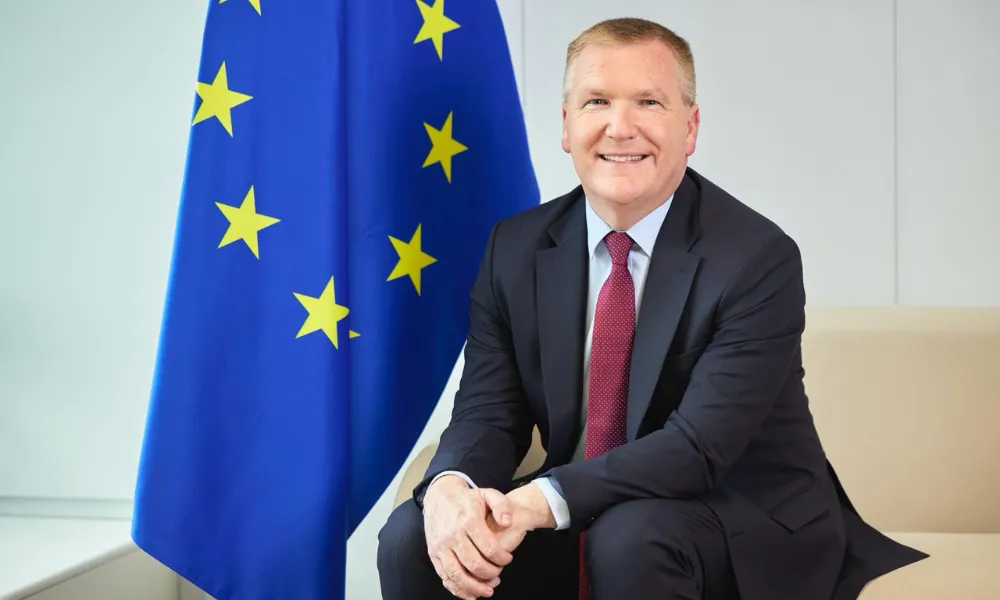
By Justice Commissioner Michael McGrath*
This weekend, we celebrate the 25th anniversary of the Charter of Fundamental Rights of the European Union, the beating heart of fairness and justice across the EU. The Charter is more than a text - it is a promise: a promise to uphold the founding values of dignity, freedom, democracy, equality, the rule of law, and respect for human rights for everyone in our Union.
Marking this milestone reminds us why the Charter matters - and challenges us to ensure its fundamental rights remain a living part of everyday life.
In my 25 years of public service - from my first election in my local town council, through national office, to serving at a European level - I have lived and breathed democracy. Democracy and the fundamental rights enshrined in the Charter go hand in hand: democracy enables our values to thrive, while the Charter transforms those values into real freedoms that we enjoy every day. By protecting freedom of expression and information, citizens’ rights, and equality, the Charter creates a virtuous cycle where democratic governance and fundamental rights continuously reinforce one another.
A vibrant, open civic space is the lifeblood of democracy. This is especially true in applying the Charter: civil society organisations and human rights defenders are indispensable partners in safeguarding our fundamental rights. To support their essential work, we must provide forums for dialogue, participation, and collaboration. Yet across Europe, these spaces are under pressure, facing funding cuts, political interference, and intimidation. The Charter reminds us that protecting civil society is not optional; it is central to ensuring its principles are realised in practice. The EU will remain steadfast in defending an open civic space, using every tool at its disposal, from policy initiatives to targeted funding, to strengthen democracy and human rights across the continent. We only recently came forward with the first-ever EU Strategy for Civil Society which aims to turn these aspirations into realities.
Supporting civil society goes hand in hand with empowering individual citizens. The Charter’s strength lies in its ability to protect and empower everyone in the EU, but its potential is realised only when people know their rights and know how to claim them. It’s encouraging to see that the latest Special Eurobarometer on the Charter, published this week, shows a steady increase in awareness: 49% of respondents have heard of the Charter, up 6 points since 2019 and 10 points since 2012. Awareness is not an end in itself; understanding rights is essential for citizens to exercise them effectively and seek redress when they are breached.
Over the past quarter of a century, the EU has made great progress in protecting fundamental rights. In 2009, the Charter became legally binding through the Treaty of Lisbon. While its content has remained consistent, the interpretation and implementation of its rights have evolved, ensuring its continued relevance in a rapidly changing world. For instance, safeguarding personal data is an essential fundamental right, as enshrined in the Charter, ensuring that individuals maintain autonomy, dignity, and privacy in the digital age. This principle is reinforced by the landmark General Data Protection Regulation, which sets a high standard for data protection across the EU.
The Charter is not abstract, it has tangible impacts on daily life. When you decline cookies on a website, it is because you have rights to privacy and data protection. The Charter also protects us from discrimination. The right to good administration ensures EU authorities act fairly, process cases promptly, and provide reasons for their decisions. Children enjoy protections too, including the right to education, the safeguarding of their best interests, and the recognition of their voices in decisions affecting them, in accordance with their age and maturity.
For 25 years, the Charter has safeguarded our rights and guided lawmakers and institutions in upholding fundamental freedoms when implementing EU law. Today, as we celebrate this milestone, I reaffirm my commitment to the Charter’s values.
There is still work to do, and I will strive to ensure that for the next 25 years, and beyond, the Charter’s rights are fully respected, defended, and made a living realityfor everyone across the European Union.
*European Commissioner for Democracy, Justice, the Rule of Law and Consumer Protection