Voice Across
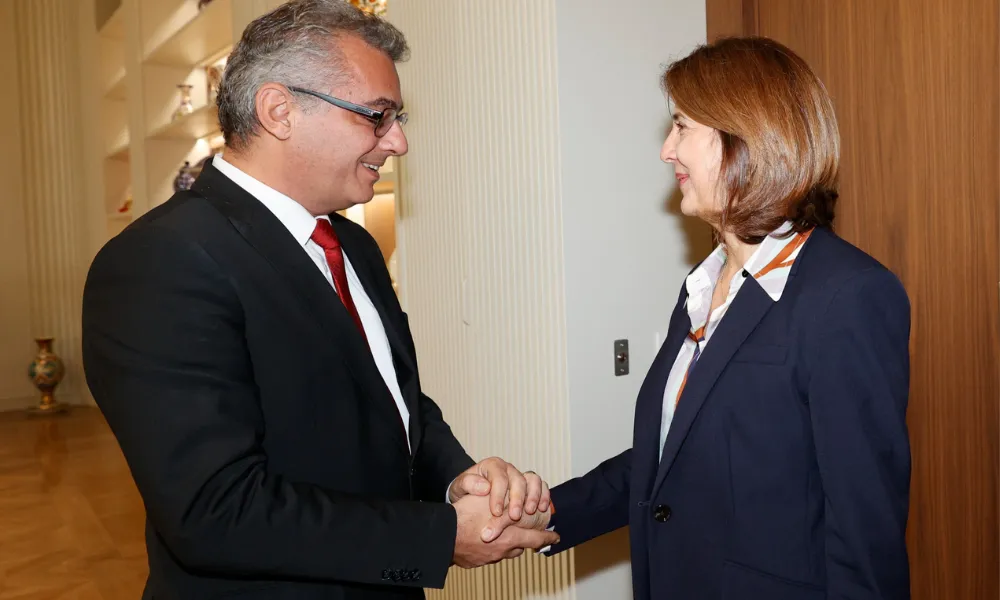
United Nations Secretary General’s Personal Envoy María Angela Holguín has returned to Cyprus at a delicate and potentially decisive moment. Besides separate talks with Turkish Cypriot Leader Tufan Erhürman and Greek Cypriot Leader Nikos Christodoulides, on 11 December she will meet both leaders together before travelling to Athens and Ankara for consultations with officials responsible for the Cyprus file. If progress is made, the United Nations intends to convene an informal 5+1 meeting before the end of the year.
For many, this sequence of contacts represents more than routine diplomacy. It represents a test. Can the two sides still identify a shared starting point for meaningful talks, or have years of tension, mistrust and shifting political landscapes pushed them too far apart?
Both communities face internal pressures
It is tempting, and politically comfortable, to say that “the other side” is moving in the wrong direction. That narrative exists on both sides of the island. Yet Holguín arrives at a moment when each community faces internal pressures that complicate negotiation.
In the Greek Cypriot community, frustration with the lack of progress has created space for harder rhetoric. Far-right groups have gained influence. Political leaders feel narrow margins for manoeuvre.
In the Turkish Cypriot community, the prolonged absence of a solution has produced its own anxieties: economic vulnerability, demographic concerns, governance challenges and a growing sense that endless open-ended processes no longer inspire confidence.
These realities mirror each other more than we often admit.
What Erhürman emphasises: Continuity, equality and realism
Turkish Cypriot leader Tufan Erhürman has articulated his stance with notable consistency. He stresses that certain past convergences remain essential if negotiations are to resume meaningfully. These include political equality in substance, effective participation in governance and the rotating presidency with a 2 to 1 ratio.
From his perspective, these are not maximalist positions. They are the foundations that earlier rounds of negotiation had already built and that kept the idea of a federal partnership viable.
At the same time, Erhürman has signalled openness to creative arrangements. Whether the future model is described as a federation, a partnership, a cooperative structure or a loose common roof over the two existing administrations matters less than whether it guarantees equality and works in practice.
This flexibility deserves recognition. It does not foreclose federal possibilities. It acknowledges that political realities on both sides require models that can evolve with time.
The Christodoulides dilemma: Governing within constraints
Greek Cypriot leader Nikos Christodoulides also faces significant pressures. He governs without a party structure and without a stable parliamentary base. His coalition depends on support from moderates, centrists and conservative voters, but also from a segment of the far right. This creates a difficult balancing act.
Symbolic gestures that may feel benign in one community can be misread in the other. The political room for compromise is narrower than many imagine. Christodoulides must navigate this environment carefully, just as Erhürman must. Neither leader is operating with a free hand.
Hardliners exist on both sides
It is important to acknowledge a truth often avoided in public debate. Hardline narratives exist in both communities. They are not the exclusive property of one side.
Perhaps the most destabilising factor for Turkish Cypriots is the mainstreaming of ELAM. Once dismissed as fringe, ELAM now shapes public discourse and influences the boundaries of political action in the south. Its ideology rejects political equality and defeats any notion of partnership.
The party’s march to the Nicosia crossing point on the anniversary of Türkiye’s 1974 intervention was not simply a demonstration. It was a political message designed to intimidate and to cast Turkish Cypriots as an unwanted presence.
When political space narrows, these voices become louder. They frame compromise as weakness and insist that only unilateral positions protect identity and security. They may disagree on facts, but they often mirror one another in tone and certainty.
Holguín’s mission requires sensitivity to these constraints rather than judgment and her task will be to help the leaders rise above those pressures, not to reinforce them.
Today’s shared challenges
If this process proceeds, negotiations will not take place in the political environment of 2017. The regional and internal landscape has changed.
On the Greek Cypriot side, economic pressures remain, maritime questions and energy planning create new sensitivities, and growing nationalist narratives limit political flexibility.
On the Turkish Cypriot side, financial and institutional challenges affect public confidence, young people are increasingly disillusioned, and the community worries about its political and cultural future.
These challenges must be understood if negotiations are to be anchored in reality rather than rhetoric.
The unresolved past remains a barrier to trust
One of the deepest challenges for both communities is that the past has never been fully or mutually acknowledged. Turkish Cypriots often note that there has been no formal recognition of the suffering they experienced in the intercommunal violence of the 1950s and 1960s. Greek Cypriots, on the other hand, carry their own profound trauma, particularly the mass displacement and loss experienced during the 1974 Turkish military operation. What one community remembers as liberation is remembered by the other as catastrophe.
Neither pain cancels the other. Both are real. Both continue to shape identity, memory and political expectations.
For Turkish Cypriots, the lack of recognition of their historical vulnerability reinforces the belief that any future settlement must contain effective safeguards and clear political equality. For Greek Cypriots, the memories of 1974 and the refugee experience continue to influence perceptions of security, territorial issues and trust.
If the island is to move forward, both sides will need to demonstrate empathy for each other’s losses and fears. Honest acknowledgment is not an exercise in blame, but a necessary step toward rebuilding confidence and creating a shared space for compromise.
The “no return to the old status quo” sentiment
A new element in the discussion is the Turkish Cypriot expectation that the era of consequences imposed only on one side in the event of failure should end.
There is a growing belief among Turkish Cypriots that if this new effort collapses again, the community should not return to the familiar isolation of past decades. Instead, they expect at minimum the “3Ds”: Direct travel, direct trade, direct contact with the international community.
Many Greek Cypriot readers may view this with concern, fearing that such measures could resemble movement toward a two-state outcome. For Turkish Cypriots, however, the conversation is framed differently. The debate is about avoiding the repetition of a cycle in which failed talks consistently penalise only one community.
Holguín’s challenge will be to understand the sensitivities this issue carries on both sides and to ensure it does not become another trigger for mistrust.
The 5+1 meeting: Clarity, not miracles
If the informal 5+1 meeting proceeds before yearend, it is unlikely to produce miracles. What it can produce is clarity. It can show whether both leaderships are willing to work within the space that still exists or whether a fundamental rethinking of the process is needed.
Clarity is not always comfortable. But clarity is necessary.
Both sides now face constraints that did not exist eight years ago. Nationalism has gained ground. Regional tensions have increased. Public confidence has diminished. The convergences once reached are now debated. Expectations have become fragile.
Holguín’s approach, which emphasises listening rather than imposing formulas, may be precisely what the moment requires.
A closing thought
Cyprus has known many diplomatic cycles. Some have carried real hope. Others have been exhausted before they even began. What distinguishes the present moment is the level of caution on both sides and the recognition that the island cannot afford another prolonged stalemate.
This is a moment for restraint, for honesty about each community’s fears and pressures, and for rediscovering the modest but essential common ground that still exists.
Holguín cannot solve the Cyprus problem. But she can help ensure that both sides take a step closer to each other rather than further apart.
In a region where disappointment has become familiar, even that would be progress.