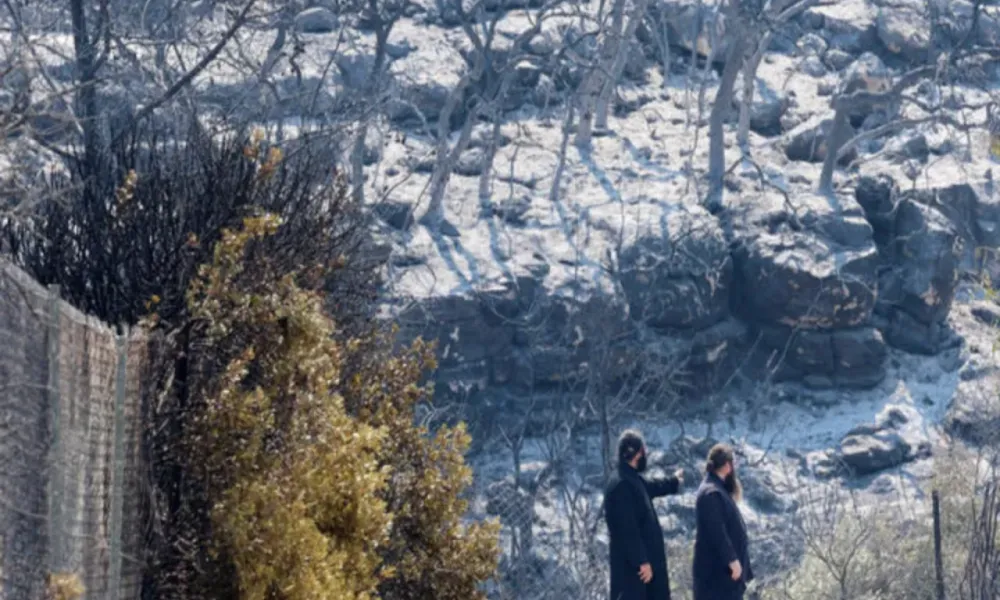
The European Commission has confirmed that the new European Firefighting Hub in Cyprus will be inaugurated in Paphos during the Informal European Council meeting on 23–24 April, held in the context of the Cyprus Presidency of the Council of the EU.
The announcement followed the weekly meeting of the College of Commissioners, where the Commission presented a new comprehensive European wildfire risk management strategy aimed at responding to the growing threat of forest fires across the continent.
Firefighting hub to open in Paphos
The new European Firefighting Hub will be located near Paphos Airport and will function as a regional operational and training centre for wildfire management in the Eastern Mediterranean.
According to the European Commission, the hub will serve a dual role:
- Operational coordination during wildfire emergencies
- Training and knowledge exchange through a European centre of excellence
The project is co-financed between Cyprus and the European Union.
Speaking after the announcement, Hadja Lahbib, Commissioner for Humanitarian Aid and Crisis Management, explained that Cyprus will develop the infrastructure while the EU will support the initiative through the European Union Civil Protection Mechanism.
The EU contribution will focus on training, preparedness exercises and the exchange of best practices among participating countries.
Initiative announced by von der Leyen
The creation of the hub follows the announcement made by Ursula von der Leyen during her State of the Union address last September, when she outlined plans to strengthen Europe’s wildfire response capacity.
European officials noted that the new facility will also strengthen cooperation between the EU and countries of the Southern Neighbourhood, particularly in the areas of civil protection, wildfire preparedness and multi-risk crisis management.
Europe facing worsening wildfire seasons
The Commission said the strategy responds to the rapidly worsening wildfire situation across Europe.
According to EU data, 2025 recorded the worst wildfire season in Europe, with more than one million hectares of land burned, an area larger than the entire territory of Cyprus. Countries such as Sweden, Germany and Austria have recently requested assistance late into October, illustrating the lengthening of the wildfire season.
Four pillars of the new EU strategy
The Commission’s approach is built around four key pillars:
Prevention – Preparedness – Response – Recovery
Prevention measures include landscape management strategies such as sustainable agriculture, controlled burning and grazing, which help reduce flammable biomass.
The abandonment of rural areas has been identified as a major factor increasing wildfire risk due to the accumulation of combustible vegetation.
The EU also plans to strengthen the European Forest Fire Information System (EFFIS) and introduce artificial intelligence tools to improve risk forecasting and crisis management.
Expansion of the rescEU firefighting fleet
The European Union is also expanding its rescEU aerial firefighting fleet, adding:
- 12 new firefighting aircraft
- 5 helicopters
One helicopter has already been delivered and is expected to become operational in 2026.
In total, the EU will invest approximately €900 million in strengthening European aerial firefighting capabilities.
The Commission will also continue pre-positioning firefighters in high-risk areas and expanding cross-border personnel exchanges to improve operational coordination.
Prevention seen as a key investment
According to an analysis by the European Commission and the World Bank, every euro invested in prevention and preparedness can generate returns between 1.6 and 39 times the original cost by reducing damage caused by disasters.
The strategy also includes public awareness initiatives, as up to 96% of wildfires are linked to human activity.
Educational programmes, volunteer schemes and improved preparedness for communities located at the urban–forest interface will be promoted.
EU support remains complementary
The European Commission stressed that responsibility for wildfire management remains with EU member states, while the EU provides financial support, coordination and operational assistance through the European Civil Protection Mechanism.
The creation of the European Firefighting Hub in Cyprus is expected to strengthen the EU’s regional capacity to respond to large-scale wildfires in the Mediterranean basin.
Source: Cyprus News Agency