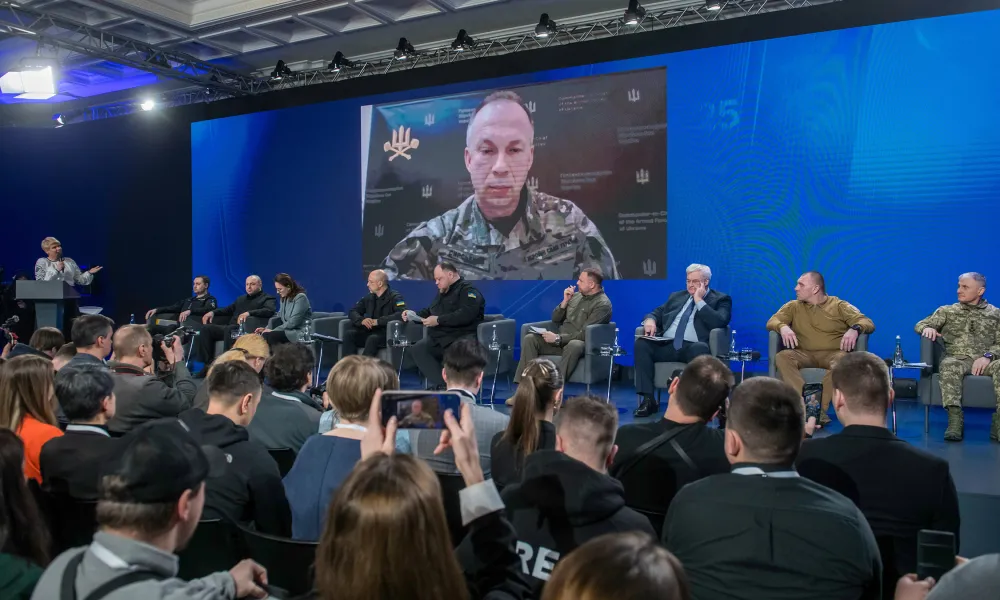

President Volodymyr Zelensky dismissed Ukraine's commander in chief, General Oleksandr Syrskyi, on Tuesday night, following days of mass protests in Kyiv and other cities demanding his removal. Zelensky named Major General Mykhailo Drapatyi, commander of Ukraine's Joint Forces, as his replacement.
The dismissal marked a reversal for Zelensky, who had just days earlier sided with Syrskyi and fired the popular defence minister, Mykhailo Fedorov, after only six months in the post. Fedorov, 35, had built a reputation as a champion of drone and robotics-driven warfare and had clashed with Syrskyi over how Ukraine should fight the war. His removal triggered thousands to join demonstrations calling for his reinstatement, Syrskyi's dismissal, and broader military reform.
Drapatyi, 43, had publicly backed Fedorov after his sacking, arguing that "the military needs change" and warning that a commander has no right to stay silent about problems. He is regarded as part of a younger generation of Ukrainian officers who built their reputations during the full-scale war, known for tactical innovation and a more decentralised command style than Syrskyi's.
Zelensky thanked Syrskyi for his service, crediting him with Ukraine's results in the defence of Kyiv, the Kharkiv counteroffensive and the Kursk operation, and saying that every soldier deserved dignified treatment. Syrskyi, 60, had held the post since February 2024, when he succeeded Valerii Zaluzhnyi, and was earlier credited with leading the defence of Kyiv in 2022. He earned the nickname "the Butcher" during the 2023 battle of Bakhmut over what critics described as a high tolerance for casualties, a characterisation he has disputed, saying that preserving his soldiers' lives had been his priority throughout.
Kyrylo Budanov, the former intelligence chief who now heads the president's office, sought to reassure the public as the crisis deepened, saying the situation was "being resolved professionally, constructively" and asking Ukrainians to remain calm. Zelensky said he made the final decision after a series of meetings with military commanders across the ranks.
The upheaval is the second time in just over a year that street pressure has forced Zelensky to reverse course. Mass protests last summer pushed him to abandon an effort to weaken the country's anti-corruption agencies. Since elections remain suspended for the duration of the war, demonstrations have increasingly served as one of the few checks on presidential power available to Ukrainians.
Sources: The New York Times, The Associated Press, Euronews, CNN