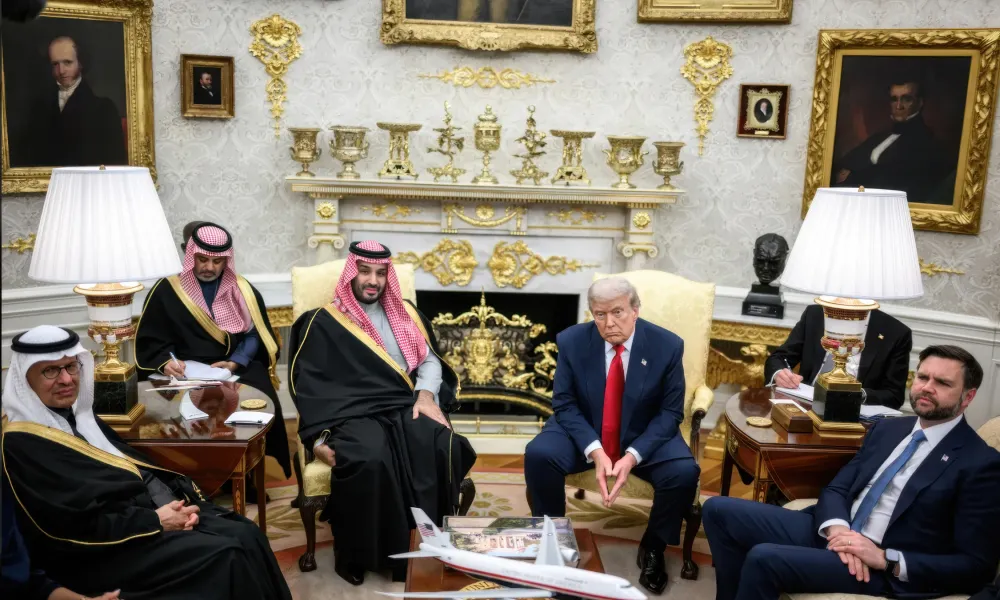

The Trump administration is due to announce on Wednesday that it has reached a broad nuclear agreement with Saudi Arabia, one that could eventually let the kingdom enrich its own fuel for nuclear reactors, according to the New York Times, which cited US officials. Two officials told the Associated Press that Donald Trump has approved the agreement, which is expected to run for 30 years and involve American firms in developing the Saudi programme.
The accord is intended to bind Washington more closely to Riyadh at a moment when the war with Iran is straining the relationship. The administration estimates it will bring billions of dollars to the American nuclear industry, beginning with Westinghouse, according to the Times.
Officials plan to sign the deal formally on Wednesday and notify Congress shortly afterwards. Although the agreement is likely to have support among many Republicans, some lawmakers from both parties, along with Israeli officials, have voiced opposition, fearing Riyadh could eventually turn a civilian programme toward weapons development.
The agreement is known as a 123 Agreement, a legally binding framework for nuclear cooperation between states, aimed at preventing proliferation. The United States has 26 such agreements in place with 51 governments and the International Atomic Energy Agency.
To secure the deal with Crown Prince Mohammed bin Salman, Trump agreed to terms that may restrict international inspectors' access to sites Washington suspects could be used to divert fuel toward weapons projects. After a joint economic study with Saudi Arabia, the kingdom may also be permitted to enrich uranium or reprocess plutonium domestically, according to the Times.
That marks a significant departure from the 2009 agreement with the United Arab Emirates, long considered the "gold standard" of nonproliferation, under which Abu Dhabi accepted stringent inspections and gave up the right to produce its own nuclear fuel. CNN reported last week that the tentative Saudi deal lacked the international safeguards built into the UAE agreement, though the administration is expected to argue that joint US-Saudi partnerships will allow it to monitor the kingdom's programme closely.
Prince Mohammed has said he would build nuclear weapons if Iran does the same. Iran maintains its own programme is for civilian purposes, though it has enriched uranium close to weapons grade since Trump withdrew from the 2015 nuclear deal in 2018. Trump ordered US forces to join Israel in striking Iran's nuclear sites in June 2025, then opened a wider war against Iran in February.
The Saudi agreement includes two secret side letters, which the administration is expected to argue contain proprietary business information and sensitive national security material. Some members of Congress may withhold support until the letters are made public, the Times reported.
Congress can vote a resolution of disapproval on the deal under the Atomic Energy Act, but doing so would require a veto-proof majority, making the agreement likely to pass despite the objections.
Sources: The New York Times, The Associated Press, CNN