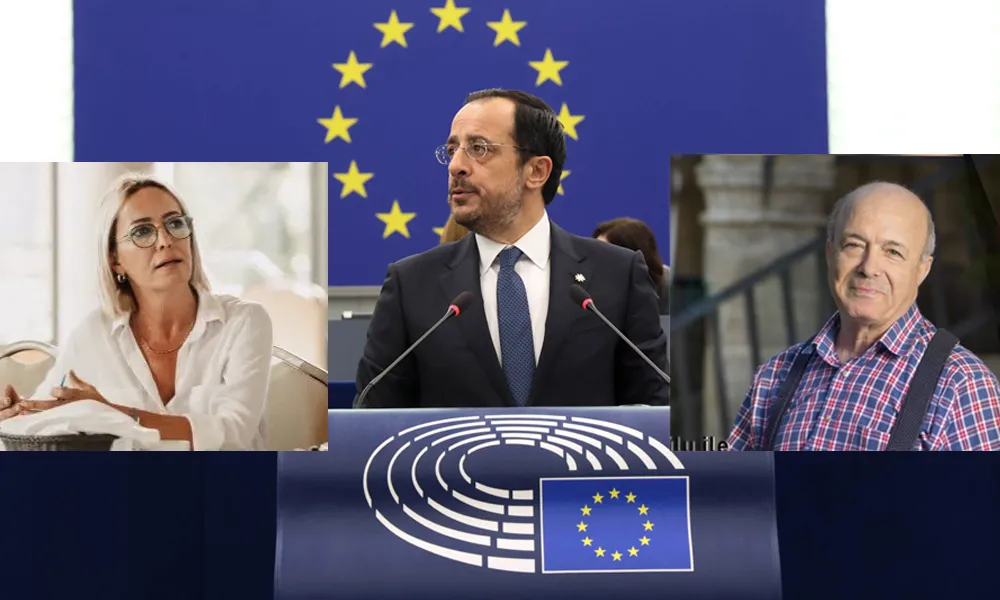
The Strasbourg trip had been a four-day visit organised by the European Parliament Office in Cyprus on the occasion of the first plenary under Cyprus EU Presidency. A mixed group of journalists travelled together, Greek Cypriots and Turkish Cypriots sharing flights, buses, dinners and long days at the European Parliament. Sharing space, but not quite sharing a moment. The Turkish Cypriots were there, yet not fully there. Part of the group, but slightly outside it. As if time had frozen somewhere between theory and daily life.
We joked together. We spoke in English, the safest common ground. We laughed about how similar we are. We are friendly with them, we ask each other about water and coffee, another joke whether the coffee is Turkish or Greek. The closeness and the distance appear and disappear. Different plans, different rhythms. The similarity was obvious. So was the separation.
In theory, the Cyprus issue remains the number one national cause. In reality, everyday survival, economic pressure and political fatigue have pushed it aside. Even for those who lost everything, it has quietly become a non-issue, something like a non-paper of the European Parliament.
The Cyprus President enters the European Parliament, welcomed by Roberta Metsola, Greek anthem plays, we enter the plenary chamber in Strasbourg as President Christodoulides will address the MEPs. Politicians know that visibility matters, matters.
The new leader of the Republican Turkish Party (CTP) Sıla Usar İncirli recently spoke about the growing “invisibility” of Turkish Cypriots. The President of the Republic confirmed it in his speecj without saying so. There was no reference to reconciliation, no concrete steps for bringing Turkish Cypriots closer to the European Union, no language of shared ownership. One could not help but wonder whether our TC compatriots’ trip, and the entire performance around it, was worth it. Especially in a year that is meant to prepare the ground for renewed negotiations. The words heard again were occupation and liberation. Nothing more.
Earlier, at the celebratory opening of the EU Presidency in Nicosia, Turkish Cypriots were again absent. During Ursula von der Leyen’s visit, the Green Line became a viewing platform. Leaders peered through gaps between barrels, as if watching birds from a hide.
Against this backdrop, Politis to the point spoke to two Turkish Cypriot journalists who took part in the delegation. Hasan Kahvecioğlu of Halkın Sesi and Aysemden Akin of Bugün Kıbrıs offered their readings of a Presidency that has just begun and reflected on whether it feels like theirs at all.
Hasan Kahvecioğlu
There is a contrast between the President’s public statements, where he says he is ready for talks with the Turkish Cypriot leader, and the language he actually uses.
Journalist of Halkin Sesi, Hasan Kahvecioğlu, is one of the loud voices of rapprochement, member of the Cyprus section of the Association of European Journalists, the only bicommunal media group in Cyprus. He speaks Greek and he is watching closely the Cyprus issue developments, he cares about the prospects for reunification. Despite many disappointments and rounds of talks he still feels a Cypriot. He listens to President Christodoulides’ speech with real attention and notices once again that there is no genuine reference to Turkish Cypriots. No acknowledgment of the community, its concerns, or even the TC presence within the broader European family.
For Kahvecioğlu, the situation is problematic to begin with, as two out of six seats in the European Parliaments belong to the TCs.
Regarding the President’s speech, Kahvecioğlu said that nothing was accidental but the choice of words reflected a political choice. “I feel this is a big change in the policy if you compare it with the previous GC leader”, he says.
“There is a contrast between the President’s public statements, where he says he is ready for talks with the Turkish Cypriot leader, and the language he actually uses. He is aware of the pressures and challenges that the TC leader faces in trying to resume negotiations. Yet he insists on focusing on smaller, technical issues, avoiding the bigger picture”.
There was no mention of reconciliation. No signal of trust building. Instead, familiar terms dominated the speech.
“Occupation. Liberation. These are words we have heard for decades”, he says, noting that “this terminology marks a clear shift from the previous Greek Cypriot leadership. It is not the right language for someone who is, at that moment, speaking as the head of Europe”. Such language, he believes, closes emotional space before the Cyprus dialogue even begins.
Kahvecioğlu believes the choice of words is rooted in politics.
By using these terms without even mentioning Turkey directly, he strengthens his position at home, avoiding criticism from nationalist voices. But at the same time, Kahvecioğlu believes, the GC leader avoids taking any political risk toward genuine engagement with Turkish Cypriots. Without that risk, the Cyprus issue does not move forward.
He points to missed opportunities from the current narrative. The ad hoc committee meant to bring Turkish Cypriots closer to the EU has remained inactive since the collapse of Crans Montana.
“He is the President. Under that hat, I expected him to reactivate the committee, to create practical bridges. Look at the Halloumi issue. Look at the Green Line Regulation. These are areas where he could make a real difference.”
The symbolism of the Presidency’s opening also mattered.
“This Presidency opened with closed crossings. Barrels that have been there since 1958 were once again used to signify occupation. And when European leaders were taken to look through gaps in the barricades, ordinary people in the north reacted. They said it clearly. We are not a zoo.”
For Kahvecioğlu, the expectation for the Cyprus Presidency remains:
“I would have hoped for just one sentence that acknowledged us. Not as a problem. Not as an obstacle. But as people who share this island and deserve to be part of its future. Instead, the message I received is that the President can live comfortably with the status quo. That he is prepared to finish his term with this problem unresolved.”
Ayşemden Akın
At a time when there is a real opportunity for a solution, there is no strong evidence of sincerity.
Ayşemden Akın is the chief editor of Bugün Kıbrıs, known for her investigative reporting on corruption, and is under protection following threats received after publishing a major investigation that drew international concern from press freedom organisations. Her reading of current Cyprus EU Presidency and the mission to Strassbourg is equally direct.
“Unfortunately, at a time when there is a real opportunity for a solution, there is no strong evidence of sincerity”, she says. “I do not believe that Turkish Cypriots genuinely occupy the mind and heart of the Greek Cypriot President. At best, there is a distant sympathy”.
Akin describes a leader who remains within a safe political zone:
“He appears to be playing for time. He seems quite comfortable with the existing status quo. As the leader of a half republic, he is present in Europe, meeting world leaders, discussing global issues. But he does not approach the Cyprus problem through a Cypriot lens.”
Instead, she argues, the issue is framed through ethnic identities and bargaining logic.
“There is a mindset that sees Turkish Cypriots as ‘the other side’. Given the power he holds, I would have expected far more effort on behalf of our community.”
Her disappointment does not diminish her support for Cyprus’ success internationally.
“I genuinely want our shared homeland to succeed in Europe and the world. To strengthen its economy, democracy and international standing. That makes me happy. But he could have been far closer to Turkish Cypriots. Much more engaged.”
The timing, she adds, made the silence even heavier. Following years of separatist leadership, Turkish Cypriots elected a peace-oriented leader, Tufan Erhürman, with 63 per cent of the vote.
“That democratic message mattered. The President could have taken steps to ease Erhürman’s position, to give him confidence. He could have honoured what the Turkish Cypriot community communicated to the world through that choice”.
On the role of the EU Presidency, Akin said that the Turkish Cypriots are a modern community: “Secular, democratic, outward looking. Our place is in Europe, with equal citizenship rights. For young people especially, integration with the world depends on finding ways to deliver these rights now, not after an undefined solution.”
And she rejects the logic of postponement.
“You cannot keep saying everything comes after a solution. That only deepens isolation. The Presidency could have helped make Turkish Cypriots more visible. Instead, invisibility continues.”
The imagery of the Green Line visit remains also for her a sore point.
“European leaders were shown the north through gaps between barrels, as if nothing has changed in 25 years. There was no concern for how the community here feels”.
She further pointed out that Cypriots must now break out of this vicious circle and “like the civilized world, find a way to coexist, to produce together, and to create together on this tiny island”.
For Akin, this political comfort is the real tragedy.
“He is simply telling the story he has written himself. If this is his political vision, then there is little more to say. By continuing the mutual blame game, both leaders can comfortably preserve their positions”.
“That is both my expectation and my deep sadness. What I long for is to see new and courageous leadership, to present the world with an exemplary model of peace. And for those who achieve this to be Cypriots themselves”.
One more European mission ends. One more step in the Cyprus EU Presidency is completed. But inclusion remains absent. Leadership continues to speak to its own voters, careful not to unsettle them, careful not to risk political capital.
Reconciliation, after all, is a culture. And for now, that culture is missing from the EU Presidency, just as Turkish Cypriots themselves remain missing from its narrative.