


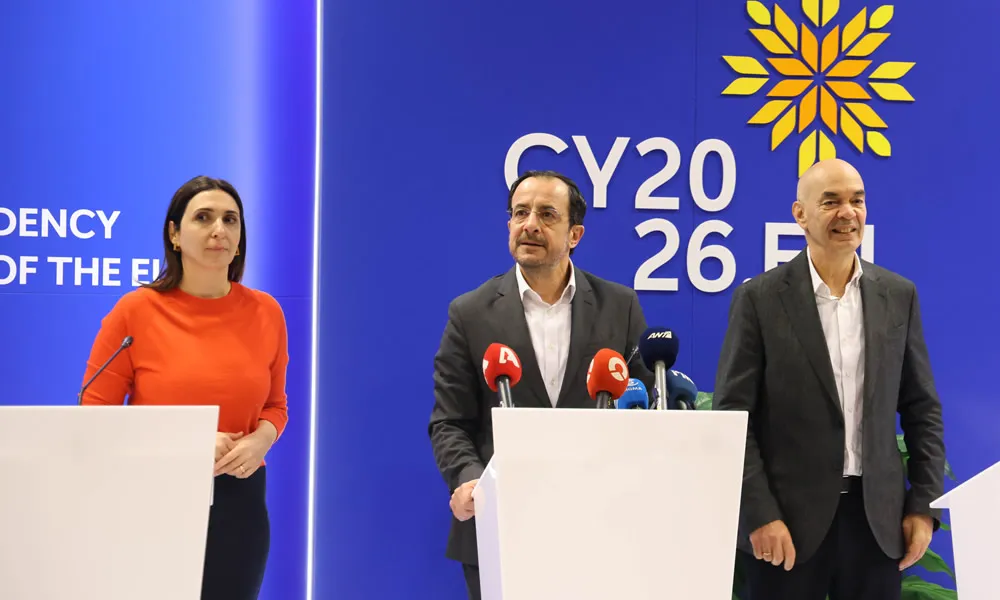
Appearing before the European Parliament on Tuesday (20 January), President Nicos Christodoulides presented the priorities of the Cypriot Presidency of the Council of the EU. He set as his primary goal an autonomous Union, capable of defending its borders and its citizens, open to the world in order to build bridges of cooperation.
What is Cyprus’s contribution to an autonomous EU in the turbulent world we live in?
In earlier times, the answer would have been obvious: the resolution of the Cyprus problem, of course. In an exceptionally complex international environment, such a development would strategically serve European interests in the Eastern Mediterranean.
Through the lens of the Cypriot Presidency, the member state concerned, in cooperation with the European Commission, could have prepared a package of initiatives aimed at giving momentum to the United Nations’ efforts for reunification.
In the minds of Europeans, Cyprus has a chain effect on EU–Turkey relations and on broader relations in the Eastern Mediterranean. If these initiatives were carefully designed, they could feed into the resolution of the Cyprus problem, also serving the ultimate goal of an autonomous Union.
The ground for the Cypriot Presidency would have been fertile. The United Nations, which bears primary responsibility and works closely with the EU, has long undertaken such initiatives. Nothing is moving forward because they simply do not exist in President Christodoulides’s thinking. The Cypriot President prefers to speak before the European Parliament as if he were from another country, delivering an academic lecture: “Cyprus’s accession has transformed the island, bringing prosperity, security and opportunities.”
This is only half the truth. Division deepens, occupation remains and the island is heavily militarised. Without a settlement, the European acquis does not apply across the entire territory of the Republic of Cyprus.
Christodoulides remains at the level of observations: “European integration cannot be complete as long as a member state remains divided and under illegal occupation, as long as Greek Cypriots and Turkish Cypriots do not enjoy the same fundamental rights as all other Europeans.”
Yet he has nothing to propose to the Members of the European Parliament. So far, the Cypriot Presidency has limited itself to photographic exhibitions and visitor tours along the Green Line.
Environment
The start of the Cypriot Presidency coincided with one of the most turbulent periods in international relations. A series of developments inevitably overshadow it (Venezuela, Greenland, the so‑called Peace Council). Christodoulides observes the complex international landscape and expresses generally valid concerns. But he worries more about others than about Cyprus.
Next week, the UN Secretary General’s personal envoy, María Ángela Holguín, arrives in Cyprus expecting answers. How will negotiations restart so that this time they lead to a result? When will bridges be built, which is also the slogan of the Cypriot Presidency? Not even a single crossing point is being opened along the Green Line.
Logically, Christodoulides should have many reasons to attract European interest and support now that Cyprus holds the Presidency. The security issues troubling the EU concern Cyprus in particular. The actions of President Trump have cast doubt on long‑established principles underpinning the international system, such as collective action and territorial integrity, as opposed to unilateralism, interventions and blackmail. If Cyprus wishes to capitalise on the UN’s collective decision‑making system, it will find strong support in the EU, perhaps even more than before.
In the European Parliament, Christodoulides expressed solidarity with Ukraine, saying that “Cyprus is under occupation and knows first‑hand what lack of security means.” At times one gets the impression that the Cyprus problem is still in 1974 and Cyprus is still before accession.
Yet many know that Cypriots have in their hands UN solution proposals that cover all key issues: restoration of territorial integrity, withdrawal of troops, nothing resembling Ukraine. The most recent proposals, such as the Guterres Framework at Crans‑Montana, include a new security system that abolishes outdated rights of unilateral intervention.
Turkey
Christodoulides invited the President of Turkey, Recep Tayyip Erdoğan, to Cyprus to participate in a Middle East summit in April. The invitation went unanswered and does not appear to be considered significant by European diplomacy, which is seeking strategic solutions with Turkey. The EU seeks a partnership relationship with Turkey, viewing it as an important economic partner and contributor to security and stability.
The Cypriot Presidency would have been a golden opportunity for Christodoulides if he had long ago designed a coherent approach to Turkey. The Cypriot President held various contacts in European capitals, implying that he had appointed envoys to send messages to Ankara (Merz, Macron, Rutte). Nothing was confirmed, no one remembers it. Clearly, these actions do not align with European diplomatic practice, which requires a plan, proposals leading to solutions and detailed, persistent handling.
In the Council, proposals concerning Turkey remain pending: an enhanced customs union, visas, participation in security structures, trade, investments and more. Under current conditions, the EU could consider appropriate linkages if Cyprus spoke clearly and specifically about what it wants regarding the Cyprus problem. Without commitments, nothing moves forward, everything remains suspended and no one is interested in gestures from Turkey, as the Cypriot President requests.
Reunification Needs
What could certainly constitute an initiative of the Cypriot Presidency with a European stamp for a settlement? In his own words, Christodoulides says: “The European Union has all the tools for the solution of the Cyprus problem.” Yet he remains only in words, without explaining which tools these are and how they are used.
The European envoy Johannes Hahn (interview in Politis, 20 December) revealed that the European Commission included “a provision in the next long‑term EU budget for the period 2028 to 2034 stating that, in the event of Cyprus’s reunification, the EU budget must be revised to reflect the settlement and the additional economic needs arising from reunification.” For some curious reason, there has been no comment from Nicosia. Hahn has departed and may return in February.
At the same time, the Cypriot Presidency is promoting the 2028 to 2034 budget file, which must be completed by the end of 2026. The provision for the needs of Cyprus’s reunification has been incorporated and time is now critical for Cyprus if it wishes to move forward.
Christodoulides could seize the opportunity and organise a dialogue together with the European Commission and the Turkish Cypriot community on the needs of reunification. This, of course, requires sincere openings, bridges with the Turkish Cypriot community and the will to create momentum for a settlement.