
Invest Cyprus and the Business Facilitation Centre appear to be delivering results on their own as Cyprus’s formally established mechanisms for attracting foreign investment. In the technology sector alone, 600 companies that approached Invest Cyprus have invested in the country over the past three years, while 268 companies were registered through the fast-track mechanism in 2023 alone.
Two institutional mechanisms, CIPA-Invest Cyprus, established in 2008, and the Business Facilitation Centre, which began operating in 2020 as a Fast-Track Activation Mechanism and evolved into a one-stop shop based in Nicosia in March 2025 following a decision by the government of Nikos Christodoulides, constitute the only official central points of contact for foreign investors in Cyprus.
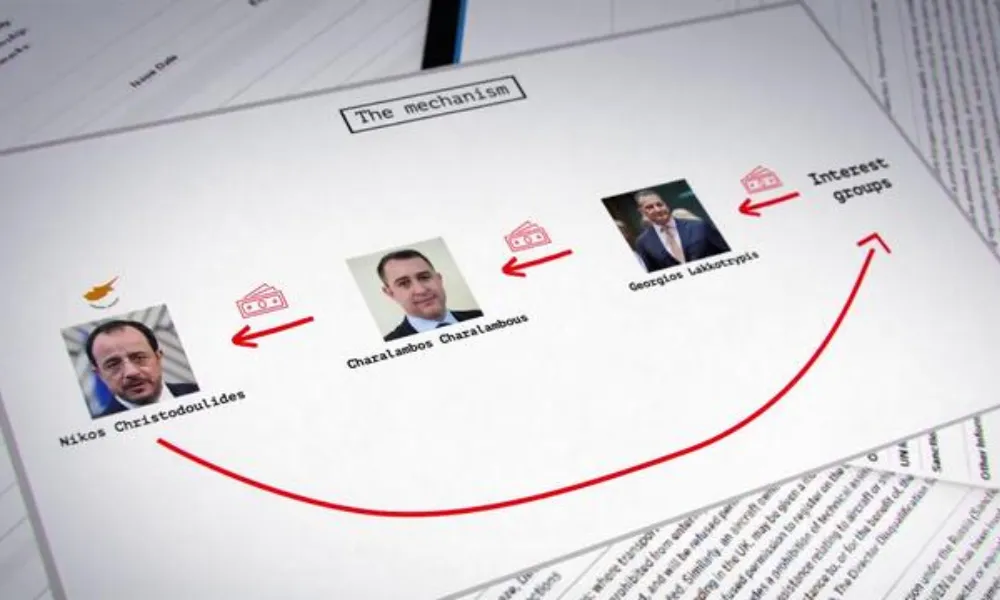
Any alternative route that passes through the Presidential Palace and promises access at the highest level, including personal contact with the President of the Republic to bypass bureaucracy, with or without a corresponding cash contribution framed as corporate social responsibility, inevitably raises suspicions of non-institutional dealings.
Following the circulation of a video on X showing individuals from the president’s close circle allegedly offering “facilitations” outside these formal mechanisms, Politis examined the role, operation and effectiveness of both Invest Cyprus and the Business Facilitation Centre.
The role of the Presidential Palace
According to sources familiar with how Invest Cyprus and similar investment promotion agencies operate internationally, the role of the president and other senior officials is limited to participation in official overseas missions aimed at promoting investment.
Such missions typically coincide with the signing of memoranda of understanding between Cyprus and other states, or with high-level conferences and exhibitions held abroad. Direct contacts between the president or ministers and business leaders representing major corporations usually take place at these events, in the presence of technocrats and according to an informal but well-established protocol.
Six hundred technology companies
Despite the reputational setback caused by the Videogate affair, Invest Cyprus, which is currently working alongside the Presidential Palace on the rebranding of Cyprus as part of efforts to restore its credibility as an investment destination, continues to record significant successes in attracting foreign investment.
Investments have come primarily from countries including India, Canada, France, the United States, Spain, Israel, Lebanon, the United Arab Emirates, Saudi Arabia and Japan.
A substantial share of these investments relates to technology, research and innovation, with additional interest in sectors such as health, tourism, education, shipping, financial services and energy. According to sources, the strong momentum in the technology sector over the past three years has continued and is now reflected in macroeconomic data. In 2025, the sector’s annual contribution to GDP reached 15 percent, equivalent to €4 billion. In total, 600 technology companies have invested in Cyprus over the past three years.
Two hundred and sixty-eight through the fast-track mechanism
Alongside Invest Cyprus, the Fast-Track Activation Mechanism, created in October 2020 under the Ministry of Commerce, remains a key tool for attracting investment.
The mechanism was introduced as part of measures to support economic recovery following the public health crisis. It also coincided with a period when Cyprus was under intense scrutiny over the so-called golden passports scheme, shortly before the release of the Al Jazeera investigation, and when the country was seeking ways to restore credibility through transparent procedures while increasing liquidity as businesses closed and citizenship revenues ended.
The inflow of foreign capital was expected to support job creation and attract highly skilled professionals not available locally. The criteria for inclusion in the mechanism were clearly defined and publicly available via the Business in Cyprus website. Incentives included company incorporation within seven working days and residence and employment permits for third-country nationals within four to six weeks, with a focus on digital skills.
While there is no comprehensive assessment of the mechanism’s overall contribution to date, registrations of 268 foreign-interest companies were completed through the mechanism in 2023 alone.
Company registration within ten days
In May 2025, President Christodoulides inaugurated the Business Facilitation Centre as an evolution of the fast-track mechanism, stating that its aim was to support, attract and accelerate mature projects that contribute positively to sustainable development.
The centre operates through cooperation between the Strategic Developments Sector within the Town Planning Department, Invest Cyprus, the Business Facilitation Unit of the Ministry of Energy, and designated contact points across licensing authorities.
Its services include information and tailored guidance for business establishment and operation, a single point of contact for company formation and licensing adapted to the needs of each investment, access to the fast-track licensing mechanism under the Strategic Development Facilitation Law, registration with the Registrar of Companies and Intellectual Property, the social insurance employer registers and the Tax Department, enrolment in the Register of Foreign Interest Companies, facilitation of incentives for employing third-country nationals, and guidance on licensing for energy projects and projects financed through European or state programmes.
If eligibility criteria are met, registration in the Register of Foreign Interest Companies is completed within ten working days of the proper submission of the electronic application.
Planning approval within one year
The Business Facilitation Centre also supports investments classified as strategic developments. Under the 2023 law, these include projects in health and social care, education, culture, sports, the environment, agriculture, industry, tourism, energy, shipping, research and technology.
Criteria include a minimum investment of €25 million, or the creation of at least 80 new jobs, or an investment of €15 million combined with 30 permanent new jobs.
The management fee for classifying a project as strategic is €10,000, non-refundable, with a second fee of between €23,000 and €30,000 payable upon submission of the first licensing application. Fees for environmental opinions amount to €7,500, while assessments for deviations from development plans cost €8,500.
Each strategic project is assigned a project manager who serves as the sole point of contact between the applicant and all public authorities throughout the licensing process. Centralised issuance of planning and building permits by the Strategic Developments Sector must be completed within one year.
Why the mediation?
Given the scope of facilitation offered by the Republic of Cyprus and considering that these mechanisms were created, in the president’s own words at the inauguration of the Business Facilitation Centre nine months ago, to reduce bureaucracy, digitise procedures and provide faster and better service focused on the needs of businesses and investors, a key question emerges.
Why, then, would prospective investors seek contact with the president’s inner circle or with the President of the Republic himself, when formal, transparent and institutional channels are already in place?
This article was first published in Politis' Sunday paper