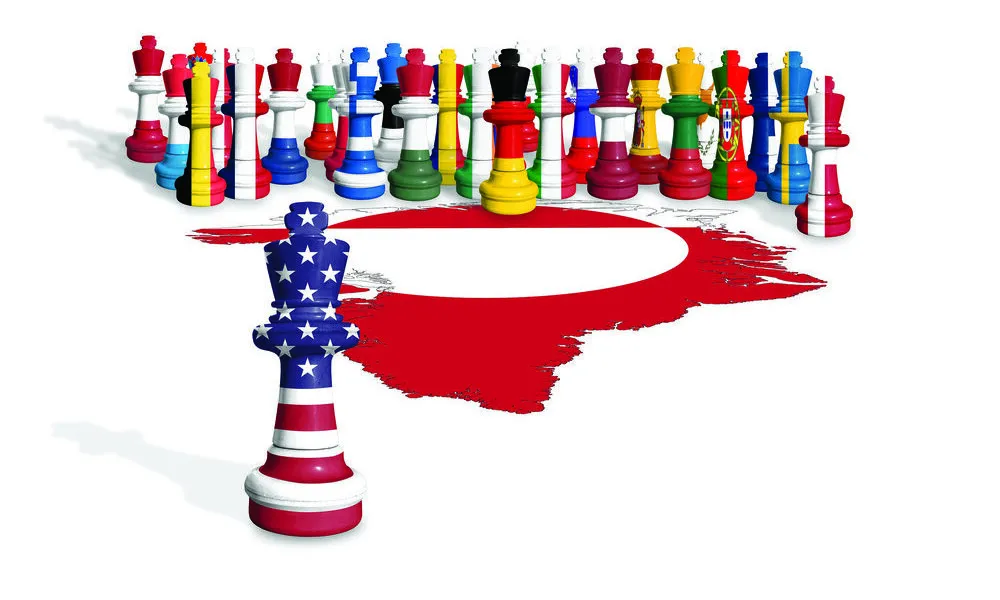
NATO is founded on the principle that allies do not threaten one another’s sovereignty. When the leader of the Alliance’s most powerful country publicly implies that he questions the sovereignty of a member state, in this case Denmark, a crisis of trust emerges at the very core of the Alliance.
The Nordic countries, Denmark, Norway, Sweden and Finland, now form a critical strategic arc of NATO facing Russia. If these countries begin to feel politically threatened by the United States, they are likely to coordinate more closely among themselves, place less faith in American security guarantees and, logically, shift from Atlanticism towards deeper European integration.
Greece’s Position
US moves regarding Greenland inevitably bring into focus the case of Greece, which has long argued that it is threatened by another NATO member, Turkey. Greek complaints, which were often met with indifference or even cynicism by Nordic countries, now appear far more understandable than in the past.
They underscore Greece’s longstanding position that NATO lacks a mechanism to protect member states when the threat comes from within the Alliance itself. Until now, many allies treated Greek concerns as a bilateral dispute with Turkey. When, however, the US president publicly questions Danish territory and no institutional alarm is triggered within NATO, it becomes clear that the problem is not Greek but systemic.
The narrative of an “internal NATO dispute” begins to erode, reinforcing Greece’s argument that an alliance cannot credibly guarantee security only against external threats while remaining silent when the threat is internal.
Atlanticists and Europeans
At the same time, within the European Union, the balance is shifting in favour of the so called Europeanists over the Atlanticists. The former, led by France, Germany, Spain, Greece and others, argue that the EU must develop an autonomous defence pillar. The latter, led by the Netherlands, the Nordic countries, Poland and most of the former Eastern European states that joined the EU in 2004, believe the EU’s defence pillar should remain NATO, under US leadership.
This divide highlights the EU’s failure to function as a unified geopolitical actor. Instead, it remains a battleground between two competing visions. Europeanists seek an autonomous Europe that acts as a power in foreign policy, the economy and defence. Atlanticists want a strong Europe economically, but militarily anchored to the United States.
Following Russia’s invasion of Ukraine, Atlanticists held the upper hand. That balance has begun to shift following Donald Trump’s demands that Europe increase defence spending and, more importantly, his aggressive stance on Greenland and remarks about annexing Canada, a NATO member.
Europe has begun to question US predictability. As a result, the balance is tilting towards the Europeanists. Trump appears unwilling to lead as primus inter pares within the West, preferring instead to decide and command. Inevitably, this awakens uncomfortable historical associations for some Europeans, recalling the interwar period when Hitler arbitrarily laid claim to Austria, Czechoslovakia and Poland.
A Path Towards Isolation
If Trump’s posture does not change and his retreat on Greenland proves tactical rather than substantive, the United States could face a scenario of genuine international isolation, not because it seeks it, but because former allies no longer trust it.
Realistically, this would take the form of gradual disengagement. Allies would keep the US formally “in the game” while quietly building alternative options. This may never lead to a full rupture, largely for economic reasons, but it would result in less cooperation, weaker alignment during crises and a greater willingness to act without Washington.
A Gift to Russia and China
This dynamic benefits Moscow and Beijing. Neither needs military confrontation to weaken NATO or the West. Internal erosion and the questioning of rules suffice. The image of a NATO where the US pressures allies into submission while those allies publicly resist offers a major strategic advantage to its rivals.
Trump’s argument that NATO must “do something for the US” transforms collective defence into a transactional relationship, sowing doubt rather than security.
NATO will not collapse easily. It has institutions, forces, plans and bases. But such behaviour shifts it from an alliance of values into an alliance of power, undermining its institutional credibility and reinforcing calls for a European NATO, at least within NATO.
Gaza and the UN
The situation is further complicated by Trump’s proposal regarding Gaza. At the level of rhetoric and political legitimacy, his idea of a “Gaza council” threatens the very logic of the United Nations.
Bypassing the UN undermines the global order. The UN exists precisely to prevent powerful states from creating ad hoc mechanisms to resolve crises outside international law. A Gaza council operating outside the UN framework, with Trump as a permanent chair, would not be bound by General Assembly or Security Council resolutions and would not be accountable to international law.
Some may argue this already happens. But does the UN’s weakness justify the creation of parallel systems that legitimise war or occupation?
The precedent is clear. If the US can establish a Gaza council, Russia can do the same for Ukraine, China for Taiwan, Turkey for northern Syria or Cyprus.
In such a scenario, the UN becomes ornamental, law is replaced by power and small states lose their only forums of equal voice. The UN and the EU are the only arenas where small states possess institutional parity. If crises are resolved by councils of the powerful, small states lose their last refuges and the world returns to spheres of influence.
Greenland and the Cyprus Precedent
More troubling still are reports by the The New York Times that plans for Greenland draw directly on the model of the British Bases in Cyprus. If applied, this would represent not only a return to spheres of influence but a revival of colonialism disguised as strategic security.
Cyprus is the precedent. It became independent in 1960 but inherited sovereign foreign bases and a system of guarantor powers without the consent of its people. Its independence was conditional, designed primarily to serve external interests.
If the same model is applied to Greenland, Europe enters dangerous territory. A new hybrid of sovereignty would emerge, autonomy with footnotes, peoples incorporated into strategic designs without consent. Cyprus risks becoming not a warning, but a template.
That would mean colonialism never truly ended. It merely changed its language and its disguise.