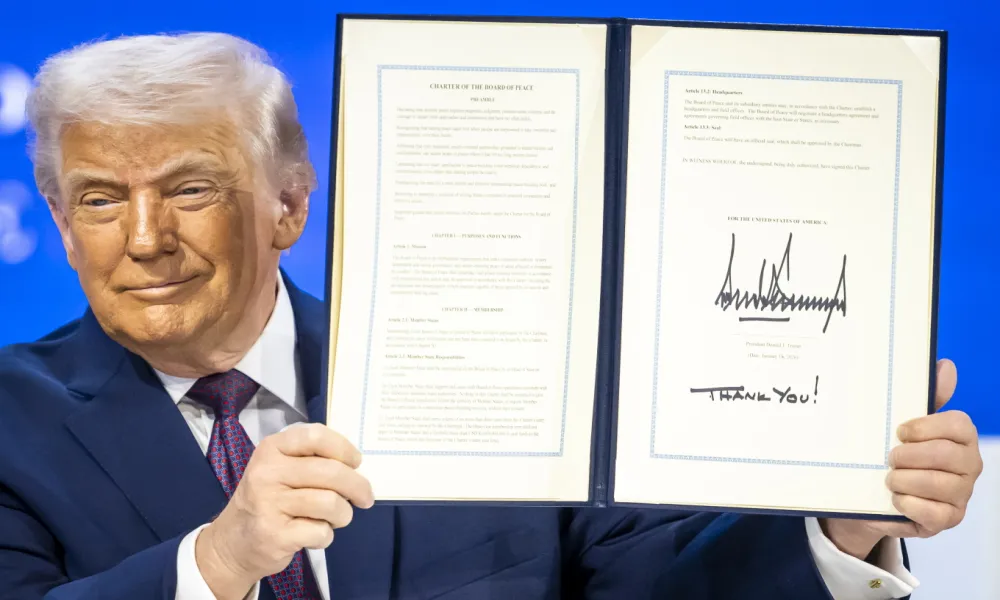

Nicosia appears to be keeping its distance from the Peace Council that was established yesterday during a special ceremony on the sidelines of the World Economic Forum in Davos, Switzerland, with the participation of 19 states and US President Donald Trump, who sought to ease international concerns over the undermining of the United Nations by saying that this new organisation could cooperate with the UN to end wars.
Practical reasons for absence
The President of the Republic, like several other heads of state, had been invited by the US President but did not attend yesterday’s ceremony, citing practical reasons, as on the same day the Extraordinary European Council convened by Antonio Costa on the issue of Greenland was scheduled.
This obligation facilitated Nicosia’s position, which is seeking diplomatic ways to extricate itself from the tight framework imposed on more than 50 states by the US President.
Contact with the State Department
The Ministry of Foreign Affairs contacted the State Department to explain Nicosia’s position and to raise the concerns of the Cypriot government regarding the US attempt to establish a new international body, which would not be limited to Gaza, as had initially been agreed.
Retreat
It is recalled that the Peace Council emerged as an idea of the US President for the day after in Gaza and that UN Security Council Resolution 2803 exists for this specific Council, providing that it would concern exclusively Gaza for a specific period of time.
However, the Charter prepared by the US administration, which accompanied Donald Trump’s invitation to various leaders, contained wording indicating that the Peace Council would operate indefinitely and would go beyond the framework of Gaza. This triggered international reactions, with several countries rejecting the US President’s invitation, arguing that the new international body would operate in competition with the United Nations.
This, along with many other problematic elements, such as the centralised nature of the Council with provisions for a lifetime presidency for Donald Trump, alarmed Western governments. As a result, Nicosia shifted its position and retreated, moving from initial enthusiasm to concern.
However, the small size of the country does not allow the Cypriot government to reject the US President’s proposal in a clear manner, and efforts are being made through diplomatic manoeuvres to address the issue.
The reasoning
The position of Nicosia was explained yesterday by Foreign Minister Constantinos Kombos in statements following the Cabinet meeting. Adopting a “yes, but” approach, Mr Kombos said that the Republic of Cyprus supports the initiatives of the US President for Gaza and for the resolution of disputes more broadly. However, he stressed that everything must always take place within the framework set by international law and the Charter of the United Nations.
From the statements of the Foreign Minister it became clear that Nicosia is trying by every means to avoid a rupture in relations with the United States. For this reason, he expressed “warm thanks to the President of the United States for the invitation to a closed circle of invitees”.
At the same time, he did not conceal Nicosia’s concerns, saying that certain issues and questions arise regarding the way the Peace Council will operate.
He clarified that the Republic of Cyprus is positive towards the peace process for Gaza and recalled that Nicosia welcomed the agreement with the presence of President Christodoulides in Sharm el Sheikh. However, he drew a distinction between the initial approach regarding the Peace Council and UN Resolution 2803, leaving it to be understood that the expansion of the Council’s powers under the Charter ratified yesterday is causing concern in Nicosia.
Contacts with the US
He also raised the issue of the tight timeframe between the invitation and the Charter ratification ceremony, noting that international agreements of this kind require time to be analysed and discussed by the parties involved.
“Therefore,” he added, “we are trying to achieve a time decompression, so that there is the necessary clarity for all of us as to exactly how we proceed.”
He revealed that Nicosia came into contact with the US side and communicated its positions. He also pointed out that the Republic of Cyprus holds the Presidency of the Council of the EU, noting that efforts are being made in Brussels to shape a common position and stance among the member states on this issue.
He acknowledged, however, that up to that point there had been no positive outcome in the effort to coordinate with European partners.
Information from P indicates that eight EU member states were not invited by Donald Trump, which makes coordination at a European level more difficult. In addition, European governments are focused on the Greenland issue, which dominated yesterday evening’s extraordinary European Council.
Turkey factor
A common stance within the EU would facilitate Nicosia’s position, which is unable to stand up to Donald Trump due to the small size of the country, as well as the fact that Turkey participated in the Charter ratification ceremony in order to gain the favour of the US President.
The Turkey factor appears to be causing particular concern in Nicosia, which on the one hand is seeking ways to extricate itself from the process and on the other states that it has not responded negatively to Donald Trump’s proposal and that developments and the dynamic nature of events must be taken into account.
23 countries
During yesterday’s Charter signing ceremony for the Peace Council by Donald Trump, representatives from approximately 20 countries participated. Specifically, leaders from Saudi Arabia, Qatar, the United Arab Emirates, Argentina and Paraguay were present.
Turkish Foreign Minister Hakan Fidan also participated, along with representatives from Bahrain and Morocco.
From EU member states, only Bulgaria and Hungary participated, while The Washington Post reported that 23 countries from the Middle East, South America and Central Asia have so far accepted Trump’s invitation.