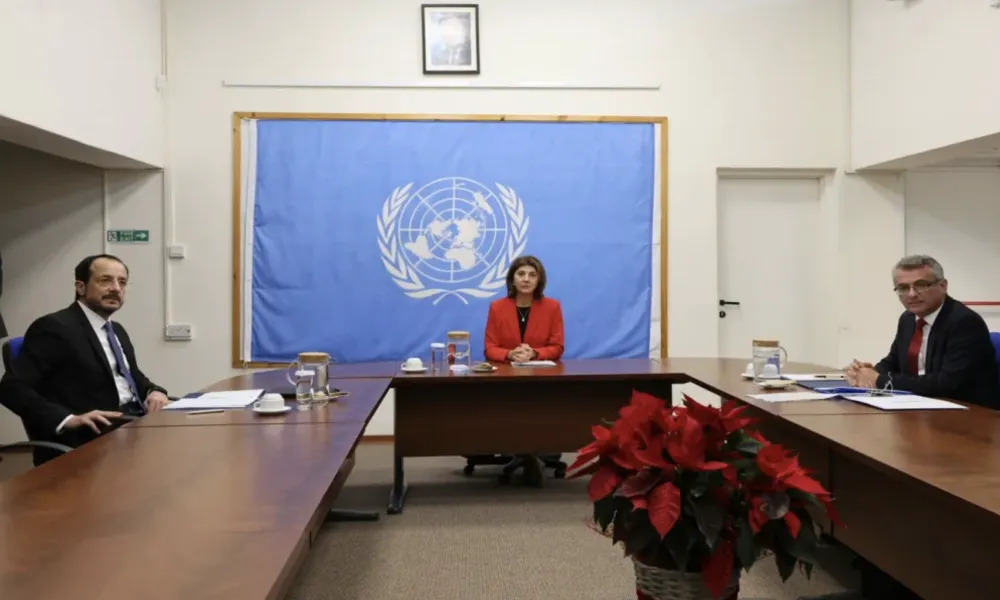
The trilateral meeting in Nicosia between the leaders of the two communities in Cyprus, Nikos Christodoulides and Tufan Erhürman, and the UN Secretary-General’s personal envoy, Maria Angela Olguín Queiró, appears to have gone beyond formalities and media optics. It has evolved into a significant step towards thawing the Cyprus issue, and may signal that the island is at a pivotal point in diplomatic efforts that could lead to the long-awaited resumption of negotiations, which were halted in July 2017 at Crans-Montana just as an agreement seemed within reach.
Cyprus is facing one of the most important moments in its recent history. The international environment, societal dynamics in both communities, the political context, UN initiatives, and EU political developments converge to create a favourable scenario. The pressing question is no longer whether talks will resume, but whether this renewed effort can lead to a mutually agreed solution—or if yet another historic opportunity will be lost. Sources with active involvement in the Cyprus issue, speaking to Politis anonymously, highlighted several factors shaping this new context:
Status quo at its limit
For years, Cyprus has existed in a fragile but balanced status quo: on one side, the Republic of Cyprus within the EU with full international recognition; on the other, the “TRNC” in the north, politically isolated and dependent on Ankara. For the first time since the failure of the 2017 talks, this status quo is showing signs of erosion both practically and politically. Key observations include:
-
The EU, especially Germany, and the UK see the Cyprus issue as an obstacle to relations with Turkey.
-
Turkey is seeking to reset its relationship with the West for economic, energy, and strategic reasons.
-
Turkish Cypriots are increasingly ready to push for a solution and international recognition, reflected in their recent leadership change.
-
Greek Cypriots recognise that prolonged stagnation risks de facto entrenchment of the island’s division.
The conclusion is clear: the current situation cannot continue indefinitely, and all parties understand this.
International context
Global developments push towards a resolution. Conflicts in Ukraine, the Middle East, energy balances, and European security considerations create a new environment in which Cyprus cannot be ignored. The EU needs Turkey on migration, energy, and security issues; Turkey needs the EU for investment, financing, and customs union upgrades. Within this framework, the Cyprus issue is key. The UN envoy, Maria Angela Olguín, is playing an active role as a mediator with a specific plan and timeline. Sources indicate that the next trilateral meeting could take place within the next 2–3 months, providing a subtle but effective pressure mechanism for both leaders.
Political equality as a basis
A significant development is the adoption of a shared understanding of political equality. The UN statement following the trilateral meeting on 11 December 2025, which lasted more than three hours despite being scheduled for one, emphasised:
"The two leaders agreed that the real goal is to resolve the Cyprus issue through political equality, as described in UN Security Council resolutions. Confidence-building measures are important to create a favourable environment but do not replace the achievement of a solution."
This carefully worded approach allows the sensitive issue of political equality to be discussed without causing domestic political turmoil. Historically, the concept has been politically toxic among Greek Cypriots, often associated with “single positive vote” concerns. This time, sources suggest a formulation has been found that:
-
Aligns with UN resolutions.
-
Is accepted by the UN.
-
Avoids excessive interpretation.
-
Allows both sides to claim they remain within their red lines.
Turkish Cypriot priorities
The Turkish Cypriot community is pushing for international recognition and presence. Tufan Erhürman’s decisive victory in the recent elections, securing 63% of the vote, reflects a social demand to end isolation, gain minimal international status, and reduce complete dependence on Ankara. Diplomats note that this aspiration is not directed against Greek Cypriots, but is seen as a prerequisite for a functional coexistence where neither community feels subordinate.
Domestic politics
Both communities currently face a political environment that allows initiatives to move forward. Party positions are generally unable or unwilling to obstruct the process:
-
DISY is recalibrating and cannot aggressively block a new attempt.
-
AKEL has its negotiator actively engaged and cannot remain neutral.
-
DIKO, while previously an obstacle, is currently passive.
-
ELAM may oppose efforts but lacks the power to determine outcomes.
Meanwhile, the unusual electoral landscape, with new political actors emerging, provides President Christodoulides greater manoeuvrability. Public disengagement and dissatisfaction with governance, corruption, and daily hardships means citizens are likely to welcome progress with cautious optimism.
Preparatory measures and roadmap
One key lesson from 2017 is being addressed: the need for structured preparation. Agreed frameworks before official negotiations, technical arrangements for ports and crossings, trade flows, and a clear accountability mechanism in case of failure are all part of the plan. The UN and EU aim to prevent past pitfalls where blame-shifting dominated.
UN assessments indicate that talks must start by June 2026, or the momentum may be lost, tensions may rise, and the process could falter. Early 2026 is a critical period, coinciding with Cyprus’s EU Council Presidency and broader geopolitical dynamics, including EU-Turkey relations and the UN Secretary-General’s term.
Why now?
Five key factors explain why talks are now likely:
-
Changing international context and increased EU–UN pressure.
-
Turkey has strategic reasons to engage positively.
-
Turkish Cypriots are pushing for recognition and dignity.
-
Greek Cypriots see little benefit in maintaining political inertia.
-
Shared negotiating principles, including political equality and the Guterres framework, make a meaningful restart feasible.
The real challenge
The critical challenge is starting the process, not completing it. Cyprus remains a deeply complex and emotionally charged issue. But for the first time in years, circumstances are aligned, creating an opportunity to shape outcomes rather than merely react. As one informed source told Politis:
"We can be guided by events towards a solution - or we can create the events ourselves. The goal is not to miss this window of opportunity."
This article was originally published in the Politis Sunday Edition.