
By Kritonas Kapsalis
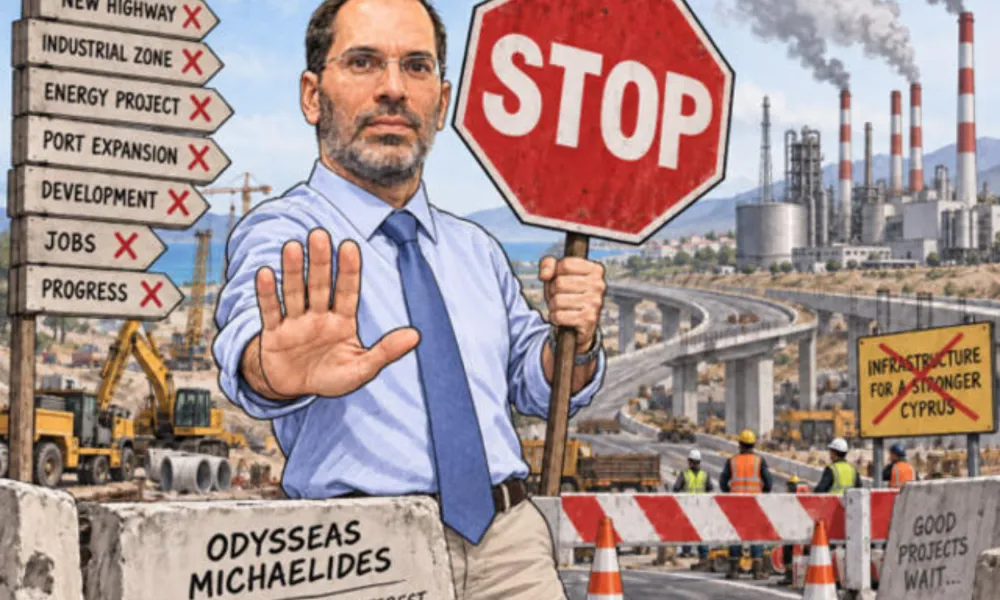
For years, Odysseas Michaelides built his public image as an uncompromising guardian of the public purse, an official prepared to confront ministers, government departments, organisations and other institutions in order, as he maintained, to protect every last euro of taxpayers’ money.
Scrutiny of public expenditure is, of course, essential. But specific cases now raise a different question: what happens when oversight becomes an overriding focus on achieving the lowest possible immediate cost, when projects are blocked or challenged for years, and when an auditing institution appears to assume a role extending well beyond examining legality and sound administration?
The final bill is not necessarily determined on the day a tender is cancelled. Sometimes it becomes clear years later.
The bills arriving today
The most recent example concerns the new Legal Service building.
In 2023, the project had an estimated cost of €45 million excluding VAT and involved a building of approximately 23,300 square metres intended for around 400 employees.
Michaelides strongly objected at the time.
In a letter dated 18 September 2023, he explicitly proposed cancelling the tender. He questioned the need to design a building for 400 officials when there were 193 established posts, described the proposed floor area as excessive and calculated the cost at €133,875 per employee.
The tender was cancelled several days later.
To be fair, the government cited fiscal constraints at the time, rather than solely the Auditor General’s objections. It would therefore be inaccurate to claim that Michaelides single-handedly cancelled the project.
His intervention was nevertheless influential in the public debate, and the Audit Office had explicitly called for cancellation.
On 10 September 2026, a new tender was launched for a building with a minimum floor area of 23,410 square metres, 11 storeys, two underground levels and 12 years of maintenance.
In scale, therefore, it is essentially comparable to the project challenged in 2023.
The difference is the price.
Instead of €45 million, the new project is valued at €68 million excluding VAT.
That is an increase of €23 million, or 51%. Including VAT, the projected bill has increased from approximately €53.55 million to €80.92 million.
Three years have passed and the building once considered expensive is now €23 million more expensive.
The ‘unviable’ Paphos-Polis road
Similar questions arise over the Paphos-Polis Chrysochous motorway.
In 2017, Michaelides maintained that the project was not financially viable.
Even after a decision was taken to construct the road in stages as far as Stroumpi, he argued that the underlying figures had not changed, referring to a cost of approximately €80 million.
The first section was eventually awarded to INTRAKAT in 2021 for €72.979 million plus VAT.
That contract was subsequently terminated following serious disputes with the contractor.
Again, the termination cannot be attributed entirely to Michaelides. That distinction must be made clear.
But the cost of time is equally clear.
In 2025, the state estimated that completing the remaining work would require €90.2 million plus VAT.
When new bids were opened in April 2026, the lowest offer stood at €124.85 million.
A road that became the subject of a political battle nine years ago because a cost of approximately €80 million was considered excessive is now facing a bid of almost €125 million merely to complete its first phase.
Once again, time has a price.
The ‘cheap’ Pentakomo solution
If one case best encapsulates the principle of prioritising the lowest price above everything else, it is the Pentakomo waste treatment facility.
European technical advisers JASPERS had recommended that assessment of the complex project should not be based solely on financial considerations but should also incorporate technical criteria, experience and the feasibility of the proposed technology.
According to information subsequently made public through an investigation into the project, Michaelides, who was then serving at the Ministry of Communications, supported a model in which the lowest price would be the decisive criterion.
The project did indeed initially appear cheaper.
In practice, however, the facility encountered serious problems.
The secondary fuel produced could not be used as originally envisaged, quantities of material were instead sent to landfill, and the affair ultimately became the subject of both a commission of inquiry and a criminal investigation.
The state is now planning a substantial new upgrade to the facility, with a new contractor expected to be appointed during the second half of 2027 and the works estimated to take 36 months.
That illustrates the real cost of a “cheap” solution that fails to operate as intended: the state pays once to build it and again to fix it.
The €30 million bus issue
A fourth case is also worth remembering precisely because it dates from before Michaelides became Auditor General.
During the first public passenger transport contracts, Michaelides served at the Ministry of Communications and was involved in developing the system.
Years later, overpayments to bus operators were identified and estimated at approximately €30 million.
Then ministry director-general Alekos Michaelides directly accused him of having participated in determining the Cost Per Kilometre, arguing that the high rate was a principal reason for the overpayments.
In a letter, he reminded Michaelides that he had been “the person who determined the Cost Per Kilometre in those years”.
Odysseas Michaelides rejected the accusations, maintaining that he had confronted the bus companies and attempted to restrict payments.
The €30 million therefore cannot simply be attributed to him as a personal loss to the state.
The case nevertheless demonstrates an important distinction: designing and managing a complex system is very different from auditing that system retrospectively.
Who ultimately pays?
Nobody can credibly argue that everything that went wrong with the Legal Service building, the Paphos-Polis road, Pentakomo or public transport has one person solely responsible for it.
Nor would it be reasonable to blame Michaelides for every price increase, failed contractor or mistaken government decision.
What can be argued is that his interventions exercised influence over public decision-making that was disproportionate to the formal scope of his office, having created a climate in which, according to the article’s assessment, much of the civil service feared challenging the Audit Office.
A pattern worth examining
Absolute focus on immediate cost does not necessarily produce savings.
The cheapest option is not always the most economical. Delays are not free. Cancelling a project does not eliminate its eventual cost. And an auditing mechanism cannot operate as though time, technology, inflation and lost opportunities carry no price.
The figures now invite a second look:
- On the Paphos-Polis road, the roughly €80 million once considered excessive now appears distant compared with the €124.85 million lowest new bid.
- At Pentakomo, the cheaper solution now requires another significant upgrade to perform as it was originally supposed to.
- In public transport, a system in which Michaelides himself had an administrative role subsequently generated alleged overpayments worth tens of millions of euros, which he later criticised as Auditor General.
Protecting taxpayers is not ultimately measured by how many projects are stopped or how many objections are raised.
It is measured by the final bill.
And the final bills associated with some of these decisions are still arriving.