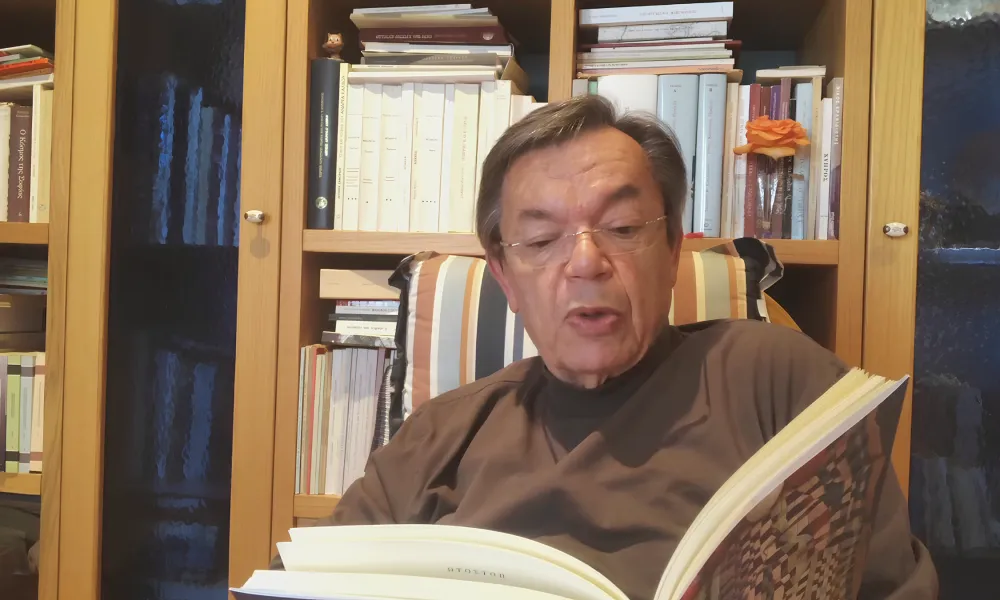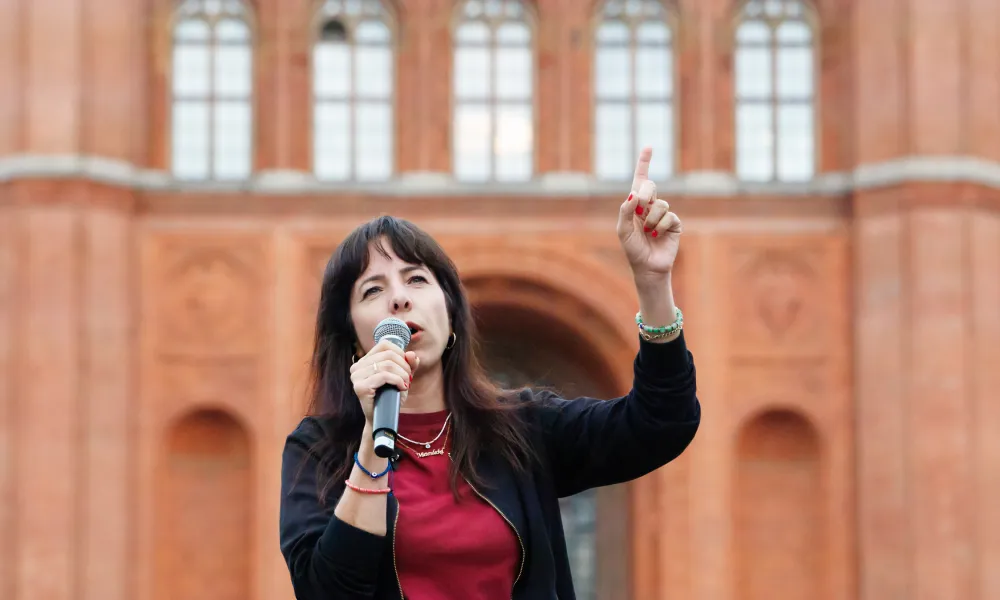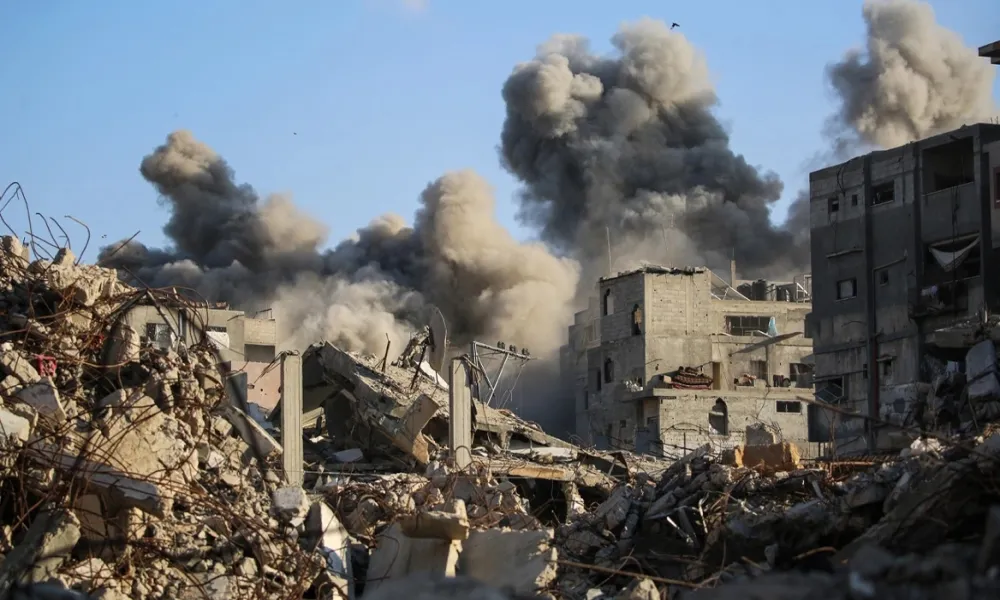

As the war in Gaza unfolded, headlines multiplied while access to journalists on the ground was denied, narratives hardened, and coverage increasingly shifted away from the destruction itself. A new study by the Institute for Mass Media and Universitas Publications - authored by Nicholas Karides examines how Cypriot media reported the war and asks a difficult question: did journalism merely struggle under unprecedented constraints, or did its framing and silences help normalise what was happening on the ground?
“It will be for scholars to decide whether the abhorrent terrorist attack on 7 October 2023 merited a declaration of war and the ferocity and ruthlessness which Israel unleashed against what, in the end, was an unarmed and abandoned people,” writes Nicholas Karides, Director of IMME and contributor to the Media Pluralism Monitor for Cyprus. “It will also be up to scholars (and potentially jurists at the ICJ and the ICC) to decide whether Operation Iron Swords could have been ended much sooner when the military objectives it set out had been fulfilled.”
Journalism’s responsibility is to interrogate events as they unfold. That responsibility, Karides argues in this study, was not fulfilled. Not internationally, and not in Cyprus.
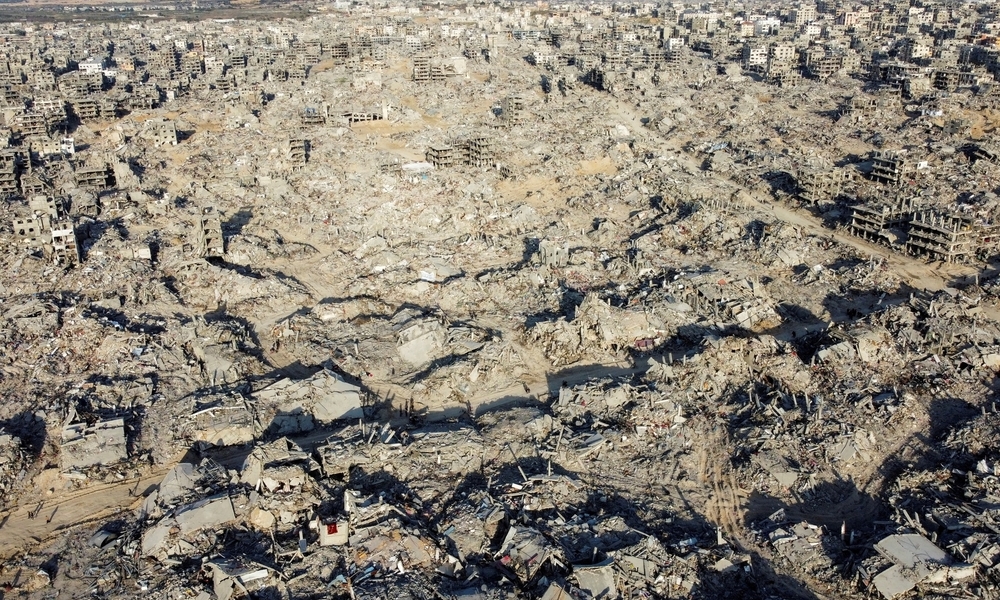
The study examines how the Cypriot media covered the war in Gaza from October 2023 through late 2025. Its conclusion is that Gaza was steadily displaced. The war itself became background, while diplomacy, logistics, national positioning, and security narratives moved to the foreground.
Reporting without access
From the outset, journalism faced an unprecedented structural barrier. Israel barred all foreign journalists from entering Gaza, while Egypt maintained its own restrictions. The only reporters left on the ground were Palestinian journalists, working under extreme conditions.
By December 2025, data from the Committee for the Protection of Journalists showed that 249 journalists had been killed in Gaza, the vast majority Palestinian. Karides describes this as a systematic effort to silence reporting.
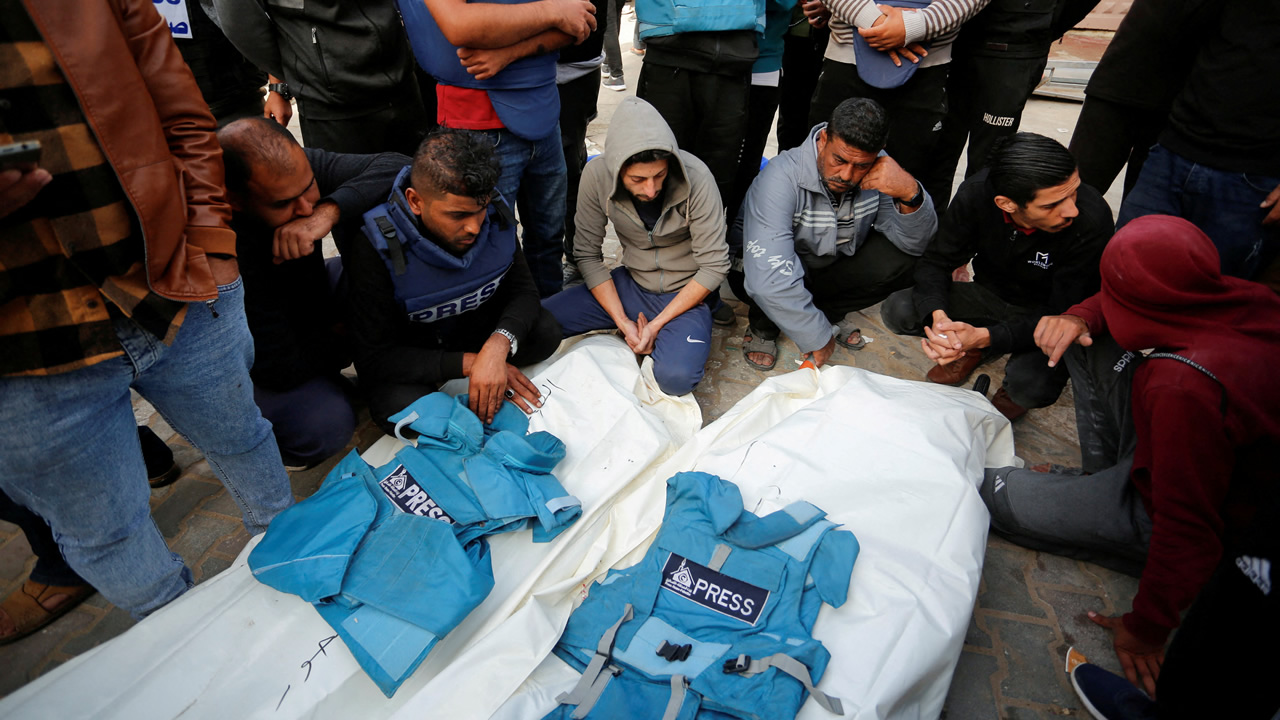
In his Substack, he writes: “In banning media from Gaza then assassinating Palestinian journalists and putting out shameless excuses to justify their killings, Israel silenced their voices but equally sinisterly it entrenched in international public consciousness the notion that Palestinian journalists are not worthy of the journalistic pursuit for factual reporting.”
The result was a profound asymmetry of information. Cypriot media, like most international outlets, relied almost entirely on second-hand material: news agencies, official military briefings, social media footage, and humanitarian testimony. Verification was often impossible. In that vacuum, the narrative power of a state actor with a sophisticated communications apparatus proved decisive.
The backdrop of war
According to the study, the early weeks of coverage were dominated by the shock of 7 October and Israel’s right to self-defence. As the war progressed, however, Gaza itself began to recede from the centre of reporting.
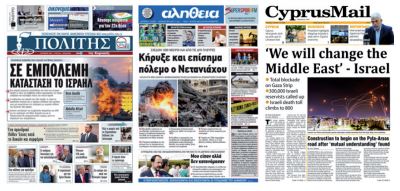
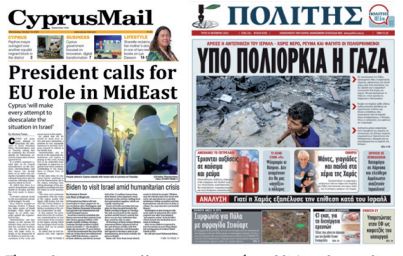
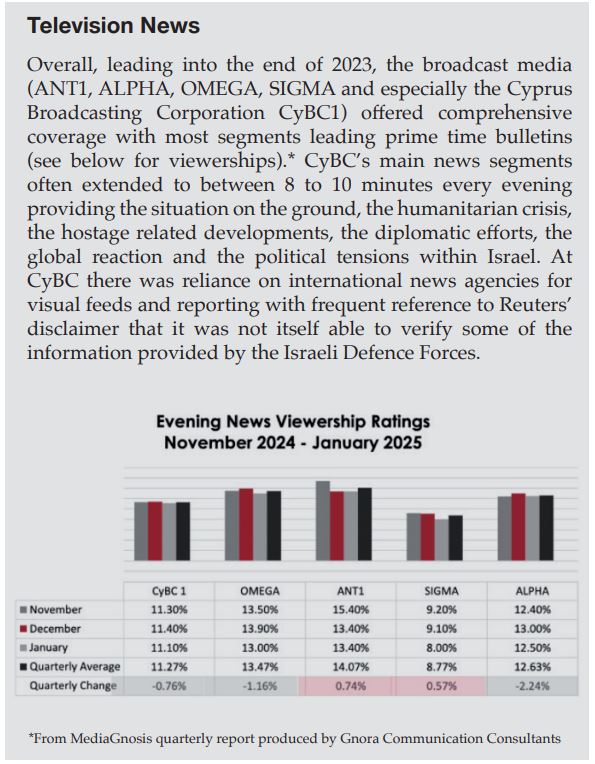
What replaced it was a series of secondary narratives: evacuations through Cyprus, humanitarian initiatives, diplomatic positioning, security alerts, and Cyprus’ self-presentation as a stabilising actor in the region. These stories were not insignificant. But their cumulative effect was to turn Gaza into scenery.
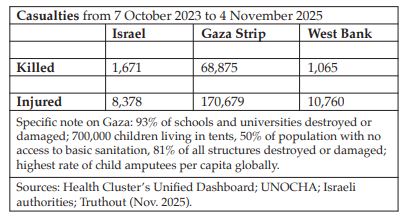
Civilian death tolls, mass displacement, and the destruction of infrastructure became repetitive motifs, stripped of urgency by constant repetition and unresolved claims.
Karides argues that this shift was not accidental. Prioritisation is itself a form of language. When Gaza ceased to lead bulletins unless directly linked to Cypriot interests, the media implicitly reframed the conflict as distant, abstract, and ultimately manageable.
The Cyprus lens
The tendency to interpret international crises through the prism of the island’s strategic value, its unresolved national problem, and its regional alliances meant that Gaza was often discussed in terms of what it meant for Cyprus, rather than what was happening to Palestinians.
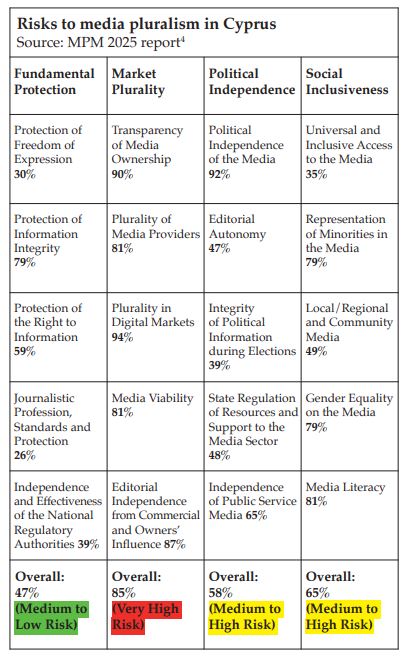
Government narratives, particularly the repeated assertion that Cyprus was “part of the solution, not part of the problem,” were widely relayed and rarely interrogated. The study notes a striking absence of sustained questioning about the contradictions between humanitarian rhetoric and strategic alignment with Israel.
International enabling
The most uncomfortable argument in the study emerges when Karides turns to the concept of international enabling. He draws on the work of Francesca Albanese, the UN Special Rapporteur on the occupied Palestinian territories, who in her report Gaza Genocide: A Collective Crime described what unfolded in Gaza as a “genocidal undertaking” that was “internationally enabled.”
Karides writes: “Taking Albanese’s notion of ‘international enabling’ a step further, one must examine whether the western media –of which Cyprus’ are a part– by not pressing for the facts hard enough, by not making distinctions clear enough, by not questioning the language used frequently enough, and by not highlighting the obligations of the international community boldly enough– have themselves in Albanese’s words ‘facilitated, legitimized and eventually normalized the genocide’.”
He is careful not to present this as a definitive accusation. “It is a difficult and unprovable charge,” he writes, “but it is one that feels embarrassingly real; enough, at least, for media ethics committees globally and every journalist individually to seriously contemplate.”
The cost to journalism
Beyond Gaza itself, Karides argues that the consequences of this failure extend to journalism as a profession. Public trust, already fragile, has been further eroded. So too has the credibility of international institutions tasked with protecting journalists.
“Palestinian journalists like all journalists elsewhere can be biased as they can be impartial, they can be driven and dignified but lazy and easily corrupted, they can be clumsy but also exceptional,” he writes. “It is worth considering that perhaps without them we would have known only half of the already limited things we know happened in Gaza.”
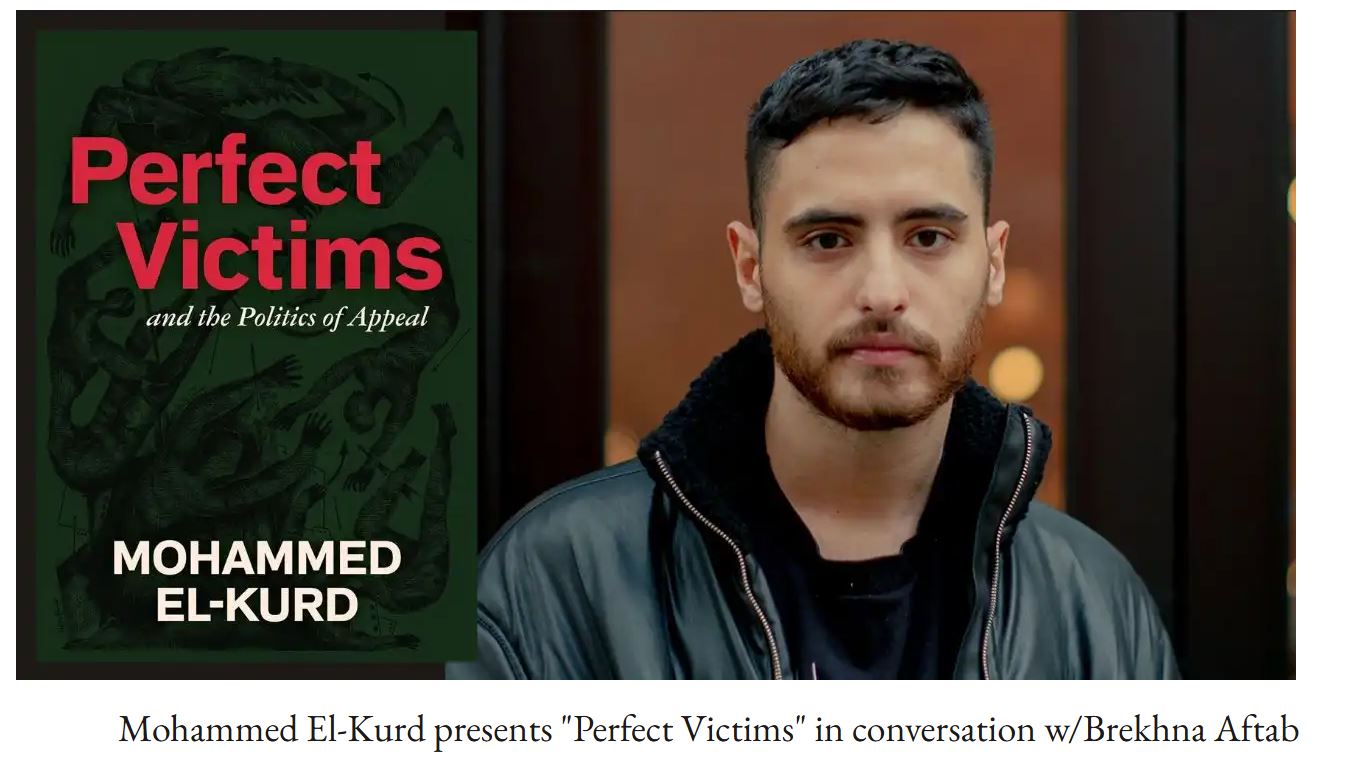
Instead, Gaza was, in his words, “handled with what can only be described as a media-colonial gaze,” reduced to a distant spectacle of suffering. He recalls the call by Palestinian writer and scholar Mohammed El Kurd for humility from Western knowledge producers, a call he suggests applies equally to the media.
A failure closer to home
What makes the findings particularly unsettling is that Cyprus, given its own history of occupation, displacement, and international neglect, might have been expected to resist this pattern. According to the study, it largely did not.
“All in all,” Karides concludes, “the media, Cypriot and international, for reasons sometimes beyond their control but other times in ignorance or, worse, willfully, failed to bring to the world’s attention with conviction and responsibility what really happened in Gaza.”
He adds: “In the end it fell short of defending the interests of a voiceless and dehumanized people and failed to preserve the integrity of the journalistic record, potentially, even, of the historical record.”
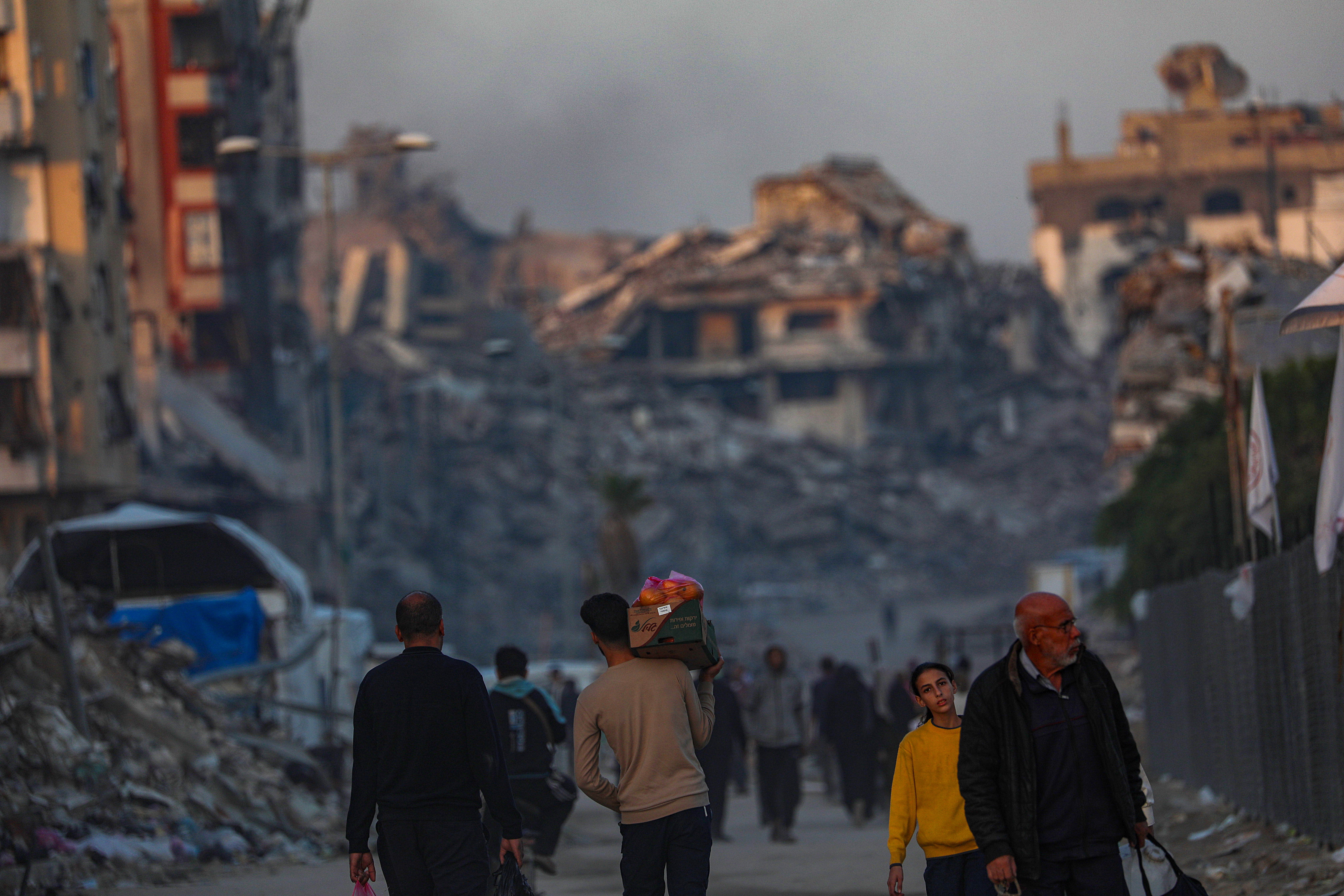
It is a sobering assessment. Not only of a war, but of the institution tasked with bearing witness to it.