Voice Across
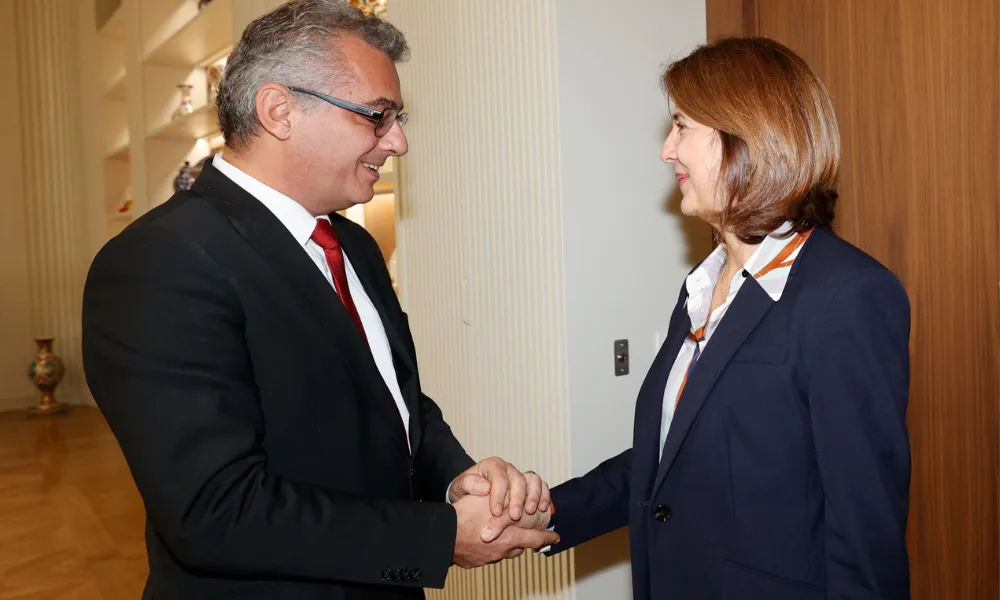
The Cyprus issue has entered a period of cautious possibility after years of drift. The recent trilateral meeting in Nicosia between Turkish Cypriot leader Tufan Erhürman, Greek Cypriot leader Nikos Christodoulides and the United Nations Secretary General’s Personal Envoy María Angela Holguín Cuéllar may at first appear like one more formal encounter in a conflict that has seen many. Yet this was the first time since the collapse of the Crans Montana talks in the summer of 2017 that the two Cypriot leaders formally met under United Nations auspices and produced a joint statement. After eight years of stagnation and fragmented dialogue, this alone restores a degree of diplomatic normalcy that had been missing.
The meeting did not solve the Cyprus problem, nor did it open the way to immediate negotiations. However, it revived the only international framework capable of sustaining a real process. For the first time in years, the leaders reaffirmed a common reference point. That reference was political equality as defined in United Nations Security Council resolutions.
Return to UN parameters
The joint statement contained no explicit mention of a bizonal, bicommunal federation. This is notable because such terminology is normally tied to the UN framework. The leaders instead reaffirmed political equality as described in Security Council resolutions. This phrase is often misunderstood as vague, yet in the Cyprus context it has a precise meaning. It includes rotating presidency at a two to one ratio, effective participation of each community in all federal organs and a compulsory positive Turkish Cypriot vote in every federal level decision. These elements have accumulated over decades of negotiations and reflect the only workable model for shared governance on the island. They are not an invention of one community. They have become part of the UN parameters since the 2004 Annan Plan period.
Despite this, political equality has not yet been embraced in full by the Greek Cypriot leadership. Christodoulides has repeatedly avoided committing to rotating presidency, and during the press briefing he again distanced himself from the Turkish Cypriot methodology. When asked whether Erhürman’s four points were discussed, he replied that there was no extensive discussion on that issue and that he had expressed his positions previously. He stressed that the meeting focused on aspects of the Cyprus problem and confidence building measures, not on methodology. For Erhürman, however, methodology is substance because it forms the foundation that determines whether negotiations can succeed.
Erhürman's method and agreement
Erhürman approaches the Cyprus issue with a structured, four stage methodology inspired partly by United Nations Secretary General António Guterres’ observation that differences can be addressed only if there is a clear method to guide negotiations. Stage One requires that political equality, with all its components, be accepted explicitly before entering comprehensive talks. The trilateral meeting recorded only part of this first stage. While both leaders acknowledged political equality, none of the concrete institutional definitions were incorporated. Rotating presidency was not accepted. The architecture of effective participation was not addressed. The positive vote requirement was not mentioned.
For this reason, Erhürman made it clear that the joint statement represents only a partial reflection of Stage One. He stressed that unless the remainder of the first stage is accepted, the reference carries limited practical meaning. He also underlined that the Turkish Cypriot side will not enter full negotiations until all four stages are agreed. These stages include acceptance of political equality in its complete form, a time limit for negotiations, respect for past convergences and a United Nations guarantee that if the Greek Cypriot side leaves the table again, embargoes imposed on Turkish Cypriots will be lifted.
Christodoulides has not accepted these points and has referred to them, implicitly, as preconditions, a term Erhürman rejects. For Erhürman, these points are not conditions but structural necessities to prevent yet another cycle of open ended dialogue leading nowhere.
GC leader
Christodoulides’ avoidance of rotating presidency remains one of the most significant gaps between the sides. Without rotating presidency, political equality cannot function in practice because the entire institutional logic of federal power sharing depends on it. His reluctance reveals a hesitation that is deeply rooted in the Greek Cypriot political landscape. Christodoulides insists that he accepts political equality, yet he avoids agreeing to its concrete expressions. This difference in interpretation remains one of the core obstacles to real progress.
Christodoulides also dismissed any discussion of methodology and insisted that the meeting focused on substance. For him, substance refers to the broad contours of a future settlement. For Erhürman, substance includes the rules that prevent either side from being trapped in endless negotiations. The distance between these approaches makes clear why the Turkish Cypriot leader insists that the methodology must be agreed first.
Practical Steps and Their Limits
The trilateral meeting produced progress on several practical matters. The most important were the agreement to finalise the Hellim or Halloumi protected designation of origin transition by the end of January and improvements at the Metehan or Agios Dometios crossing. Seven booths are now active there. Licensing and permit procedures will now be available in Bostancı and Derinya. Discussions were also held on cooperation in health, population registry and education.
These steps matter. They touch the daily lives of Turkish Cypriots as well as Greek Cypriots and build modest trust between the two communities. Yet they cannot replace political negotiations. They do not address sovereignty, governance, security or guarantees. They are useful, but they do not substitute for the resolution process.
5+1 readiness
The leaders expressed readiness to attend a five plus one meeting, although Christodoulides said the timing depends on discussions between Holguín and officials in Athens and Ankara. Erhürman maintained that the current level of progress is insufficient for such a meeting. He described the developments so far as early steps and stressed that more substantive work on crossing points and cooperation mechanisms is necessary before moving to a broader format.
This divergence reflects the deeper differences in how each leader views the path forward. Christodoulides is eager to demonstrate diplomatic activity ahead of the Greek Cypriot EU Council Presidency in 2026. Erhürman insists on structural preparation to avoid a repeat of Geneva in 2021, where a meeting collapsed almost immediately due to lack of common ground.
Türkiye continues to support a settlement that includes full political equality and effective participation for the Turkish Cypriot community. Athens aligns closely with Christodoulides while encouraging a multilateral format. The European Union has grown more vocal. The European Union envoy for the Cyprus problem Johannes Hahn has stressed that the time for concrete movement has arrived. These factors do not resolve the Cyprus problem. They do, however, create a geopolitical environment that is slightly more favourable to engagement.
Prospects and caution
The trilateral meeting has reintroduced a shared reference framework that had been absent since 2017. It did not produce a breakthrough, nor did it collapse. Instead, it created a level of alignment that allows the process to breathe. At the same time, the core disagreements remain untouched. The most serious concerns relate to the definition of political equality and the absence of agreement on rotating presidency. The meeting reaffirmed political equality in principle but avoided its real content. The absence of any mention of a bizonal and bicommunal federation also reflects the care with which both sides navigate their political environments.
Cyprus now stands at a point where cautious optimism is justified. The trilateral meeting did not create miracles, but it reintroduced the only viable framework for a settlement. The reaffirmation of political equality as defined by the United Nations is an essential step. The progress on crossing points and the Hellim or Halloumi file shows that the two sides can still work together. The willingness to consider a five plus one format suggests that the regional actors are ready to support a renewed effort.
Whether this moment leads to a structured negotiation or becomes a brief interval before another period of stagnation depends on what happens next. For now, after eight silent years, the Cyprus issue has taken its first real step back into the arena of international diplomacy. That alone is significant. The island is not on the brink of a solution, but it has finally recovered the minimum conditions for serious dialogue. The responsibility now lies with the leaders and the regional actors to ensure that this fragile opening is not lost.
Yusuf KANLI, Executive Board member and Vice Chair of the Turkish Association of Journalists, Editorial Advisor of Anka News Agency, Journalist/Columnist.