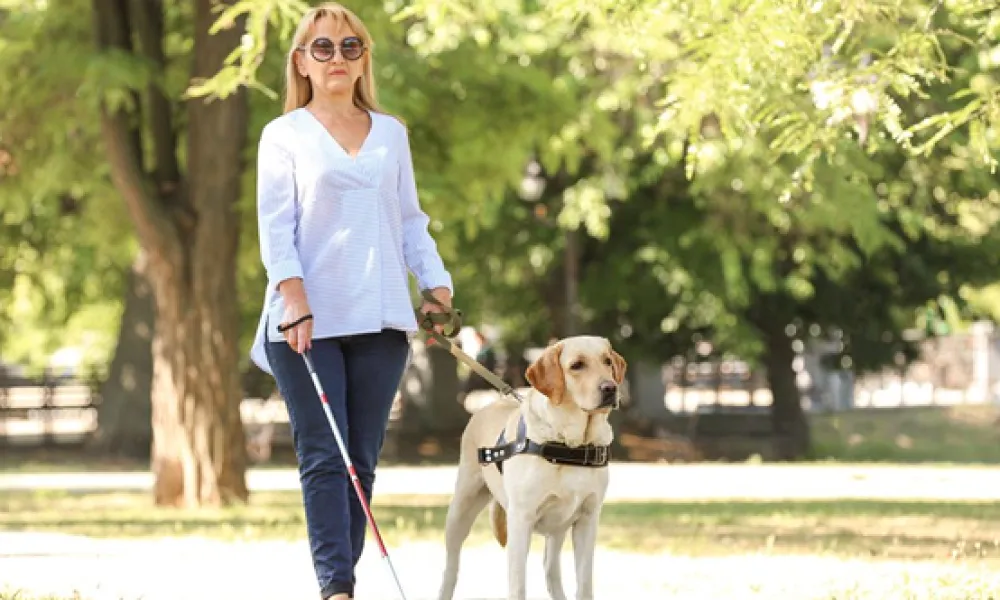
Around 2,000 people with visual impairments live in Cyprus, yet only five of them have a guide dog, with no legal framework in place for the assessment or certification of the process that ensures accessibility. This was stated during a discussion on Monday at the House Committee on Human Rights.
The Committee will proceed with two bills to address the issue, in line with the UN Convention on the Rights of Persons with Disabilities, members said. The first, tabled by DIKO MP Christos Senekis, seeks to enshrine as a fundamental right the acquisition of a guide dog for persons with visual and other disabilities, as well as their access to all public and private spaces. The second, submitted by Green Party MP Charalambos Theopemptou, concerns the certification and evaluation of guide dogs and the imposition of severe penalties on those who deny access to persons accompanied by a guide dog.
'Have to start somewhere'
All representatives of ministries, deputy ministries, competent departments, organisations and NGOs welcomed the bill submitted by Senekis, which will be discussed article by article at the Committee’s next meeting on Monday, with the aim of submitting it to the House plenary as soon as possible, said Committee Chair and AKEL MP Irene Charalambidou. She added that Theopemptou’s bill is expected to be submitted to the plenary either this Thursday or next.
The two bills are complementary, Charalambidou said after the discussion, noting that state services are not yet ready to fully implement what the legislation provides for, “but we have to start somewhere”. She stressed that Cyprus has around 2,000 people with visual impairments who would benefit greatly from guide dogs, adding that guide dogs are extremely costly and require training and certification. “I believe the state has an obligation to contribute to the greatest possible extent so that all those who need a guide dog are able to acquire one,” she said.
She added that political will and social sensitivity are required so that persons with disabilities can feel like equal and active members of society.
Costs up to €25,000
During the discussion, a representative of the School for the Blind said it could cooperate with foreign training centres and be part of the process in Cyprus. She noted that the training of a specialised guide dog costs around €25,000 and takes two years. Cyprus has some private centres, while the nearest large training centre is in Greece, where the right of access for persons with disabilities accompanied by guide dogs was enshrined in law in 2010.
DIKO MP Christos Senekis said that this right is recognised as fundamental under the 2006 UN Convention on the Rights of Persons with Disabilities, which was ratified by the Republic of Cyprus in 2011. The protection applies to persons with disabilities, including those with visual impairments.
“Being accompanied by an assistance dog is not a choice or a convenience. It is a necessary means for daily mobility, accessibility, autonomy and meaningful social participation for persons with disabilities. In practice, a guide dog constitutes an extension of the independence, safety and dignity of the person who needs it,” he said.
Senekis expressed satisfaction with the broad consensus reached, noting that it creates the conditions for swift completion of the legislative process and the submission of the bill to the House plenary for approval.