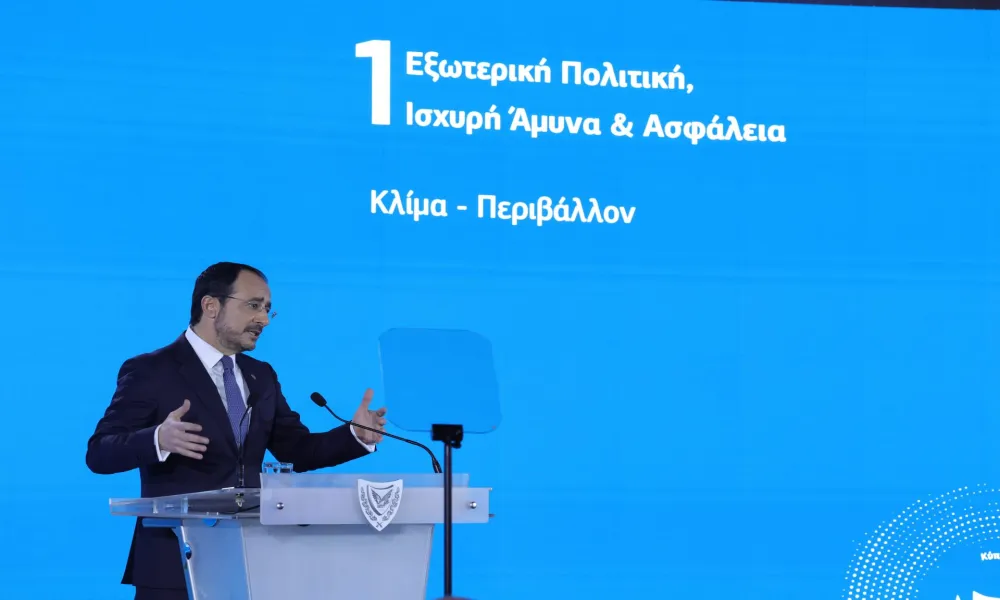

A few months before the parliamentary elections in May, the Noverna Analytics poll outlines a political landscape defined by clear contrasts. The President of the Republic retains a stronger standing in foreign policy, yet records significant erosion in internal governance, particularly on corruption. At the same time, Parliament faces a credibility gap, with a majority of citizens expressing limited trust in the institution.
The President’s image across policy areas
Public evaluation of President Nikos Christodoulides varies markedly depending on the policy field.
On internal governance, only 30% state that they approve of his handling, while 63% disapprove. The balance is clearly negative, suggesting that day-to-day management of domestic issues such as water supply, energy matters and crime does not convince the majority of society.
The picture is even more adverse in the field of tackling corruption. Just 21% approve of the President’s handling, compared to 72% who disapprove. Corruption remains the government’s weakest point. Despite declarations on transparency and reform, the public does not appear persuaded that substantive change has taken place, particularly following the circulation of a widely known video involving close associates of the President and references to the fund of First Lady Philippa Karsera.
In contrast, the assessment is significantly more positive in foreign policy. Overall, 55% approve of the President’s handling of international affairs. On the Cyprus issue, 46% approve, with the level of disapproval lower than on domestic matters. In this area, the President appears to have built political capital.
The distinction is clear. He is evaluated positively as an international actor and negatively as a manager of domestic governance.
The marked fluctuations in approval across policy fields indicate the presence of a discerning electorate with differentiated views, rather than a public uniformly aligned along fixed partisan preferences.
Corruption: stagnation or deterioration?
The survey also examined whether the level of corruption has changed under the current presidency compared to the previous period. Fifty-seven per cent state that it “remains the same”, 31% believe it “has increased” and only 10% consider that it “has decreased”.
The majority does not perceive improvement. One in three considers the current administration worse in managing corruption than the previous government of President Nicos Anastasiades. Even those who do not believe the situation has deteriorated do not identify substantive progress. In a country where corruption has been a central factor in political erosion over the past decade, the perception of stagnation carries political weight.
Analysis by party preference indicates that support for the President is strongest among DIKO voters, where higher levels of approval are recorded both in internal governance and in the handling of corruption. Among DISY voters the picture is more complex, with a significant segment appearing cautious. Within the opposition, disapproval is pronounced.
The prevailing perception regarding corruption also appears to create space for anti-system parties to develop electoral momentum.
The Cyprus issue and societal alignment
Despite criticism of governance, majority support is recorded for a bizonal bicommunal federation based on the framework discussed in Crans-Montana in 2017. Fifty-four per cent state they are in favour, 28% against and 18% do not express a view.
This finding suggests that, notwithstanding institutional distrust and reservations about domestic policy, society remains within the framework of a federal solution. No shift towards fundamentally different options on the national question is recorded.
Parliament under scrutiny
Attention also turns to the House of Representatives.
Fifty-three per cent state that they do not trust Parliament as an institution, compared to 43% who say they do. This constitutes a narrow but clear majority of distrust. Parliament enters the pre-election period with a notable credibility deficit.
On whether legislation responds to society’s needs, 3% respond “very much”, 33% “quite”, 46% “a little” and 16% “not at all”. In total, 62% consider that legislative work responds inadequately or not at all to social needs.
The challenge therefore concerns not only individuals but the functioning of the institution itself. The perception that laws do not reflect social priorities reinforces a sense of distance from the political system.
Younger generations more critical
Age-based analysis shows that younger citizens adopt a stricter stance. In the 18 to 34 age group, the majority consider that laws respond “a little” to social needs, while “very much” responses are almost non-existent. In older age groups, the “quite” response increases and overall evaluations are slightly more positive.
This differentiation suggests a generational distance from the political system. Younger citizens appear less confrontational and more disengaged.
Economy: stability without momentum
In the economic field, findings reflect stagnation rather than crisis. Regarding their personal financial situation over the past 12 months, 60% state it remained the same, 24% say it worsened and 15% report improvement. Looking ahead to the next 12 months, the majority expect it to remain unchanged.
There is no evidence of widespread economic pessimism, but neither is there strong optimism. Society does not perceive collapse, yet does not feel it is on a trajectory of meaningful improvement.
Perceptions regarding both the national economic course and personal finances limit, for the time being, the potential for improvement in the President’s domestic governance image, despite recently announced tax reforms.
Political assessment
Overall, the poll outlines a nuanced political environment. The President maintains a positive standing in foreign policy but faces substantial criticism in internal governance and corruption. Parliament operates with reduced public trust, while citizens question the effectiveness of legislative output.
The climate is not explosive, but it is corrosive. The absence of intense anger does not indicate the absence of dissatisfaction. It reflects limited expectations.
In parliamentary elections, limited expectations often translate into volatility, abstention and the search for alternative options. The ballot in May is unlikely to be shaped by enthusiasm. It will reflect an assessment, positive or negative, of both the President and Parliament.
Survey identity
Conducted by: Noverna Analytics & Research, member of SEDEAK and ESOMAR, on behalf of the newspaper Politis
Sample and methodology: 1,051 interviews with a representative sample of the voting population in the government-controlled areas eligible to vote in the upcoming parliamentary elections, using random sampling
Interview method: Structured questionnaire with telephone interviews via CATI (Computer Assisted Telephone Interviewing)
Polling dates: 25 January – 9 February
Weighting: The sample was weighted according to the demographic profile of the electorate
Maximum margin of statistical error: ±2.7% at a 95% confidence level