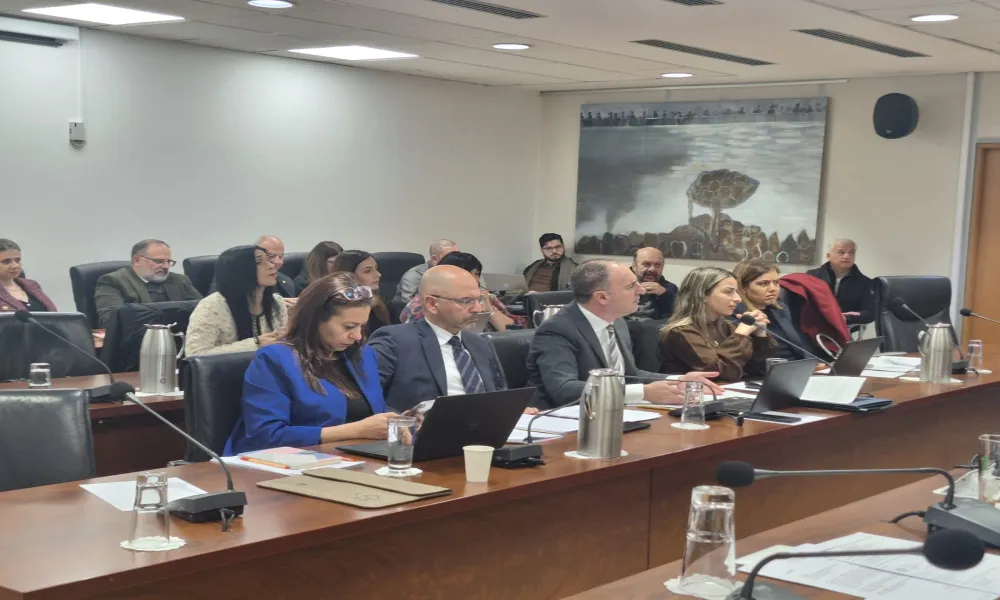

With the First Lady absent and the Auditor General on the defensive, the House Audit Committee failed to obtain clear answers on the findings of the Audit Office regarding the Independent Social Support Body. Instead, written statements and repeated lines of defence escalated tensions, triggering institutional clashes and leaving key questions unresolved.
Written defence, physical absence
Although the First Lady did not attend yesterday’s session, she submitted her positions in writing, reiterating that there is “nothing reprehensible” in the operation of the Body and claiming that some are exploiting the issue in order to harm her husband.
Her absence, attributed to prior commitments, prompted reactions from MPs across almost all parties, who stressed that she should have been present, as she is the only person able to respond to questions concerning the “consultations” that preceded the contributions under scrutiny.
An inconclusive committee session
With the First Lady absent and the General Accountant in a defensive stance, the Audit Committee attempted, without success, to obtain clear explanations regarding the Audit Office’s findings on the Independent Social Support Body.
Rather than addressing specific cases where large donations coincided with state consultations, licensing procedures or regulatory decisions, both Filippa Karsera Christodoulides, through her letter, and Andreas Antoniadis reiterated well-known arguments in defence of the Body. This approach led the discussion into heightened tension, institutional disputes and ultimately a dead end.
In her letter, the First Lady maintained that “no reprehensible act or irregularity/illegality” had been identified in the Body’s operation. She spoke of “instrumentalisation” of the issue with the aim of damaging the President of the Republic.
She further insisted that all donations were made exclusively via bank transfers into a special state account, that the donor registry was always available to auditing authorities, and that the non-publication of detailed donor information was linked to personal data protection legislation and a relevant ruling by the Supreme Constitutional Court, secured following an appeal by her husband, the President of the Republic.
Findings that raised alarms
The Audit Office’s report goes beyond procedural observations, recording cases that, as noted, create conditions of a “peculiar relationship”.
Among other things, it refers to companies which, during periods of consultations with the state for the awarding of high-value contracts, simultaneously made contributions to the Body. In one case, a company engaged in consultations for a project exceeding €10 million reportedly made a donation during the same period.
Particular reference is also made to a natural person whose company was granted a construction permit for a commercial property, and who contributed €200,000 to the Body in 2023 and a further €200,000 in 2024.
The Audit Office stresses that such contributions, when coinciding with state decisions that directly affect financial interests, may create problematic relationships, even if illegality cannot be directly proven.
The Auditor General, Andreas Papakonstantinou, clarified before the Committee that his service cannot prove whether there was any quid pro quo, stressing however that its role is to highlight risks and gaps requiring political and institutional handling.
“Unnatural” increase in donations
Another issue highlighted concerns the funding pattern of the Body in recent years. In 2023, donations reportedly increased fivefold, while in 2024 expenditure tripled.
The term “unnatural behaviour” was not used as an allegation of illegality but as an indication of a sudden and sharp change, underscoring the need for stricter safeguards, particularly when donors operate in sectors regulated by the state.
“You are adopting Filippa’s position”
During the discussion on the Audit Office’s findings and role, remarks by Audit Committee Chair Zacharias Koulias, suggesting that the Auditor General had exceeded his mandate, prompted an immediate and strong reaction from AKEL MP Eirini Charalambidou.
She questioned whether the Auditor was being criticised “for doing his job”, while Mr Koulias insisted that the report contained political judgements outside the Audit Office’s remit.
The exchange escalated when Ms Charalambidou accused the Committee Chair of fully adopting the First Lady’s positions and of interfering in the Audit Office’s work. Mr Koulias rejected the accusation, stating that neither the President nor his wife required his support.
The debate took on a personal tone, with Ms Charalambidou repeating that he was “adopting Filippa’s position” and directly accusing him of intervention, while other MPs attempted to steer the discussion back to the substance of the report.
“You are also the General Accountant”
Tensions also flared over the role of the General Accountant in handling donor data, peaking when DISY MP Nikos Georgiou took the floor.
Referring to a recently released video explicitly mentioning a €10,000 donation, he asked whether this contribution appeared on the donor list submitted to Parliament. The General Accountant replied with a single word: “No”.
The response fuelled further tension, with Mr Georgiou arguing that the omission creates the impression that certain donations remain “under the radar”.
He reminded the Committee that Andreas Antoniadis, “apart from being the Body’s treasurer, is also the General Accountant of the Republic”, adding that under the law, every state expenditure exceeding €5,000 is published.
He concluded pointedly that in the case of the Body, where principles of transparency and accountability should have applied, “we were selling favours and servility”.
The General Accountant reacted strongly, rejecting insinuations against him and stating his intention to leave the session, asking rhetorically: “What do you want me to do? Break the law?” Following interventions by MPs, he remained in the room, though no answers were provided regarding the completeness or publication of donor data.
What Antoniadis did – and did not – say
Responding to the criticism, the General Accountant argued that the Body operated within the existing legal framework, citing legislative restrictions and Supreme Constitutional Court rulings on donor disclosure.
He reiterated that all donations were made exclusively via bank transfers into a special state account under the supervision of the General Accounting Office, dismissing allegations of opaque procedures.
He added that stricter procedures and governance changes were introduced from 2023 onwards, and that donor logos were published following the consent of the majority of donors.
However, his statements did not address the specific donor cases cited in the Audit Office report, nor the timing of large donations in relation to state consultations, licensing or regulatory decisions.
Proposal to abolish the Body
On the political front, beyond the discussion of the Audit Office report, independent MP Alexandra Attalides stated that, in light of the issues raised, there is an intention to submit a bill proposing the abolition of the Independent Social Support Body.
She noted that this intention is shared by AKEL General Secretary Stefanos Stefanou and DISY MP Kyriakos Hatzigiannis, arguing that the Body’s operation, as reflected in the Audit Office report and the preceding debate, necessitates a comprehensive review of its institutional framework and structure in order to safeguard transparency and accountability.