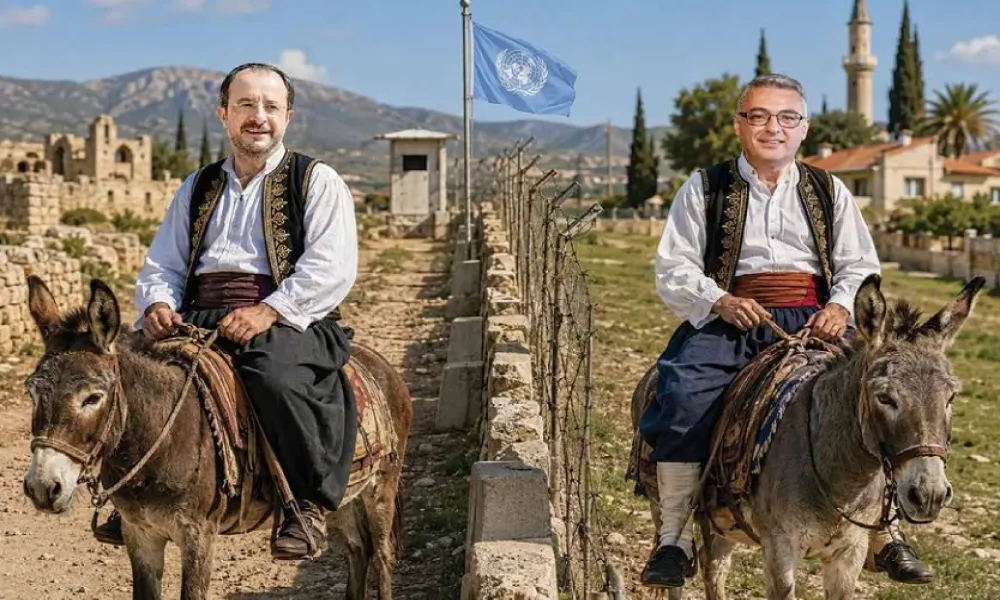

Caption: The photograph is AI-generated.
UN Secretaries-General come and go. They land at Larnaca, descend from the aircraft with a grave expression and make statements about the "critical juncture" at which the Cyprus problem finds itself. They speak reliably of the eternally open "window of opportunity" and even measure the distance from a solution. We are, that is, 5km from a solution, "one mile" from a solution, or they warn that we are at one of the last, or even "the last chance" to solve the problem. What is standard are the commemorative photographs with the local leaderships, in front of checkpoints and inside halls at the old Nicosia airport. Then they depart with a folder full of notes and that daft, cheerful expression on the face that says: "What on earth did I get myself into, the poor sod!"
Guterres
On 27 July yet another Secretary-General arrives, Antonio Guterres, in the hope of doing something. What exactly, remains unclear. Restarting the talks? He began his career with the Cyprus problem and shows, Portuguese masochist that he is, that he wants to fall flat on his face with the Cyprus problem. Will he break the deadlock? Will he find common ground? He probably won't grasp the difference between an "informal enlarged meeting" and an "enlarged informal meeting"!
The man has handled wars, humanitarian crises, coups and global disasters. We do not know, however, whether he is adequately prepared for the Cypriot phrase "En kala ta pramata, alla thelei doulia" ("Things are fine, but there's work to be done"), and above all for "trava me tzai as kleo" ("drag me along, even as I weep").
Ban
The last UN Secretary-General to set foot in Cyprus was Ban Ki-moon, on 31 January 2010. He met with the then President of the Republic Demetris Christofias and the then Turkish Cypriot leader Mehmet Ali Talat, aiming to speed up the talks for a solution. If I am not mistaken, we were then 7km from a solution.
The visit had all the essential ingredients of a Cypriot peace effort: handshakes, smiles, statements of optimism and the assurance that the two sides had made "significant progress".
The key feature of that meeting was the genuflections. Kneeling before Christofias were Talat, Nami and Tziellepis, while further back Ban Ki-moon prayed with his palms pressed together like a little Buddha. All of them were begging Christofias to agree to close the internal aspect of the Cyprus problem on the basis of the so-called Downer convergences.
Before that
Before Ban Ki-moon there had been other Secretaries-General, who left behind them plans, agreements, frameworks and documents. Cyprus may not have acquired a solution, but it acquired a rich archive. The Austrian Kurt Waldheim visited the island four times. Two visits took place before 1974, while the third was carried out in August of that same year, a few days after the completion of the second phase of the Turkish invasion. He saw Makarios and Denktash and understood that all that had changed was the rider of the donkey. Before 1974, Makarios sat astride the donkey, a thoroughbred of the finest local stock, swinging his legs. After 1974, Denktash took the rider's seat, with Makarios running along behind.
Kurt's most important visit, in any case, came in 1979, when the ten-point Kyprianou-Denktash agreement emerged. It was there, of course, that he understood what Spyros was made of. Spyros sent the message urbi et orbi that he does not yield, he does not submit, he regroups and counterattacks, because our borders are at Kyrenia and, if need be, we can reach as far as Ankara. Denktash remained firmly astride the donkey, swinging his legs.
Kofi Annan
The Cyprus problem is perhaps the only problem in the world that possesses more "bases for a solution" than solutions. It has high-level agreements, resolutions, parameters, convergences, divergences, Confidence Building Measures and informal meetings without an agenda. What it does not have is an expiry date.
Then came Kofi Annan, the man who linked his name to the largest and most detailed effort to solve the Cyprus problem. "The Black man", as Koulias used to say. Between 14 and 16 May 2002 he visited the island and held meetings with President Glafcos Clerides and the Turkish Cypriot leader Rauf Denktash. Six months later, in November 2002, the first text of the Annan plan was presented. Nobody spoke up at the time. On the contrary, at first everything suggested that the Cypriots had begun to think that compromise was not such a bad thing after all.
In 2003, of course, we had a qualitative change, courtesy of Akel. It saddled us with Tassos Papadopoulos, because "the man has changed, sir", as Christofias exclaimed.
Kofi Annan returned and on 26 February presented the third version of his plan.
The plan was evolving faster than a mobile phone update. Annan 1, Annan 2, Annan 3, Annan 4 on the sly, and finally Annan 5. Each new version fixed certain problems and created quite enough new ones to provide material for discussion for the decades to come.
In the end, the plan was led to the separate referendums of 2004. The result is well known. The Greek Cypriots said a heroic "no", the Turkish Cypriots said a convenient "yes", the international community said it would continue its efforts, and Nicos Anastasiades understood that to have a political future he had to become a rejectionist. The important thing is that the Greek Cypriots also mounted another donkey, this one imported from Brussels. Ever since, the leaders of the two communities have been swinging their legs astride two donkeys braying at each other across the Green Line.
And that is roughly how we arrived at 2026, still awaiting yet another visit by a Secretary-General.
The great why
Why, though, does the Cyprus problem remain unsolved and agonisingly impenetrable? Perhaps because the Cypriots won't come round. Perhaps because they do not consent, do not compromise and do not trust easily. Perhaps because each side fervently desires a solution, on the condition that it is precisely the solution it desires itself and the other side rejects.
There is, of course, a deeper social dimension. It is a matter of goals, of quality objectives, as our ancient forebears used to say. In the final analysis, if the Cyprus problem is solved, what will we fight for? What will we get worked up about at the coffee shops, apart from the football? With what motivation will the black-clad, club-wielding Elam supporter come out to tell us when we will reach Karpasia? What will groups of friends discuss on Sunday afternoons? Who backed down? Who is selling out? Who is intransigent? Who put the Cyprus problem in the freezer and who took it out to defrost? How will the television shows fill their panels without one former negotiator, two international relations experts and three people who "know the background well"?
The Cyprus problem is not simply a national problem. It is a way of life. It is the constant value in a changing world. Governments fall, parties vanish, football teams are promoted and relegated, but the Cyprus problem remains "at a critical juncture".
Antonio Guterres will come, will listen to the two sides and will most probably conclude that a distance exists. One side will ask for a resumption from where the talks left off, the other will ask for them to begin from a new basis, and all together they will agree that they disagree on the point from which they ought to start.
At the end, a statement may be issued saying that the talks took place in a constructive climate, that there was a sincere exchange of views and that the Secretary-General will continue his contacts until he retires. Cyprus will remain on standby until the election of the new UN Secretary-General.