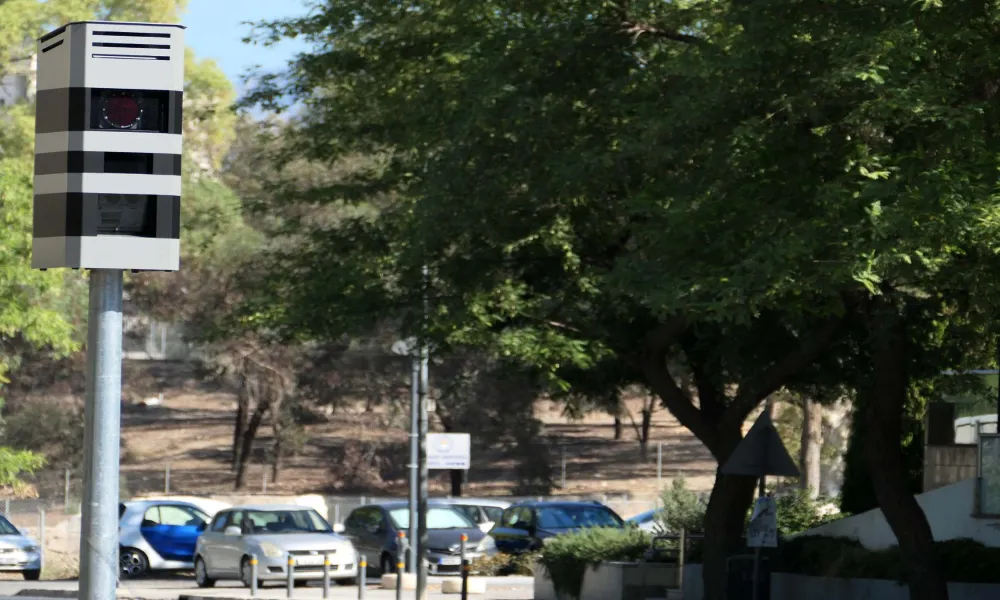

The case of the roughly 320,000 unserved traffic-camera fines is not simply another technical or bureaucratic problem. It exposes a deeper dysfunction in the way the state understands its responsibilities towards citizens.
The situation reflects extraordinary audacity. State services delay action for months or even years, yet when they finally move, they expect citizens to immediately and fully bear the consequences of that very inertia.
No one can seriously argue that violations of the Highway Code should go unpunished. Speeding, running red lights and using a mobile phone while driving put lives at risk. A modern traffic-camera system can make a significant contribution to road safety, provided it operates with transparency, speed, consistency and equal treatment.
The problem, therefore, is not that the state wants to collect fines. The problem is that it is attempting to transfer the cost of a system it failed to organise properly onto citizens.
What does the delay undermine?
A penalty serves a purpose only when it is reasonably linked in time to the offence that triggered it.
A driver informed of a violation a few days later can recognise the mistake and change their behaviour. When the fine arrives two or three years later, however, the deterrent effect is almost entirely lost.
The citizen may not even remember the incident, the circumstances surrounding it or who was using the vehicle at the time. More importantly, they were never given the opportunity to know that their driving behaviour had repeatedly been recorded as unlawful and to correct it in a timely manner.
This becomes particularly significant when multiple fines are delivered at once. A driver may learn in a single day that they committed ten or more violations during 2023 and 2024.
Alongside the substantial financial burden, they may also face the accumulation of penalty points, potentially leading to the suspension of their driving licence.
That consequence is far from trivial. For someone who relies on a car for work, transporting children or caring for elderly relatives, losing a licence can disrupt every aspect of daily life.
The crucial question is whether it is fair for a citizen to suffer such severe cumulative consequences today because the state failed to notify them promptly.
Two classes of citizens
The failure of the notification process has effectively created two categories of drivers.
The first consists of those who received their fines, paid them on time and were aware of the penalty points accumulated against them.
The second includes those who, for justified or unjustified reasons, never received the relevant notices and are only being informed years later about the entirety of their outstanding violations.
There are undoubtedly cases where individuals may have deliberately avoided receiving registered mail. But this cannot reasonably explain 320,000 outstanding fines.
The figure is simply too large to be attributed solely to bad faith on the part of recipients. It points instead to an institutional and organisational failure.
The state itself acknowledges that service by post did not function effectively, that there was no reliable alternative notification method, and that the necessary legislative changes were not introduced in time.
It cannot now behave as though the delay is exclusively the recipient's responsibility.
The principle of equality is not satisfied merely by imposing the same fine for the same offence. It also requires that consequences be imposed within a common, predictable and fair timeframe.
Otherwise, the effectiveness of punishment depends not on the driver's behaviour, but on whether the postal service, the contractor or the relevant government department happened to function properly.
The crossing points... really?
The police decision to serve fines at the crossing points may, in their view, be legally permissible.
Legality, however, is not the only consideration. Political judgement, proportionality and respect for citizens matter as well.
The crossing points are not ordinary police stations or routine traffic checkpoints. They carry unique political and social significance and serve thousands of people every day.
Turning them into locations for the mass service of old fines creates delays, tensions and the impression that the state is using a border-control procedure to compensate for its own administrative backlog.
Even if the practice is technically lawful — and many legal experts dispute this — it is still reasonable to question whether it is institutionally appropriate and politically prudent.
The state should not be correcting one failure by creating another problem at such a sensitive location.
The strong public reaction should not be dismissed simply as unwillingness to pay or a lack of respect for police.
When someone suddenly discovers, while crossing into the occupied areas, that they owe hundreds of euros for years-old offences and may lose their licence, frustration is almost inevitable.
That does not justify abusive or aggressive behaviour, but it does demonstrate how poorly the entire process has been designed.
Not a solution
The argument that affected individuals can simply go to court, present mitigating circumstances and ask not to lose their licences is not a genuine administrative solution.
It effectively amounts to the state acknowledging the problem while requiring every individual citizen to solve it alone through time-consuming and costly legal proceedings.
The courts are already overloaded. They should not become the mechanism through which a mass administrative failure is corrected, particularly when hundreds of thousands of cases are involved.
The state should establish a clear and uniform approach for cases where delays were not the fault of the citizen.
Options might include paying fines in instalments, reviewing penalty points accumulated without timely notification, and distinguishing between those who deliberately avoided service and those who were never properly informed through no fault of their own.
The goal is not to erase all offences. It is to restore proportionality.
Political responsibility
The operating company, the police, the postal service, the Transport Ministry, the Justice Ministry and the Law Office may each have separate responsibilities.
For citizens, however, they all represent the state.
It is therefore not enough for each service to explain which part of the process fell outside its remit.
The system was launched without ensuring that offenders would be notified promptly. Warnings about deficiencies in the service process did not lead to timely corrective action. Legislation introducing electronic notifications and alternative methods of service is only arriving after a backlog of hundreds of thousands of cases has already accumulated.
That is a political failure, not merely a technical malfunction.
Parliament and the government must now decide whether they will focus solely on accelerating the service of fines or whether they will also address the injustice created by the delays.
Delivering 320,000 fines more quickly may reduce the administrative backlog, but it does not automatically restore public trust.
A state governed by the rule of law is judged not only by whether it enforces laws, but also by whether it accepts responsibility when its own mechanisms fail.
It cannot demand consistency from citizens while taking two or three years to notify them of alleged offences.
Nor can its administrative incompetence be transformed, years later, into financial and professional punishment for thousands of people.
When the state fails to respect citizens' time, rights and daily lives, it should not be surprised when distrust and resentment become mutual.