


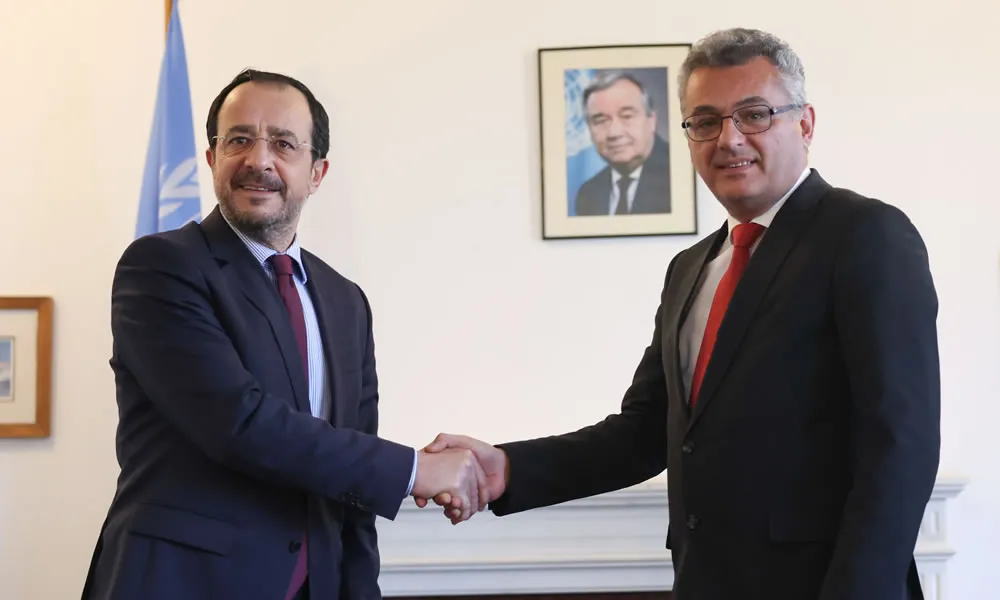
If what the President of the Republic hinted at reflects reality, then the Cyprus issue may be facing a development of weighty political significance, perhaps the most important in years. The reference to a potential "Guterres plan" to be submitted before the end of the year, allegedly with Turkish consent at the Erdogan level, is not a simple political stance. If true, it suggests either that a behind-the-scenes process is underway that is much more advanced than what has been publicly presented, or that Nicosia is attempting to create political momentum through an optimistic reading of international contacts.
The Plan
The first and obvious question is what exactly a "Guterres plan" means. The UN does not usually operate in terms of unilaterally imposing solutions. The precedent of the Annan Plan in 2004 has left a deep imprint, not only on the Cypriot political scene but also on international diplomacy surrounding the Cyprus issue itself. A Secretary-General can table ideas, a framework, bridges, or parameters, but cannot impose a political formula without prior substantive convergence between the sides. Therefore, if António Guterres is indeed preparing an initiative, it would mean he believes there is a minimum of common ground on which to move.
Here, however, arises the fundamental contradiction. What is this common ground? The Turkish and Turkish Cypriot position remains publicly oriented toward a two-state solution or, at least, the recognition of "sovereign equality" as a prerequisite for returning to meaningful talks. On the other hand, the Greek Cypriot side continues to declare commitment to a bizonal, bicommunal federation within the framework of UN resolutions. Unless there has been a shift in one of these two positions, it is difficult to explain how a solution plan could be maturing.
Unless, of course, the United Nations believes that discussion has taken place through Maria Angela Holguín's meetings with the two leaders, but mainly through Ms. Holguín's continuous political brainstorming sessions with civil society members, youth, and technocrats. In the latest meeting with a group of G/C and T/C Cyprus issue technocrats in Paphos, an in-depth discussion took place, and several approaches were even submitted that could lead to the preparation of a final plan on the Cyprus issue. Members of the negotiating teams of both President Christodoulides and T/C leader Tufan Erhürman took part in this meeting. At the center of this brainstorming was a possible solution to the Cyprus issue through a phased process.
Erdogan
The reference to a Guterres-Erdogan meeting is also pivotal. If the Turkish President indeed gave some sort of "green light," does this automatically mean that Ankara is abandoning its long-standing positions? It could, of course, mean something much more complex:
a) That Turkey is willing to return to a process, but under new terms,
b) That it is seeking broader geopolitical trade-offs within the framework of a package deal involving the Syrian, Kurdish, and energy issues, etc.,
c) That it aims to appear constructive to the international community without having altered the substance of its demands.
The Alternative Reading
There is also another reading. Nicosia may be attempting to present the mobility as greater than it actually is to reinforce the image that "something is moving." This would not be unprecedented. On the contrary, it is a core component of Christodoulides' communication policy—the narrative that under his watch, highly significant developments are constantly occurring "for the first time."
In the Cyprus issue, managing expectations has begun to form part of the political strategy, with individuals from his inner circle spreading word that these optimistic statements practically strengthen the President himself ahead of the 2028 Presidential elections, as well as DISY, with whom he will attempt to align after the parliamentary elections. There is, of course, a huge problem here: when expectations are built without clear content, the disappointment that follows is politically costly.
The critical question is what kind of initiative the UN could submit. A new comprehensive solution proposal? An updated framework based on the 2017 Guterres Framework? A roadmap for a gradual resumption of talks that will serve as a legacy for Mr. Guterres' successor when he steps down this coming December? Or a hybrid model that will attempt to bridge the gap without naming the final form of the solution from the outset? Each of these versions carries different political consequences.
A Full Plan?
If it is a full plan, political tension will be inevitable. A debate will immediately open regarding the content, compromises, guarantees, security, the territorial aspect, the property issue, and the form of the state structure. The President will also be asked whether he was informed in advance, whether he has negotiated away from the public eye, and whether he has accepted tight timetables and arbitration. If it is a procedural framework, then it is likely more of an effort to rescue the negotiation process rather than a real solution plan.
In any case, the essence is not whether a "Guterres plan" exists as a title. The essence is whether something fundamental has changed in the positions of those involved. Because without such a shift, no plan—no matter how strong its international seal—can stand on solid ground.
If, then, the President's statement is not merely a communication tool to express political optimism, the question is not just what Guterres is preparing. It is what has been agreed upon, by whom, and on what basis, without yet being said publicly. It would be good for the President to inform us about all of the above.