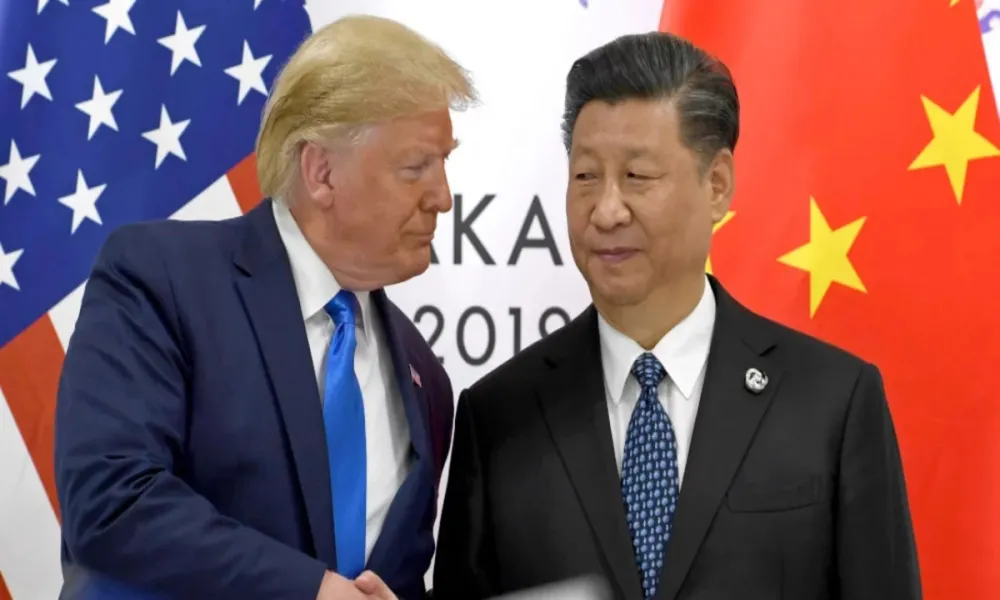

Xi Jinping was making a larger point: that the relationship between America and China has become the most consequential bilateral relationship in the world, with implications extending far beyond Washington and Beijing. Trade, security, technology and the future shape of global order all depend, to a remarkable degree, on how the two powers manage their rivalry.
That is why Mr Xi’s reference to the “Thucydides Trap” was so striking. The phrase is often casually attributed to the ancient Greek historian himself. In fact, it comes from Graham Allison of Harvard, who used it to describe the danger that arises when a rising power challenges an established one. Examining 16 such cases since the 15th century, Mr Allison found that 12 ended in war. His argument was not that conflict is preordained, but that shifts in the balance of power make fear, pride and strategic miscalculation far more potent.
Mr Xi’s warning, then, was not a scholarly flourish. It was a political signal. China does not wish its contest with America to be framed as a rivalry destined to culminate in conflict. That concern is well founded. Once strategic competition is understood in zero-sum terms, both sides begin to act as though confrontation were simply a matter of time. The expectation of conflict can itself become one of its causes.
There is no shortage of issues on which such a dynamic might take hold. America and China are already competing in trade, advanced technology, military reach and geopolitical influence. They remain at odds over Taiwan, the South China Sea and the broader balance of power in the Pacific. Yet rivalry alone does not capture the full danger of the present moment. The deeper question is whether either country is prepared to uphold the international order within which that rivalry is now unfolding.
Here another concept deserves equal attention: the “Kindleberger Trap”. Named after Charles Kindleberger, the economist and one of the architects of the Marshall Plan, it points to a different source of instability. Order depends not merely on the distribution of power, but on the existence of a state both willing and able to provide public goods: security, open markets and a predictable framework for international exchange. Trouble begins when the old hegemon can no longer sustain the system and the rising power cannot, or will not, take its place.
That may, in fact, describe the present predicament more accurately than the Thucydides Trap. China is becoming stronger, richer and more technologically capable, but it is not yet a trusted provider of international public goods. Its political model invites caution abroad; its growing power, suspicion. America, meanwhile, still possesses the alliances, institutions and reach required to underpin the order it built after 1945. Yet under Mr Trump it has often seemed less interested in maintaining that order than in unsettling it. Alliances are treated transactionally, trade as a ledger of grievances, and leadership as an optional burden.
The danger, then, is twofold. China is not yet in a position to stabilise the system; America no longer seems consistently willing to do so. One cannot confidently lead; the other no longer reliably wishes to. That leaves a vacuum in which rivalry becomes harder to contain and disorder easier to spread.
In the end, the gravest danger may not be war alone, but neglect: a world in which the old power no longer leads and the new one cannot. As a result, the contest between them may matter less than the decay around it.