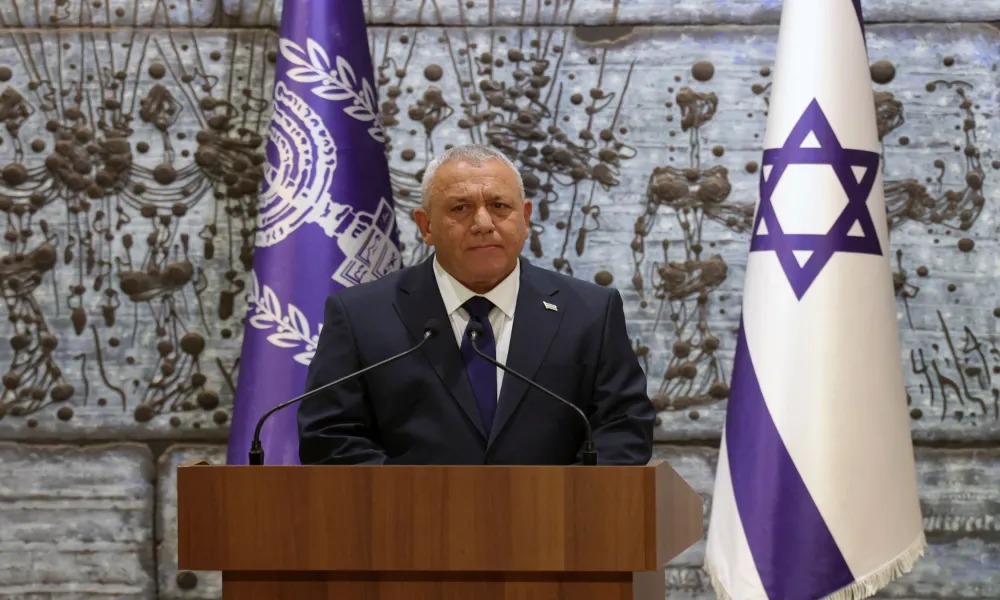

Gadi Eisenkot on Sunday received a mandate from Israeli President Isaac Herzog to form a government after securing the recommendations of 67 of the Knesset's 120 members, compared with 46 for outgoing Prime Minister Benjamin Netanyahu.
The majority exists largely on paper, however.
The 66-year-old former military chief and leader of the Yashar party has 28 days, with the possibility of a 14-day extension, to translate those recommendations into a governing coalition. Both Eisenkot and Netanyahu are now publicly speaking about national unity.
The Knesset arithmetic
In the 27 October election, Likud emerged as the largest party with 27 seats and 20.5% of the vote, compared with 21 seats for Yashar.
Parties belonging to Netanyahu's outgoing coalition won 53 seats, while the four parties aligned with Eisenkot secured 48 seats:
- Yashar
- Naftali Bennett's Together alliance (12 seats)
- The Democrats (8 seats)
- Avigdor Lieberman's Yisrael Beiteinu (7 seats)
A minimum of 61 seats is required to form a government.
The gap between Eisenkot's 48 seats and the 67 recommendations was bridged by two Arab parties: the Joint List with 11 seats and Ra'am with 8.
Both recommended Eisenkot for the mandate, but neither committed to joining his government or supporting it in office. An Arab party has participated in an Israeli governing coalition only once, and some of Eisenkot's allies reject such cooperation outright.
Reaching out to Likud
During the mandate ceremony, Eisenkot said Israel faces a national emergency and argued that a government of national necessity requires "creative and unconventional political moves".
He invited Likud and Religious Zionism, led by Finance Minister Bezalel Smotrich, to join a government under his premiership, provided they accept his leadership and four guiding principles.
These are:
- Recognition of Israel as a Jewish and democratic state.
- Acceptance of the Declaration of Independence.
- Mandatory military or national service for all citizens.
- Recognition of Hamas as a terrorist organisation and commitment to eliminating its military and governing capabilities.
The move marks a shift from Yashar's earlier position that Likud should first sever ties with extremist political forces.
Eisenkot also blamed Netanyahu for what he described as Israel's deteriorating international standing, referring to a "disastrous diplomatic crisis" in which even close allies are questioning their relationship with the country.
Lieberman and the ultra-Orthodox parties
Eisenkot met Lieberman yesterday and, according to a Yashar statement, both men expressed confidence that a stable government capable of serving a full four-year term could be formed.
Their differences remain significant, however.
Lieberman has ruled out both a minority government dependent on Arab parties and a unity government with Netanyahu, while leaving the door open to talks with the ultra-Orthodox parties.
Together, Shas and United Torah Judaism, which hold 13 seats, would bring Eisenkot's bloc to exactly 61 seats.
That option clashes with one of Eisenkot's core principles: mandatory national service. Ultra-Orthodox parties oppose ending military exemptions for members of their communities.
Israeli media have nevertheless reported signs that these parties may be distancing themselves from Netanyahu.
Netanyahu's counteroffensive
The outgoing prime minister responded with two video messages.
In the first, issued on Saturday shortly before Herzog's announcement, Netanyahu called for a national unity government including all members of his current bloc and warned against any government relying on Arab parties, which he described as supporters of terrorism.
Yashar dismissed the message as hysterical and accused him of hypocrisy.
In a second message yesterday, Netanyahu said he was ready to begin talks with any party interested in discussing a unity government.
He clarified that he meant all Zionist parties together with the ultra-Orthodox parties.
He made no reference to a rotating premiership, arguing instead that the leader of the government should come from the largest party and noting that Likud won, according to his figures, 250,000 more votes than the next-largest party.
If Eisenkot fails to form a government, the mandate could be handed to another member of parliament, most likely Netanyahu.
Should no majority emerge then either, Israel could be heading for another election.
Until a new government wins a vote of confidence, Netanyahu remains prime minister.