
President Donald Trump has stepped back, at least for now, from ordering US airstrikes against Houthi targets in Yemen, reversing a decision made just days earlier under pressure from Saudi Arabia. The reversal came on Sunday, according to administration officials, hours after commanders had approved target lists and munitions had already been loaded onto US warplanes for what officials described as an imminent wave of attacks.
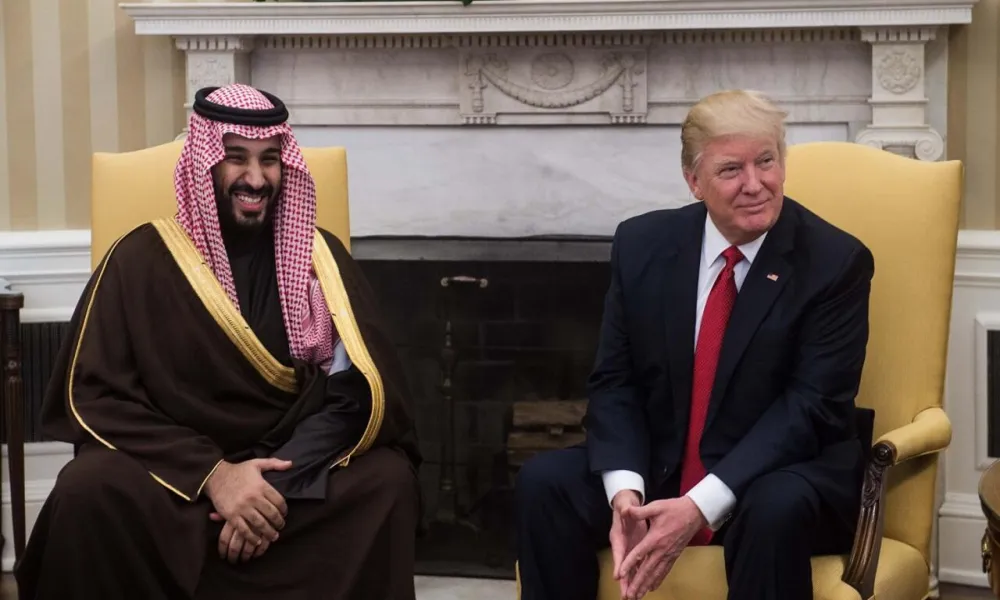
The decision caps two weeks of deliberation inside the White House over whether to answer repeated appeals from Riyadh for military help against the Iran-backed Houthis, who reignited their war with Saudi Arabia this summer after taking advantage of instability spreading across the Middle East. Crown Prince Mohammed bin Salman, the kingdom's de facto leader and a key partner in Washington's war against Iran, telephoned Trump on Thursday to press the case directly, according to officials cited by The New York Times. Trump had told advisers just a day earlier that he did not favour strikes, but reversed course after the call and instructed the Pentagon to prepare for action. By Sunday, he had reversed himself again.
A Saudi ally Washington cannot afford to lose
The dilemma facing Trump reflects Washington's dependence on Saudi cooperation at a moment when the United States is already stretched by its war against Iran. Saudi Arabia has shown its willingness to use what leverage it has when Washington does not move quickly enough. In May, the kingdom effectively blocked a Trump administration plan to use the US military to escort commercial oil tankers through the Strait of Hormuz, refusing to grant American forces use of its airspace and air bases.
The Houthis, for their part, have largely avoided targeting US shipping even as they have escalated attacks on Saudi vessels and declared a blockade on Saudi shipping in the Red Sea. The group has also seized territory near the Bab al Mandab Strait, a critical choke point for global shipping, raising fears of further disruption to energy markets already unsettled by the war with Iran. Speaking to Fox News on Sunday, Trump said he remained in "deciding mode" on the broader conflict with Iran and noted that the Houthis had so far honoured an agreement not to attack US forces.
Inner circle divided, ground option seen as weak
According to a senior administration official cited by the Times, most of Trump's inner circle was either sceptical of or outright opposed to joining the Saudi campaign, citing the strain the Iran war has already placed on US forces in the region. Any American intervention would likely have been carried out alongside a planned ground offensive by Yemeni government troops, but those forces have proven ineffective against the Houthis in recent fighting. Gregory Johnsen, a nonresident fellow at the Arab Gulf States Institute in Washington, told the Times that the anti-Houthi coalition amounted to little more than "a Frankenstein of all the leftover parts in Yemen" that are not the Houthis themselves, noting that the disparate factions often fight each other more than their common enemy.
The Houthis have been at war with Yemen's internationally recognised, Saudi-backed government since 2014. A truce reached in 2022 held for several years before the group's renewed offensive this summer. A White House spokesperson declined to discuss the president's deliberations on the record, saying only that the United States "has a defence agreement with Saudi Arabia and we will always defend our allies."
A costly precedent from last year's campaign
Washington has been here before. In the spring of 2025, the US military struck the Houthis for more than fifty days in an effort to restore freedom of navigation through the Red Sea, with the US Central Command hitting more than 1,000 targets, including radar systems, air defences, ballistic missile sites and drone production facilities. The campaign burned through roughly 1 billion dollars in munitions in its first month alone, and two 67 million dollar F/A 18 Super Hornets were lost overboard from a US carrier during operations. Trump ended that campaign abruptly less than two months in, announcing a ceasefire after the Houthis, in his words, "gave us their word that they wouldn't be shooting at ships anymore."
Officials familiar with the group's current capabilities say the Houthis have used the intervening period to rebuild, and are now reportedly using artificial intelligence to help develop new missile systems. Current and former US diplomats and military commanders who have served in the region remain sceptical that a renewed, limited bombing campaign would succeed where the last one did not, particularly given how long the group withstood sustained US bombardment in 2025.
Source: The New York Times