
The official death toll from the two devastating earthquakes that struck Venezuela on June 24 has risen to 1,943, while survivors face severe shortages of food and shelter and an increased risk of disease outbreaks, the United Nations warned on Tuesday.
The previous official toll stood at 1,719 dead.
The earthquakes, measuring 7.2 and 7.5 magnitude, the strongest to hit the South American country in more than a century, left around 10,500 people injured, according to National Assembly President Jorge Rodríguez.
Rodríguez said that approximately 30,000 people were in the port city of La Guaira, the area worst affected by the disaster, when the earthquakes struck.
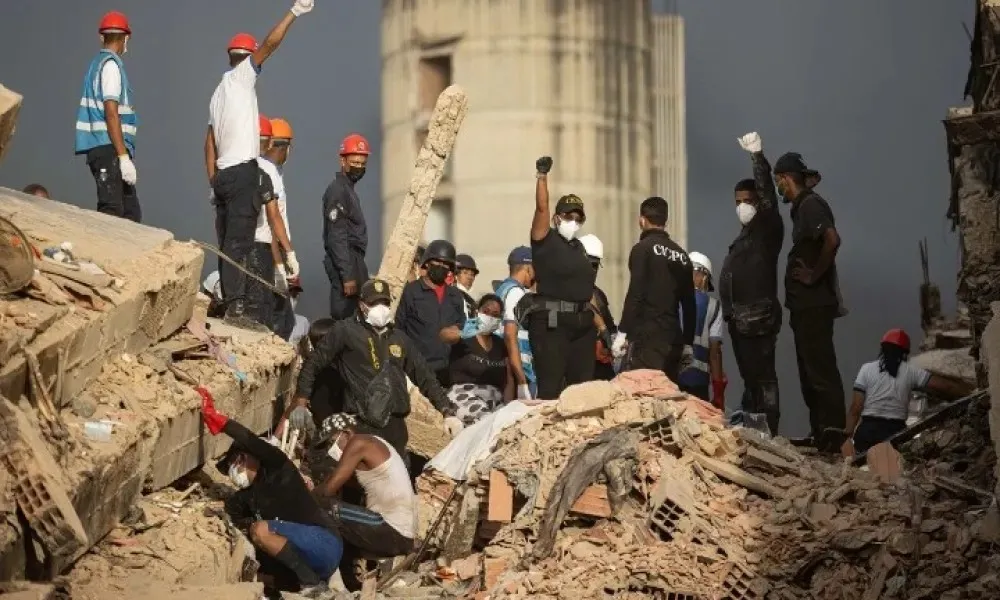
Since then, 6,461 people have been rescued, while tens of thousands remain missing. The United Nations estimates the number of missing at around 50,000.
Although the critical 72-hour window during which survivors are most commonly found has passed, experts say there remains a small possibility that people could still be discovered alive beneath the rubble.
On Tuesday, a team of Jordanian rescuers pulled a three-year-old child alive from collapsed buildings in Caracas, offering a rare glimmer of hope to rescue workers.
Across numerous disaster-stricken areas, buildings either collapsed or suffered extensive damage. Based on satellite imagery, NASA estimates that approximately 58,870 buildings were damaged or destroyed, while key infrastructure also sustained severe impacts.
In La Guaira state, the area hardest hit by the disaster, “food shortages are widespread, essential services have collapsed and communications remain largely disrupted,” the UN High Commissioner for Refugees (UNHCR) said.
“Tensions among the population are increasing as access to assistance remains limited,” the agency added.
The World Food Programme has appealed for $50 million to provide food assistance to approximately 500,000 people over the next three months.
“The earthquakes affected many families, some of whom were already struggling to access basic food supplies. With their livelihoods destroyed and infrastructure badly damaged, many now face an even deeper slide into vulnerability,” said Stephanie Hochstetter, the agency’s director in Venezuela.
According to the UN, 7.9 million people in Venezuela were already in need of humanitarian assistance at the beginning of 2026.
The World Health Organization (WHO) has also voiced concern over the potential spread of disease, warning that systems for recording missing persons and victims remain inadequate.
Damage to healthcare facilities and water and sanitation networks, combined with large-scale population displacement, could increase the risk of outbreaks of “vaccine-preventable diseases such as measles, diphtheria and whooping cough,” WHO spokesperson Christian Lindmeier told a press briefing in Geneva.
UNHCR estimates it requires around $15 million, primarily to provide temporary shelter to approximately 30,000 people over the next six months.
The United States government has announced that it is doubling its assistance to Venezuela to $300 million, with funds to be channelled through NGOs and UN agencies.
An improvised morgue has been established on the waterfront in La Guaira, as casualties and bodies continue to arrive at hospitals already overwhelmed by the scale of the disaster.
According to the WHO, citing the country’s interim president, 38 hospitals have been damaged, three of them severely.
The international community has mobilised extensively in response to the tragedy. According to UN coordinator for Venezuela Gianluca Rabola del Tindaro, 27 countries have deployed more than 40 rescue teams, with over 2,000 rescue workers and more than 160 specially trained search dogs currently operating in the field.