


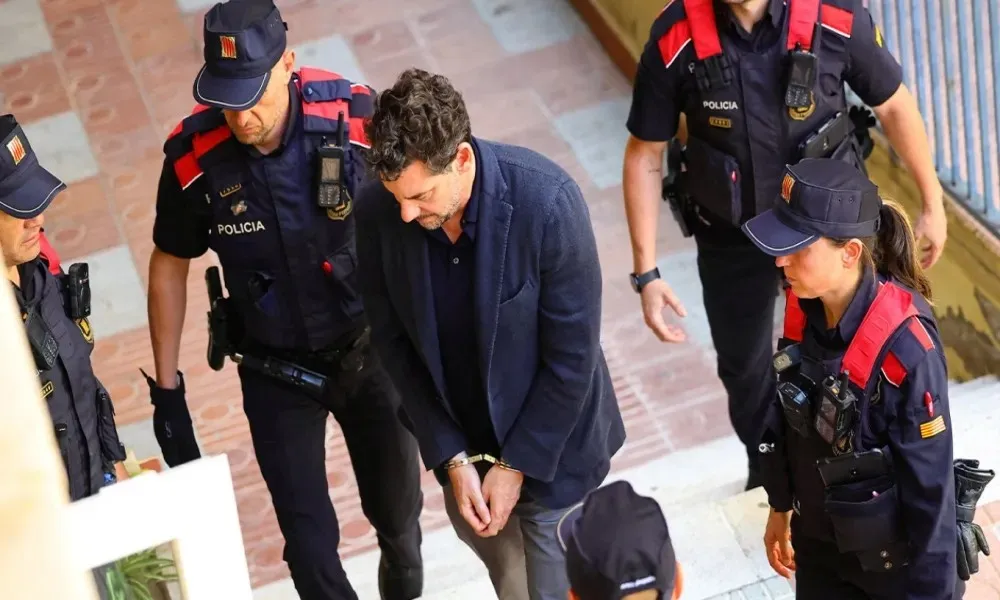
Around 18 months after the death of Isak Andic, the billionaire founder of the clothing brand Mango, authorities proceeded with the arrest of his son Jonathan, accusing him of having planned his father’s death.
Although Jonathan Andic paid €1 million bail and has been released pending trial, Spanish media report a large volume of evidence pointing towards his alleged involvement.
Among other elements, Andic’s son had visited Montserrat, the mountainous area outside Barcelona where his father died, three times prior to the fatal day.
Authorities were also drawn to a mobile phone that disappeared under mysterious circumstances, as well as a change in the will. Even more significant were the circumstances under which Isak Andic died.
Contradictions in testimony
El País highlights seven key pieces of evidence on which authorities have focused.
The first concerns contradictions between two statements Jonathan Andic gave to Catalan police, initially on 14 December 2025 (the day of the death) and later on 31 December.
At first, he said he was walking four to five metres ahead of his 71‑year‑old father when the latter stopped to take some photos with his phone. He claimed he did not have the phone within his field of vision at that moment and, while continuing to walk, heard stones falling. He turned and saw “a body rolling among the bushes.” He then heard a loud thud and a groan of pain from his father.
In his second statement, however, he claimed he saw his father using his phone only at the beginning of the hike.
Analysis of Isak Andic’s phone confirmed that only one video and one photograph were recorded at the start of the hike and that it was not used again. The autopsy also confirmed that he had the phone in his pocket when he fell. “It is unlikely that, if they were walking together, he did not see him fall,” the detention order states.
Another key point is whether Jonathan Andic had previously made the trip to Montserrat.
In his testimony, he stated he had gone there about two weeks earlier. However, other evidence showed he had been at Montserrat three times earlier in the same week (7, 8 and 10 December). This has led Catalan police to suspect premeditation.
The mark from the fall
Technical details from the fall, as highlighted by the autopsy, suggest the incident may not have been accidental.
Police technical reports indicate a “rounded sliding mark” at the scene, which they believe would require friction with the soles of the victim’s shoes “at least four times in both directions (back and forth)” to create such an imprint.
What does this mean? Officers believe it must have been done deliberately, applying pressure to the ground, rather than occurring accidentally.
The path itself presented no difficulty and did not require special footwear (such as hiking boots). A fall from that point is nevertheless possible. However, authorities maintain that the son “would undoubtedly have been able to see the fall” given the visibility and the short distance between them.
Jonathan Andic’s account of the fall contains contradictions across his different statements.
In his first call to emergency services, he said he believed his father had fallen into a ravine. In a subsequent call, he stated he was walking ahead when he “suddenly heard rocks falling and, when he turned, saw him screaming and falling.” To police, he said he was “walking ahead” and saw “the body rolling into the bushes” and heard a loud thud and a groan of pain.
The phone change and its “loss”
Authorities also note a suspicious change of phone by Jonathan Andic on 25 March 2025, months after the incident.
He had an iPhone 14, which he replaced with a 16 Pro, “erasing its contents” before subsequently losing it under “strange circumstances,” when it was allegedly stolen during “a short trip” to Quito, Ecuador.
“The dates of the disappearance of the old device coincide with information reported by the media regarding the reopening of the judicial case,” the decision states.
Autopsy findings
The autopsy indicated that the fall was “as if he had fallen headfirst down a slide, feet first.”
“There are no injuries to the palms of his hands, ruling out slipping on a rock or falling forward,” authorities note.
Father and son in conflict
Finally, authorities focus on the relationship between father and son. Despite Jonathan Andic’s claims of a good relationship, “analysis of WhatsApp messages proves otherwise.”
The main cause of the strained relationship is described as the son’s “obsession with money, to the point of asking his father for inheritance while he was still alive.” Isak Andic, it is claimed, “felt compelled to accept in order to maintain a relationship with his son.” The decision notes that this was influenced by a psychologist who was treating him.
It is also stated that the son learned “in mid‑2024” of his father’s intention “to change his will and establish a foundation to help people in need.” At that point, “a noticeable change” occurred in the son’s behaviour, as he “sought reconciliation and acknowledged that his approach to money was not appropriate.”
The father, it is added, in “an effort to reconcile with his son, accepted the trip” to Montserrat proposed by him “so that they could talk privately.”
The judge now considers there are sufficient indications pointing to Jonathan Andic’s possible “active and premeditated involvement” in his father’s death. Authorities highlight the “poor relationship” between the two, the “existence of a possible financial motive,” the “preliminary planning and study” of the location, and the “attempt to create a specific set of conditions that were as discreet as possible.”