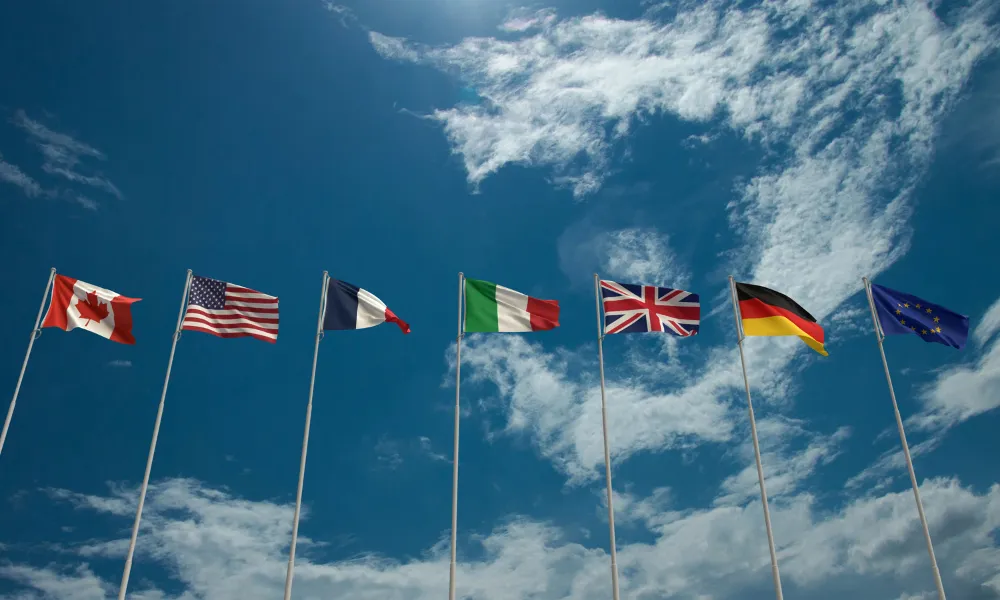

Finance ministers from the Group of Seven leading industrialised nations are meeting in Paris as governments seek a coordinated response to rising economic tensions, global imbalances and renewed volatility in bond markets. The talks, which also include central bank governors from G7 countries, come as investors continue to sell government bonds from Tokyo to New York amid concerns that higher energy prices linked to the war in Iran could fuel inflation and force central banks to raise interest rates.
French Finance Minister Roland Lescure, who is hosting the meeting, played down suggestions that bond markets were in freefall.
“They are undergoing a correction. I would not say they are collapsing,” he told reporters as he arrived for the talks. “We are no longer in a period in which public debt is not an issue.”
According to the French Finance Ministry, the meeting will focus on how countries can coordinate their response to shocks such as inflation through measures that are temporary, targeted and reversible. Asked on arrival whether she was concerned by the bond sell-off, European Central Bank President Christine Lagarde replied: “I am always concerned. That is my job.”
The Paris meeting comes ahead of the G7 leaders’ summit, which will be held in Évian from 15 to 17 June under France’s presidency. France’s official G7 calendar lists the 18-19 May Paris meeting as a gathering of finance ministers and central bank governors.
Global imbalances on the agenda
Lescure said the talks would also address what he described as deep global economic imbalances that are fuelling trade tensions and raising the risk of disruption in financial markets.
“The way the global economy has developed over the past 10 years or so is clearly not sustainable,” he said, pointing to a pattern in which China consumes too little, the United States consumes too much and Europe invests too little.
The French minister said the G7 offers an opportunity for frank discussions among allies at a time of widening differences with Washington.
“These discussions are not easy. I am not going to tell you that we agree on everything, including of course, first and foremost, with our American friends,” Lescure said ahead of the meeting.
The two-day gathering follows the recent meeting in Beijing between US President Donald Trump and Chinese President Xi Jinping, which produced few tangible economic breakthroughs.
Ministers are expected to seek an update on US-China relations, as well as on Washington’s latest efforts to reopen the Strait of Hormuz. US Treasury Secretary Scott Bessent said the China trip had been “very successful” and added that he would encourage G7 countries to adopt sanctions targeting Iran’s “war machine”. Reuters also reported that Bessent intends to press G7 partners to support sanctions aimed at restricting financial flows to Iran.
Critical minerals and rare earths
Another priority will be critical minerals and rare earths, as G7 governments look to reduce dependence on China, which dominates supply chains vital for electric vehicles, renewable energy and defence systems.
Lescure said the G7 would push for stronger coordination to monitor markets, anticipate disruptions and develop alternative sources of supply, including through joint projects with allied economies. The goal, he said, is to ensure that “no country can ever again have a monopoly” over such materials.
Source: CNA