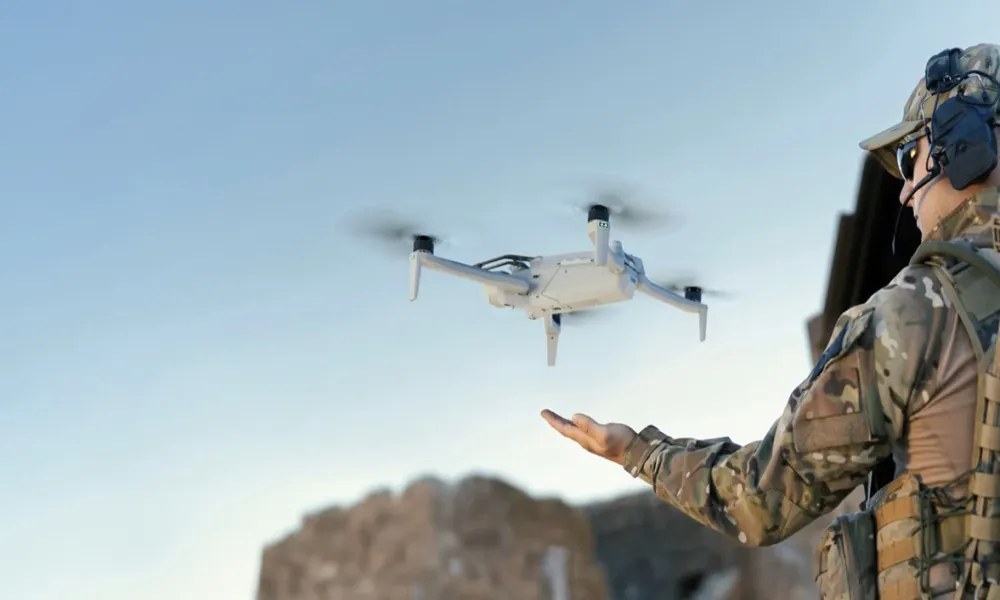

Federal and local officials in the United States are racing to strengthen protection against possible drone threats at World Cup venues, as security teams prepare for millions of fans and dozens of matches across the country.
Preparations have been complicated by shortages of equipment used to detect and counter drones, delays linked to a prolonged Department of Homeland Security shutdown and uncertainty over how newly expanded counter-drone powers should be applied.
Security officials are concerned about a wide range of potential incidents, from drones interrupting matches to more serious threats against crowded venues and fan areas. The issue has become more urgent with the first US match scheduled for June 12 in Inglewood, California, where the United States will face Paraguay.
Secret Service Director Sean Curran told lawmakers in April that his agency was facing difficulties acquiring counter-drone technology, citing supply chain problems. He said the agency had spent more than $100 million over the past 18 months to improve its capabilities and would rely on support from the Pentagon where necessary.
Homeland Security Secretary Markwayne Mullin has said the broader threat level is “extremely high”, particularly in areas outside stadiums. A Department of Homeland Security spokesperson said the agency was working with federal, state, local and international partners to protect players, fans and communities, and would respond to threats in real time.
New powers, limited time
For years, US counter-drone efforts have relied on a patchwork of agency-specific measures, while state and local authorities developed their own systems with limited powers to disable or intercept drones.
That changed in December with the Safer Skies Act, which expanded counter-drone authorities and requires the Department of Homeland Security and the Justice Department, in coordination with the Pentagon and the Transportation Department, to issue new rules for state and local law enforcement.
However, implementation is still under way. Officials and industry figures say some agencies are still trying to understand how the new rules will work in practice, even as they prepare to secure one of the world’s largest sporting events.
The FBI has also stepped up training at its drone centre in Huntsville, Alabama. FBI Director Kash Patel told lawmakers that 65 state police personnel had graduated from the programme, but demand remains high.
White House World Cup task force executive director Andrew Giuliani said counter-drone capabilities had become a major priority, with additional funding being directed towards reimbursement and security preparations. FEMA has also announced funding for World Cup host states and the Washington region.
Readiness varies by city
Local preparedness appears uneven. Curran said the Los Angeles area was “not ready for drone detection and mitigation”, although local officials have disputed that assessment.
Los Angeles Police Department Detective Michael Hackman, who leads the department’s counter-drone programme, said the LAPD was “highly prepared” and had already supported several operations with the FBI’s Los Angeles office.
While World Cup matches in the Los Angeles area will be played at SoFi Stadium in Inglewood, outside LAPD jurisdiction, the department will oversee security at FIFA Fan Fest and official fan zones nearby.
Hackman said public awareness was one of the main challenges, stressing that drone operators must understand and comply with restrictions during major events. He said the LAPD uses a layered system combining remote ID, radio-frequency detection, radar and cameras, supported by cyber and electronic countermeasures.
In Arlington, Texas, where AT&T Stadium will host nine matches, police have used drone-detection systems around the city’s Entertainment District for years. The department said it had recently received additional authority and was working to expand its ability to disable drones, but did not yet have the infrastructure to carry out mitigation operations independently.
Officials also warn that coordination will be critical, as federal, local and private-sector systems may all be operating around the same venues. Poorly coordinated counter-drone equipment can interfere with other systems and leave gaps in coverage.
With the tournament approaching, federal agencies, local police and industry partners are trying to align their plans before matches begin, amid concern that any drone-related incident could quickly trigger public blame and political scrutiny.
Source: politico