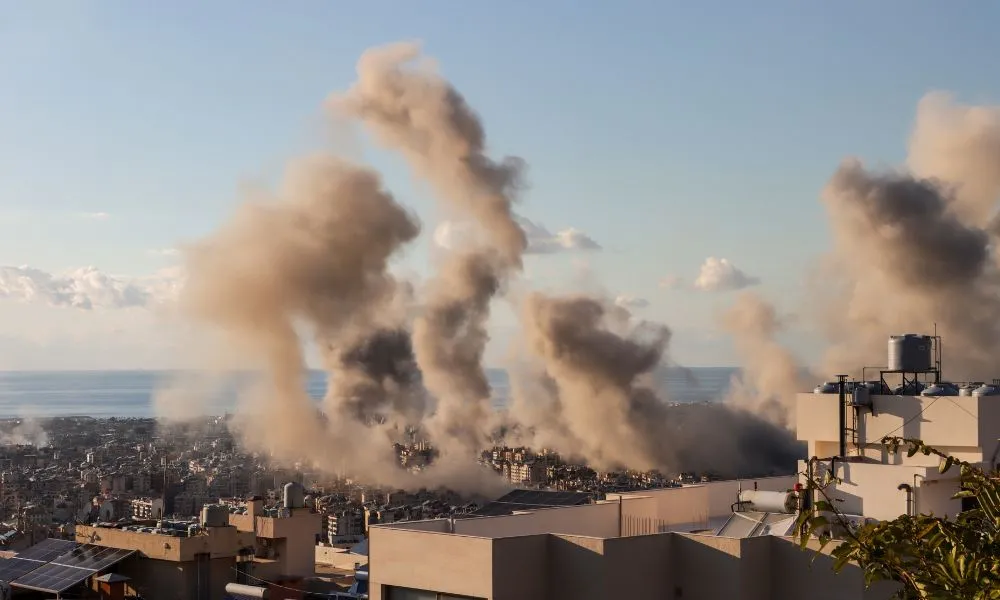

Israeli airstrikes in Lebanon on Sunday killed at least seven people, including a senior Palestinian militant leader, despite a renewed extension of a fragile ceasefire following talks in Washington, which were rejected by the Iran‑backed Hezbollah movement.
According to a preliminary toll from Lebanon’s Health Ministry, three people were killed in Tyre Felsai and two in Tyre Debba, including two children, one in each location. A further 15 people were injured in a series of strikes in the south.
In eastern Lebanon, an Israeli missile struck an apartment in the Baalbek area, killing Palestinian militant leader Wael Abdel Halim, an ally of Hezbollah, along with his 17‑year‑old daughter, according to the Lebanese state news agency ANI.
The Israeli army ordered the evacuation of several villages, some located dozens of kilometres from the border, following similar warnings issued for border communities a day earlier.
The United States announced on Friday, during the second day of talks between Israeli and Lebanese delegations in Washington, a new 45‑day extension of the ceasefire that had taken effect on 17 April and was due to expire on Sunday.
Hezbollah has rejected the negotiations, the first direct talks in decades between the two countries, which do not have diplomatic relations, particularly as they include demands for the group’s disarmament, something it has ruled out.
Israel, which occupies part of southern Lebanon, says it is “protecting Israeli communities” while facing an enemy that is trying to outmanoeuvre it, Prime Minister Benjamin Netanyahu said at the start of a cabinet meeting.
In recent weeks, Hezbollah has increasingly used FPV drones equipped with fibre‑optic systems, making them harder to counter through electronic warfare. “We are now facing the challenge of neutralising FPV drones,” Netanyahu said.
An Israeli army official also said Hezbollah launched around 200 projectiles against Israel or Israeli forces in Lebanon over the weekend. The group claimed responsibility for several attacks against Israeli military positions in the south.
A Hezbollah lawmaker, Hussein Hajj Hassan, criticised the Lebanese government, saying direct negotiations had led to “one concession after another” and arguing authorities are unable to meet Israel’s demand to disarm the group.
Lebanon has been drawn into the wider Middle East conflict since 2 March, when Hezbollah launched attacks against Israel following the killing of Iran’s Supreme Leader Ali Khamenei.
Since then, nearly 3,000 people have been killed and more than one million displaced, according to official data. Over 400 people have died in Israeli strikes since the ceasefire began, according to an AFP tally based on official figures.
In total, 21 Israelis—20 soldiers and one civilian contractor—have been killed since 2 March in the ongoing conflict.
Source: CNA