


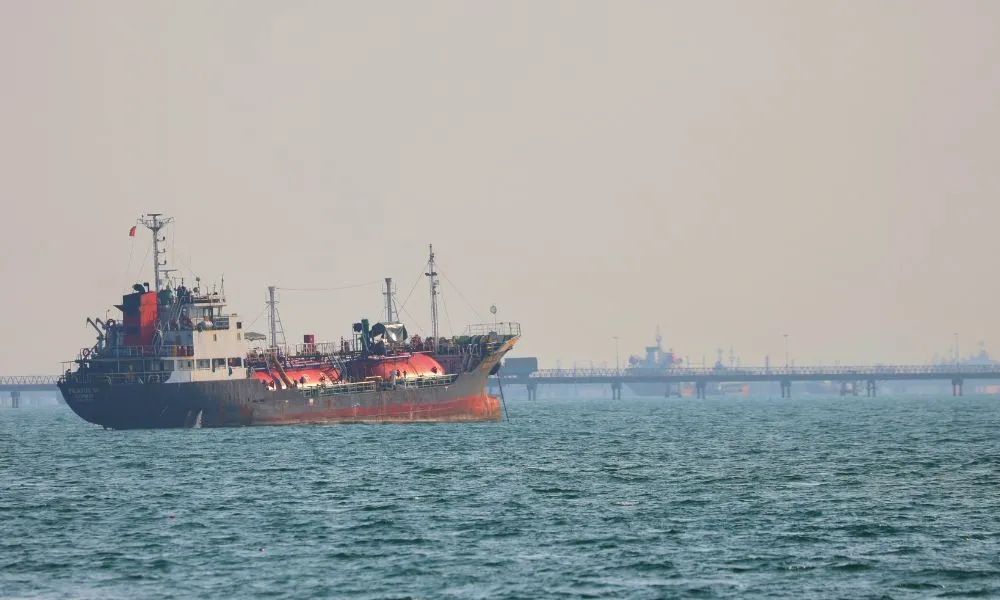
Tehran is now showing that it does not view the Strait of Hormuz solely as a critical oil passage but as a broader instrument of geopolitical power. Above the surface, Iran has demonstrated its ability to affect shipping and the flow of tankers. Beneath the surface, however, lies a second and less visible network: submarine fibre‑optic cables that carry data, banking transactions, cloud services, military communications and much of the global economy’s functionality.
According to Iranian statements and reports linked to the environment of the Revolutionary Guards, Tehran is considering imposing fees on telecommunications and technology companies for the use of cables passing through the Hormuz area. Companies such as Google, Microsoft, Meta and Amazon are among those highlighted, although it remains unclear exactly which cables pass through Iranian territorial waters and whether such a system could be implemented in practice without clashing with US sanctions.
Tehran’s message is clear: if Hormuz is vital for energy, it is equally critical for the flow of information. The importance of the Strait is no longer limited to oil and gas but extends into the core of the digital economy.
TeleGeography has noted that Hormuz is also an important passage for submarine cables. Networks such as AAE‑1, FALCON and Gulf Bridge International link the Gulf to India, Southeast Asia, Africa and Europe. At the same time, new projects in the region show efforts by states and companies to create alternative routes and greater resilience against potential risks.
Iran’s move does not necessarily mean an attack on cables is imminent. It does indicate, however, that Tehran is expanding the range of pressure it can exert. Until now, the primary threat concerned disruptions to oil flows. Now the threat is also shifting to data flows.
A serious disruption to submarine cables would not simply result in slower internet speeds. It could affect banking transactions, financial market flows, cloud services, energy networks, government communications and entire operational chains that function in real time.
Submarine cables form the backbone of the global internet. The vast majority of international data traffic passes through them rather than satellites, making them a foundation of the global economy but also a vulnerable target.
The experience of the Red Sea in 2024 demonstrated how easily disruption can occur. At that time, cables were damaged after a ship struck by the Houthis dragged its anchor along the seabed. HGC Global Communications reported that around 25% of data traffic in the region was affected. The incident showed that a major problem does not necessarily require a large‑scale military operation.
In narrow and relatively shallow passages such as Hormuz, cables can be threatened by anchors, drones, divers or small submarines. Even without a direct attack, limited access for repair crews during periods of tension can significantly prolong outages.
Repairing a submarine cable requires specialised vessels, a secure environment and time. In conditions of war or fragile ceasefire, all these factors become more difficult. The issue is not only potential damage but also uncertainty over the time needed for restoration.
Tehran is also attempting to provide a legal basis for its position. Iranian officials and pro‑Iranian media refer to the Law of the Sea and specifically to UNCLOS provisions on submarine cables. However, Iran has signed but not ratified UNCLOS and has historically adopted a more restrictive interpretation of transit rights through Hormuz.
The United States and Western governments view any restrictions or “tolls” as contrary to the principle of free navigation in international straits. Tehran, by contrast, cites sovereignty and security concerns.
The most likely scenario is not the formal imposition of “digital tolls” but a hybrid pressure model: threats, delays in repairs, uncertainty over permits and a constant reminder that Iran can increase the operational cost of the Gulf.
This threat is linked to Tehran’s broader strategy. The first lever was oil, the second shipping, and now the third is digital connectivity. All three converge in the same geographical point: Hormuz.
Some experts note that cables passing through Hormuz account for a relatively small share of global data capacity and that alternative routes exist. However, the Strait’s importance lies not only in volume but also in its geopolitical position.
Iran understands that at this narrow point converge energy, shipping, digital infrastructure and the strategic interests of the United States, China, Europe and Gulf states. This is why it is now turning its focus below the surface, where the threat may be harder to detect and potentially more destabilising.
The message from Tehran is not that it can “switch off" the global internet. It is that it can increase the cost of any geopolitical conflict by affecting not only energy and shipping but also the digital arteries of the global economy.