


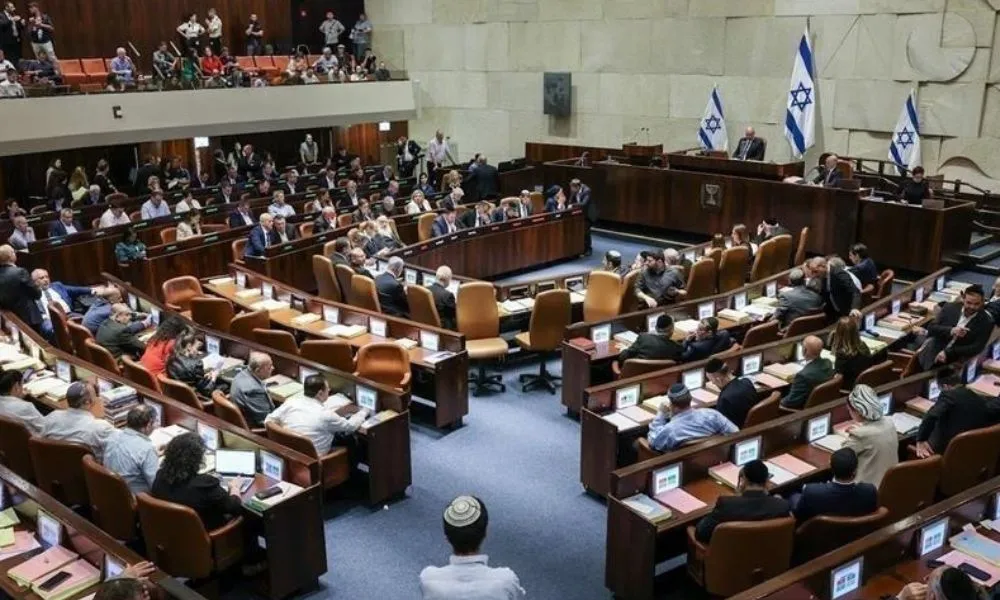
Israel’s parliament approved late on Monday a bill to establish a special military court that will try hundreds of Palestinian fighters who took part in Hamas’s attack on Israeli territory on 7 October 2023.
Israel responded with large‑scale military operations against the Palestinian enclave, which have killed more than 72,000 people, mainly civilians, and levelled much of Gaza.
Israel is estimated to be holding between 200 and 300 fighters arrested during the 7 October attack. Charges have yet to be formally brought against them.
Special legal framework and possible death sentences
The special military court, to be presided over by a panel of three judges and based in Jerusalem, may also try other Palestinian fighters arrested later in Gaza on suspicion of involvement in the 7 October attack or of having held or abused Israeli hostages.
The bill establishes a dedicated legal framework for prosecuting those accused of direct participation in the assault, including members of Hamas’s Nukhba special forces of the al‑Qassam Brigades, its armed wing. Charges expected to be brought range from terrorism and murder to sexual offences and genocide, carrying the possibility of the death penalty.
The legislation was approved by a large majority of 93 votes in the Knesset, reflecting rare cross‑party unity, while the remaining 27 lawmakers abstained or were absent.
Court hearings will be open to the public, with main sessions broadcast live on a dedicated website. Defendants will attend in person only the key hearings, following all others by video link. Survivors of the attacks will also be allowed physical access to the courtroom.
Concerns over due process and international scrutiny
Yaara Mordechai, a specialist in international law at Yale Law School, said the new law raises concerns over due process given the nature of a military court, as well as the risk of proceedings becoming politicised or turning into symbolic “show trials.”
By contrast, MP Yulia Malinovsky, one of the bill’s sponsors, argued that it ensures a fair trial conducted in accordance with the law.
“Let everyone see how the victims and their families look these murderers, rapists and abductors in the eye,” she said before the Knesset vote. “Let everyone see that the state of Israel is a sovereign state that knows how to hold accountable those who harm it.”
“They will be judged by judges of Israel, not by the street or by our emotions,” she added, stressing that resilience and the capacity to confront pain define the country.
Israel’s penal code provides for the death penalty in certain offences that the Palestinian fighters are likely to face. The last execution carried out in Israel was that of Adolf Eichmann in 1962. Military courts in the occupied West Bank can impose death sentences but have never done so.
A law adopted last March stipulating death by hanging for Palestinians convicted of terror attacks is not retroactive.
Hamas condemned the legislation, with spokesman Hazem Qassem saying the new law “serves as cover for the war crimes committed by Israel in Gaza.”
The International Criminal Court is investigating Israel’s conduct of the war and has issued arrest warrants for Prime Minister Benjamin Netanyahu and former defence minister Yoav Gallant, as well as for three senior Hamas figures who have since been killed. Israel also faces genocide allegations at the International Court of Justice following a case brought by South Africa, which it rejects as politically motivated, insisting its war is against Hamas and not the Palestinian people.
Source: CNA