


Global oil prices are rising after US President Donald Trump flatly rejected Iran’s response to an American proposal aimed at ending the war, as Tehran issued warnings to France and Britain against any intervention in the region.
“I have just read the response from Iran’s so‑called ‘representatives.’ I don’t like it – totally unacceptable!” Trump wrote on Truth Social, capitalising the final words for emphasis.
Before Asian markets even opened, crude prices surged beyond 104 dollars a barrel, with Brent crude gaining 3.29%. The increase reflects growing concern that the Strait of Hormuz will not reopen anytime soon. In peacetime, around one fifth of the world’s oil flows through the strait, which Iran has effectively shut since the start of the US‑Israeli offensive on 28 February.
More than a month after a ceasefire was declared, talks between Washington and Tehran appear more deadlocked than ever, with hopes of a settlement fading. Neither side has publicly disclosed the details of their proposals, while Trump did not clarify whether negotiations would continue.
Iran confirmed on Thursday that it had responded to the US proposal but offered no details. Iranian state television said the response, delivered to the United States via Pakistan, calls for “an end to the war” on “all fronts, especially Lebanon,” as well as “security guarantees for navigation.”
Strait of Hormuz in focus
According to a Wall Street Journal report citing sources familiar with the matter, Iran’s proposal includes the gradual reopening of the Strait of Hormuz in parallel with the lifting of the US naval blockade on Iranian ports.
The report also says Tehran is willing to dilute part of its highly enriched uranium stockpile and send it to a “third country”, possibly Russia.
The United States and Israel accuse Iran of seeking to acquire nuclear weapons through uranium enrichment, a claim Tehran has denied for decades, insisting on its right to a civilian nuclear energy programme.
Israeli Prime Minister Benjamin Netanyahu said on CBS News that “the nuclear material – the enriched uranium – still needs to be taken out of Iran” and that enrichment facilities must be dismantled. He added that while “many things have been achieved,” the war is “not over.”
Drone strikes in the Gulf
New drone attacks were reported in the Gulf on Saturday. A bulk carrier travelling from Abu Dhabi was hit by a drone in Qatari territorial waters but continued its voyage, according to Qatar’s Ministry of Defence.
Iran’s FARS news agency claimed the vessel was sailing under the US flag and “belongs to the United States,” without explicitly stating whether Iran had targeted it.
Other countries were also hit by drone attacks. Kuwait did not specify the origin, while the United Arab Emirates directly blamed Iran.
Since the war began, Gulf monarchies allied with Washington have repeatedly come under Iranian strikes.
The attacks came two days after US forces immobilised two Iranian tankers in the Gulf of Oman, which provides access to the Strait of Hormuz.
“Our restraint has ended,” warned Ebrahim Rezaei, spokesperson for Iran’s parliamentary national security committee, saying any attack on Iranian vessels would trigger “firm and decisive retaliation” against US ships and bases.
Iranian President Masoud Pezeshkian said on X that Iran would “never bow our heads before the enemy” and that dialogue or negotiations “do not mean surrender or retreat.”
هرگز در برابر دشمن سر خم نخواهیم کرد و اگر سخنی از گفتوگو یا مذاکره مطرح میشود، معنای آن تسلیم یا عقبنشینی نیست. بلکه هدف، احقاق حقوق ملت ایران و دفاع مقتدرانه از منافع ملی است.
— Masoud Pezeshkian (@drpezeshkian) May 10, 2026
France and Britain warned
Britain and France continue efforts to form an international coalition to guarantee security in the strait once the war is resolved.
The defence ministers of both countries are due to co‑chair a videoconference on Saturday with around forty counterparts from countries willing to contribute, London said.
Tehran warned that any intervention would trigger an “immediate and decisive response” by Iranian armed forces, after Paris and London announced the deployment of warships to the area, including the French aircraft carrier Charles de Gaulle.
French President Emmanuel Macron said France has “never” considered conducting military operations in Hormuz, stressing that its aim is solely to ensure maritime security “in coordination with Iran.”
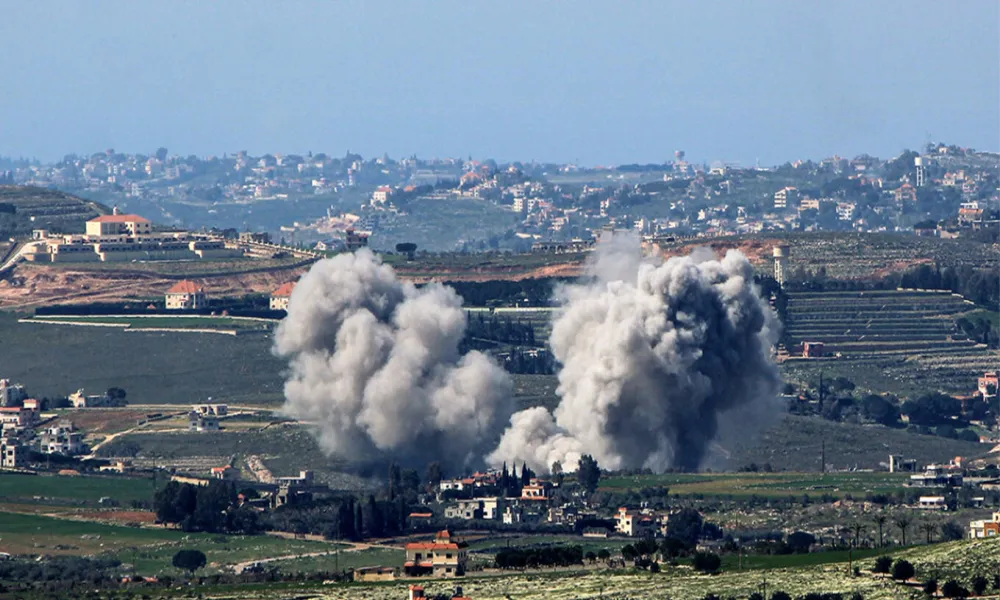
In another major theatre of the war, in Lebanon, Israel and Hezbollah have continued hostilities despite a ceasefire that was supposed to take effect on 17 April.
Lebanon’s health ministry said two rescuers linked to Hezbollah’s Islamic Health Committee were killed and five others injured in Israeli strikes in the south on Saturday. Since the latest war began on 2 March, 2,846 people have been killed in Israeli military operations, including 108 healthcare workers, the ministry said.