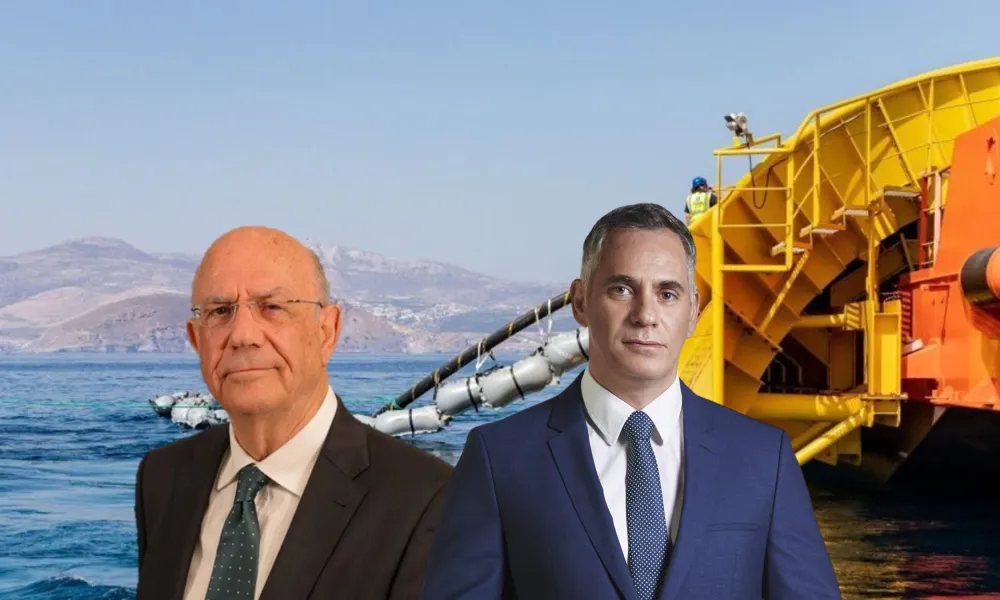

A dispute over the Great Sea Interconnector (GSI) intensified on Tuesday as Cyprus' Democratic Party (DIKO) and Finance Minister Makis Keravnos traded accusations over the government's stance on the proposed electricity link between Cyprus, Greece, and eventually Israel.
The latest exchange followed comments by DIKO leader Nikolas Papadopoulos, who questioned what he described as contradictions in the government's position on the project and asked why Keravnos had not resigned if he believed the interconnector would harm Cyprus.
Papadopoulos questions minister's position
In an interview with Politis, Papadopoulos said President Nikos Christodoulides had assured the public that the project would proceed and that Cyprus would meet its financial obligations once the relevant NAVTEX was issued by Greece.
At the same time, he argued that the finance minister continued to criticise the project.
"The Minister of Finance continues to demonise the project at every opportunity, without, however, referring us to any studies or data to support his view," Papadopoulos said.
He added that, for DIKO, "a very serious question arises: Why, according to the Minister of Finance, is the President of the Republic promoting a project that, according to him, will be disastrous for the country? And if the Minister of Finance disagrees with this project to such an extent, then why does he not resign?"
Keravnos dismisses criticism
Asked to comment on the remarks during an appearance on ANT1 television, Keravnos dismissed the criticism.
"We must discuss serious issues and not the absurdities of politics," he said.
The minister said he was not bothered by Papadopoulos' comments.
"I am not bothered at all because I always deal with serious issues that concern the citizens of this country and the future of the country," he said.
When asked whether he was considering resigning, Keravnos replied: "Why should I be thinking of resigning?"
He added that "I do not follow and I do not concern myself with the statements of anyone."
Asked about his relationship with the DIKO leader, Keravnos said: "I have nothing against Mr Papadopoulos."
He added that the DIKO leader "has obsessions about certain issues".
DIKO accuses minister of contradictory statements
In a subsequent statement, DIKO accused the minister of undermining political discourse and showing contempt towards political parties, particularly DIKO and its leadership.
The party said remarks such as "the absurdities of politics", "these are our politicians in Cyprus" and references to "obsessions" lowered the standard of public debate.
DIKO also defended its record on economic policy, saying it had supported measures that contributed to Cyprus' economic recovery and credit-rating upgrades, often at political cost.
The party rejected suggestions that it had called for Keravnos' resignation. Instead, it said it had merely raised the question of whether a minister who considered a flagship government project harmful to national interests should remain in office.
Demand for clarity on interconnector
DIKO called on Keravnos to clearly state whether he considers the Great Sea Interconnector beneficial or damaging for Cyprus, arguing that contradictory messages could not continue.
The party also criticised suggestions that Cyprus should not fulfil its obligations towards Greece regarding the project, noting that Greek consumers had already begun contributing financially through electricity bills.
Rejecting claims of any personal animosity towards the finance minister, DIKO said its primary concern was reducing electricity costs.
The party urged Keravnos to explain why he opposes the project, arguing that its implementation would challenge monopoly and oligopoly interests in the electricity market.