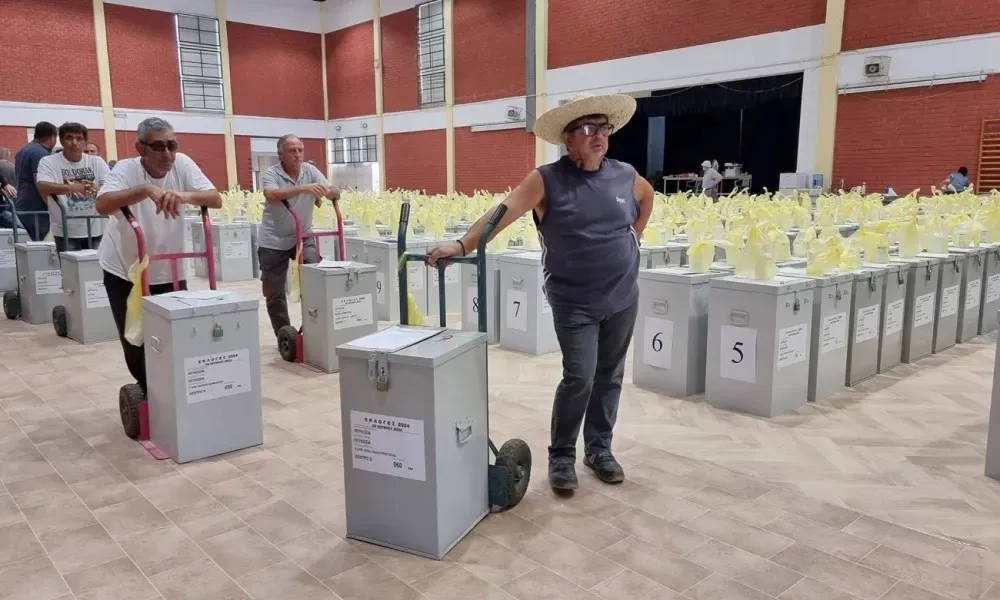

Abstention, blank votes and invalid ballots, as forms of political protest, express citizens’ discontent towards politicians and political parties. These choices often stem from different motives and varying political perceptions. In practice, however, they share a common characteristic: they do not influence the election result or the distribution of party and candidate vote percentages. Consequently, they amount to nothing more than lost votes.
Blank and invalid ballots
A blank ballot is defined as a ballot on which the voter does not mark any of the prescribed symbols (“X”, “+”, “√”) or any other sign, letter or number that would indicate their electoral preference.
A blank ballot is considered a more conscious and active form of protest. The voter participates in the process but chooses not to support any party or candidate, seeking in this way to express disapproval of the entire political system. Despite its strong symbolic nature, a blank ballot is not included in the allocation of seats and does not affect party percentages. According to current legislation, blank ballots are treated as invalid, although they are counted in the overall results and recorded separately for statistical purposes.
A similar logic applies to invalid ballots. An invalid ballot may arise either by mistake or through deliberate action by the voter, who seeks to express anger, frustration or contempt towards the political system. In some cases, invalid ballots are used as a means of protest through slogans or symbolic markings. However, this choice also has no substantive impact on the final electoral outcome.
Both blank and invalid ballots are excluded from the valid vote count. For example, if out of 100 total votes, a party receives 40 votes, another party 30, a third 10, and there are 10 blank and 10 invalid ballots, then party percentages are calculated only on the 80 valid ballots. In this case, the first party would receive 50%, the second 37.5% and the third 12.5%.
Elections and decline
In the 2016 parliamentary elections, 3,478 blank ballots were recorded, representing 0.96%, while invalid ballots reached 7,675, representing 2.12%.
In the 2021 parliamentary elections, blank ballots decreased to 2,070, or 0.56%, while invalid ballots fell to 6,826, or 1.86%. This indicates a decline in both categories.
When a ballot is invalid
The presiding officer at a polling station rejects any ballot as invalid if:
- it is not stamped with the official seal of the Republic
- it contains any mark, design or number that could reveal the voter’s identity
- it is missing an essential part or does not include all participating candidate lists
- the voter selects two or more party lists, or one list and one or more independent candidates
- the ballot is marked with symbols other than those prescribed by law
- it is marked with a pen of a colour other than blue or black
- the voter’s intention cannot be determined
- it is blank, making it impossible to identify the voter’s intention
It is noted that the presiding officer’s decision on the validity of ballots is final and not subject to appeal.
Abstention
Abstention constitutes a complete withdrawal from the electoral process. It often reflects disappointment, indifference, lack of trust in politicians and parties, or even broader doubts about the effectiveness of the political system itself.
However, despite its symbolic character, abstention is not recorded as an active political choice in the final result. Instead, it indirectly shapes electoral outcomes only through the votes of those who participate. In other words, as participation decreases, the relative weight of the votes cast increases.
In the 2021 parliamentary elections, abstention reached 34.28%, corresponding to 191,228 voters who did not participate. The message sent by these citizens was directed at all political parties, although the extent to which it was taken seriously remains open to debate.
In the 2016 parliamentary elections, abstention stood at 33.26%, corresponding to 180,644 voters. This represents an increase of 1%, or 10,584 additional voters, between the two elections.
“Blackening” parties and candidates
Undoubtedly, voters who choose either abstention or to cast blank or invalid ballots seek to express dissatisfaction with political parties and their policies. This stance constitutes a form of protest towards the political system and is often interpreted as indifference, disapproval or rejection of the current political landscape.
However, despite their different starting points and the messages they convey, abstention, blank ballots and invalid votes do not alter political balances or influence the allocation of parliamentary seats. For this reason, they are often described as “lost votes”, as they deprive citizens of the opportunity to have a direct impact on political outcomes.
The vote acquires real political weight only when it is used to choose representatives and shape political developments through active participation in the electoral process.