


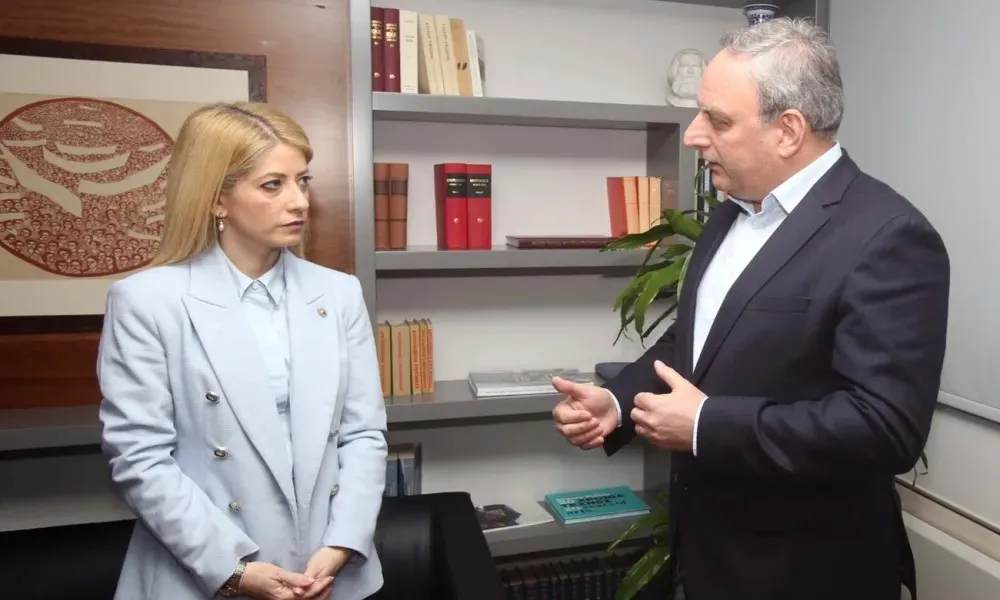
Three days before the end of the pre‑election campaign for the parliamentary elections, political forces are entering the final stretch in a climate of intense polarisation, hints of tactical alliances and escalating confrontations, which reveal not only the parties’ ambitions for the next day, but also the deeper political processes shaping the Cypriot political landscape. In recent hours, interest has focused mainly on relations between DISY and DIKO, as well as on the broader realignment of forces that could influence the composition and operation of the new House.
Searching for a framework
The apparent rapprochement between DISY and DIKO did not arise suddenly. On the contrary, it is the result of political calculations and shared interests, which have been reinforced particularly following the improvement in DIKO’s polling numbers. The possibility of a post‑election cooperation appears to be taking on more concrete form, especially as regards the management of a parliamentary majority and, in particular, the battle for the presidency of the House. Although no one can predict the formation of a parliamentary majority, it is clear that both parties aim to create a strong bloc of influence that will give them a decisive advantage in the key votes of the next day.
Cooperation with the far right?
Within this framework, indirect convergences with ELAM cannot be ruled out, despite the public reservations of the party’s leadership. These reservations concern the choice of the House presidency, as party officials signal that they do not view favourably the re‑election of Annita Demetriou. The apparent effort by DISY and DIKO to maintain open communication with ELAM is already triggering reactions, particularly from AKEL, which is attempting to highlight the risk of the 'normalisation' of the far right. The left invests politically in its rhetoric of confrontation with ELAM, seeking to present itself as a consistent force against nationalism and extreme voices.
“No to populism”
At the same time, DISY is aiming to project an image of responsibility and political stability. The party leader, Annita Demetriou, again attempted yesterday, through her public interventions, to differentiate DISY from the climate of tension and populism which, she argues, dominates the pre‑election period. Her emphasis on moderation, seriousness and institutional stability seeks to rally a centrist and more conservative audience concerned about political instability and the sharpening of public discourse.
High tensions
However, the pre‑election campaign is not limited to programme‑based debate. Instead, it increasingly features personal clashes and heightened rhetoric. A characteristic example was the intense confrontation between ELAM president Christos Christou and AKEL secretary general Stefanos Stefanou over issues of security and geopolitics. ELAM seeks to capitalise politically on the sense of insecurity caused by international developments, promoting a tougher approach to defence and national sovereignty. On the other hand, AKEL highlights ELAM’s links to extreme historical and political references, aiming to prevent its further strengthening. The exchange between the two sides reflects the deep ideological polarisation that characterises this electoral contest.
The pre‑election period is drawing to a close in an environment of intense manoeuvring, strategic alliances and growing political tension. The election result will determine not only parliamentary balances but also the model of political cooperation that will prevail in the next five years. The balances formed after the vote are expected to decisively affect both the functioning of the House and the wider political scene in the post‑election period.
AKEL, ALMA and others
Beyond the strength of the parties that will emerge after Sunday’s elections, a possible alignment among parties beyond DISY, DIKO and ELAM cannot be ruled out, based on the search for an alternative solution for the presidency of the House. AKEL secretary general Stefanos Stefanou did not rule out his own candidacy, but it is clear that AKEL does not treat such a possibility as absolute, allowing it room to explore other options. Indicative was Stefanou’s statement yesterday on the programme Aichmes on Omega, when asked whether the party might support Irene Charalambidou for the House presidency, should she express interest. “I do not answer hypothetical questions; such matters will concern us after the elections,” he said.