In recent hours, President Nikos Christodoulides has engaged in an unprecedented attempt to generate political and communication impressions regarding potential developments on the Cyprus problem. In less than 24 hours, an evident shift has been observed in the President’s rhetoric on the Cyprus issue, despite the absence of any objective conditions that would justify a change in the climate.
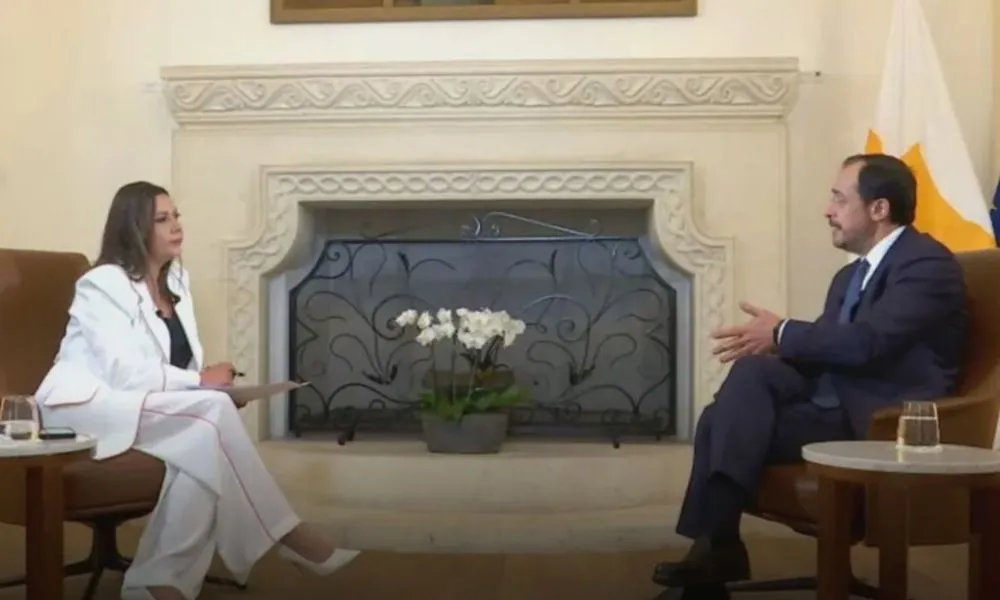
The near‑categorical statement made during his interview on Alpha on Tuesday night, in which he left open the possibility of a settlement plan being submitted before the end of 2026, that is, before the completion of the term of UN Secretary General António Guterres, triggered a series of discussions on the domestic front. The President referred to information already circulating, according to which António Guterres assessed positively a meeting with the Turkish President and received a “green light” for substantive discussions. What is being questioned, however, is not whether a new UN initiative would be desirable, but rather the fact that nothing in the current political environment justifies such optimism, or even such a specific assessment. On the contrary, all available data point to a stagnant process, without substantive progress and without the political preparation required to enable the resumption of meaningful talks.
And the shift in rhetoric
However, yesterday, just a few hours after his statement on Alpha, Nikos Christodoulides, after first attempting to create the impression that a serious and organised process was already under way under the UN Secretary General, involving behind‑the‑scenes contacts and a possible prospect of presenting a concrete settlement framework, changed his rhetoric. In statements made in Limassol, he avoided any reference to a “settlement plan,” made no mention of a specific roadmap, did not speak of timelines, nor did he present any tangible evidence that a new negotiating process exists. Instead, he confined himself to vague references to a “positive outcome,” to “support for the UN Secretary General’s effort,” and to the need for the process not to remain stuck in “endless discussions.” This shift reflects a clear retreat from the climate of high expectations that he himself had created the previous day. It also reflects a lack of presidential seriousness on this crucial issue that has long burdened the people of Cyprus.
“Speculation not supported”
At the same time, it should be noted that at present there is no concrete data confirming that a new UN initiative is in fact under way. There is no official UN announcement, no newly agreed‑upon procedure, no indication—beyond general references—that a multilateral conference is imminent, no joint communiqué, nor any change in Turkey’s long‑standing positions, which continue to insist on a two‑state solution and sovereign equality. Even the repeated invocation of “processes away from the public spotlight” serves more as a communication claim that cannot be verified than as evidence of genuine political momentum, as it is not accompanied by any concrete elements.
It is also telling that in yesterday’s statement the President appears to attempt an indirect correction of his earlier remarks, significantly lowering expectations and shifting from rhetoric about a “settlement plan” to much more ambiguous references to a “positive outcome.”
In the same context, a statement by a reliable source from the north to Politis, who wished to remain anonymous, is also of interest, as the source stressed that “there is no concrete development that would substantiate such speculation” regarding the existence of a settlement plan.
This reasonably creates the impression that the government is investing more in shaping a political atmosphere and an image of momentum on the Cyprus issue than in presenting real data that would demonstrate that a new substantive process towards resolving the problem has actually begun.
Political excess
The President frequently appears to speak almost on behalf of the UN Secretary General, pre‑announcing a “new effort,” an “expanded conference” and possible “difficult decisions.” However, neither the United Nations nor the Secretary General’s personal envoy have publicly confirmed such a scenario.
On the contrary, the picture conveyed is that of a process confined to low‑level confidence‑building measures with meagre results. The failure to agree even on new crossing points is a telling example. The Greek Cypriot side’s choice to link the issue to the logic of “reciprocity” not only failed to generate a positive climate but strengthened mistrust and inertia. If there can be no convergence even on confidence‑building measures, how can the prospect of a comprehensive settlement plan be considered realistic?
A solution on what basis?
At the same time, the President has not invested politically in preparing society for a potential settlement. He has rarely been heard clearly explaining why the current status quo is disastrous and why a mutually agreed solution of a bizonal, bicommunal federation with political equality could open new prospects for security and European normality for Cyprus as a whole. There has been no serious public campaign in favour of reunification, nor a political effort to cultivate a culture of compromise. Instead, the President appears to prefer tacit coexistence with the most hard‑line elements on the Greek Cypriot side.
Internal handling ahead of elections
Within this context, Christodoulides’ statements appear more as an element of internal political management than as a reflection of genuine diplomatic developments. The timing cannot be ignored. With parliamentary elections just over a week away and the need to maintain alliances with hard‑line parties, invoking an alleged settlement plan may serve to rally political forces that historically invest in fear and the rejection of any compromise. The message directed at this audience is that “pressure is coming and unity is needed”.
This is precisely what fuels suspicion around the President’s statements. If there were genuine intent to restart the process, efforts to create a different political climate would have preceded it, such as increased contact between the two communities, strengthening confidence‑building measures, public discourse in favour of a settlement and clear political defence of the agreed framework of a bizonal, bicommunal federation. None of this is happening.
The example involving criticism by UN rapporteurs towards both sides for obstructing the smooth operation of the 'Imagine' programme, as reported by Politis on Tuesday 12 May, is indicative of the fact that nothing has been achieved towards creating a different atmosphere.
Presidential communication frenzy
As diplomatic sources told Politis, at present there appears to be nothing that would change the climate for substantive talks. What is more likely, according to the same sources, is an effort to keep the process alive in order to avoid a formal declaration of deadlock.
That would mean maintaining a cycle of limited, low‑level consultations, which would hand the Cyprus issue over to the next UN Secretary General and to future political developments in Cyprus itself. Until then, grand statements about settlement plans risk being perceived not as signs of diplomatic momentum, but as yet another episode in the communication frenzy that characterises President Christodoulides.