


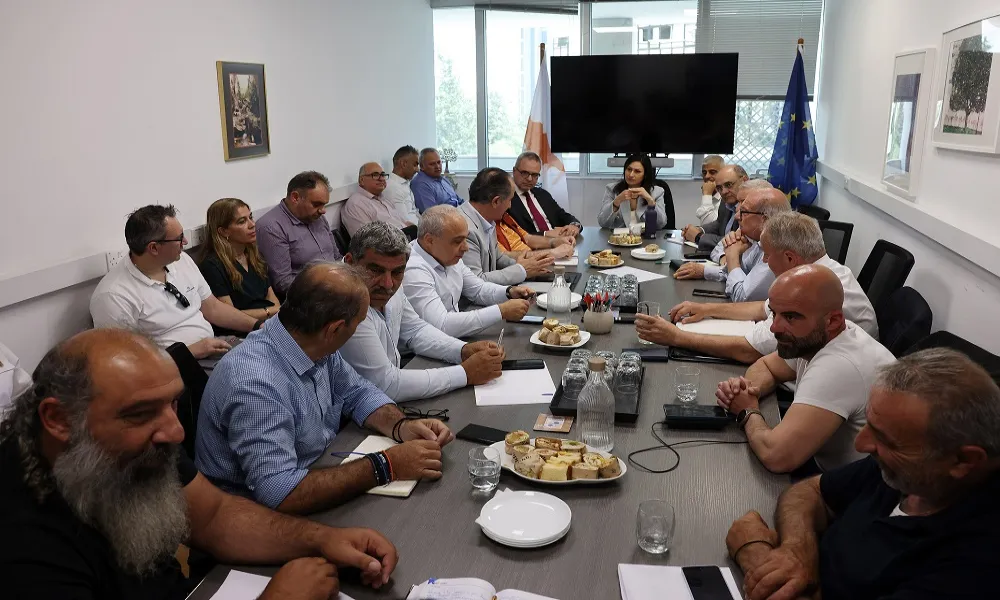
The need for continued dialogue on the issues facing the livestock sector in the shadow of foot-and-mouth disease was highlighted during a broad meeting held on Tuesday afternoon at the Agriculture Ministry under Minister Maria Panayiotou.
Although progress was recorded on some issues, the group Voice of Livestock Farmers maintained its objections to the compensation package agreed between the Agriculture Ministry and the organised farming organisations. After the meeting, the group announced that it would convene to decide its next steps.
Neofytos Neofytou, president of the group, said after the meeting that “today, we saw that we all agreed with each other, but in the end, as far as I understand, we did not agree on anything”.
The situation in the occupied areas
During the meeting, the organised farming organisations and the livestock farmers’ group were on common ground over the absence of a unified policy for dealing with the virus across the whole island, according to information obtained by Politis.
They repeated their concern that the measures currently being taken by the Republic of Cyprus are ineffective as long as the European protocol for full culling is not being applied in the occupied areas, warning that the virus could reappear in the future and spread to the government-controlled areas.
Greek Cypriot negotiator for the Cyprus problem Menelaos Menelaou, who was invited to attend the meeting, said the Republic of Cyprus is making efforts through the European Commission to provide Turkish Cypriots with incentives to adopt the European protocol. He also referred to work being carried out at the level of the bicommunal health committee, where the two sides exchange information and discuss foot-and-mouth disease.
Compensation
Another issue raised by Voice of Livestock Farmers concerned the payment of compensation. On this point, the group found itself at odds with the farming organisations, which, after lengthy dialogue with the Agriculture Ministry, expressed satisfaction with the final package announced last week and scheduled to be submitted to the Cabinet on Wednesday.
The group’s concerns focused on the level of compensation, as well as the criteria and procedures for determining it. It also called for “less bureaucracy”. According to information, this prompted the Agriculture Minister to counter-propose postponing Wednesday’s submission of the compensation package to the Cabinet and opening a new round of dialogue involving both the organised farming organisations and the livestock farmers’ group.
The farming organisations expressed reservations over such a move, citing the risk of serious delays. They argued that the compensation is highly satisfactory and reflects the breed of animals kept by each farmer, allowing the amounts to be distributed in a fair way, in their view.
According to Politis, one representative of a farming organisation asked a representative of the livestock farmers’ group what level of compensation per animal category would satisfy them. After receiving the answer, he assured the group’s representative that, under the agreement reached between the organisations and the Ministry, the amount would be much higher than the figure mentioned.
As the Agriculture Minister did not receive a response to her proposal, the decision to submit the compensation package to the Cabinet on Wednesday remains in force.
The scientific approach
The livestock farmers’ group was also briefed by the Veterinary Services and the Special Scientific Committee on the way the virus spreads and on the scientific approach used to address it, based on the European protocol.
Lytras: The meeting was mostly informative
Speaking after the meeting, Michalis Lytras, honorary president of the Panagrotiki Union of Cyprus, said the meeting was mostly informative. He also noted that the prices to be submitted to the Cabinet on Wednesday for approval, so that producers can be compensated for the culling of their animals, had been finalised a week ago by the advisory committee appointed by the Agriculture Ministry.
“We will see the results tomorrow, when they are approved by the Cabinet, and then we will discuss the remaining issues concerning the resumption of operations by producers who wish to continue in our profession,” he added.
Asked about the situation in the occupied areas, Lytras said participants were briefed on actions being taken to examine how the problem of foot-and-mouth disease could be addressed there.
“If the appropriate measures are not taken in the occupied areas, the virus will be maintained. Animals are being culled in the government-controlled areas, herds will be built up again, and the virus will return,” he said.
“What we demanded is that the European Union become more actively involved in this issue, so that we can see how the situation in the occupied areas, where the Republic of Cyprus cannot intervene, will be controlled,” he said. “Unfortunately, in the occupied areas they have always learned to receive without giving in practice what they should,” he added.
Asked whether the termination of European funding to the occupied areas was being discussed, Lytras replied in the negative, stressing that “what we are discussing and insisting on as farming organisations is that the European Union must also become involved in this issue, so that it monitors the money it provides for this purpose in the occupied areas”.
On the issue of animal cullings, he said this is being examined by the Veterinary Services in line with the protocols, adding that there has been no change in the decisions.
Livestock farmers’ president: “In the end, we did not agree on anything”
For his part, Neofytos Neofytou, president of Voice of Livestock Farmers, said that “today, we saw that we all agreed with each other, but in the end, as far as I understand, we did not agree on anything”.
“We officially, as Voice of Livestock Farmers, have been saying and shouting for about a month, since the day we were established, that we want to be present in matters concerning livestock farming,” he said.
“At the end of today’s meeting, we raised the issue of compensation, animal welfare and so on, and we were told that these had already been decided. Tomorrow, as we all know, the matter goes to the Cabinet,” Neofytou said. “We believe that, without officially having the results they wrote on paper in front of us to read, review and discuss, we cannot agree,” he stressed.
Neofytou further said that the farming organisations represent farmers and agronomists who are not involved in livestock farming. “There should have been people who are suitable, so that decisions could be made that are logical and aimed at restarting livestock farming, something we do not know and could not agree to,” he said.
Asked about compensation, Neofytou said that “for sheep and goats, we spoke about €47 to €420, and along the way we understood that because of the difference between these amounts, various documents must be submitted to certify certain situations”.
“We do not know exactly and we cannot agree to something. Perhaps they are perfect, perhaps they are the best that could have been done. But since we do not know them, we cannot agree,” he stressed.
He added that he raised the compensation issue at the end of the meeting and that there were several reactions from most of those present. “The atmosphere was very good,” he said, adding that “we spent a great deal of time discussing the situation in the occupied areas”.
On the same issue, Neofytou said that “everyone agrees with us and, if we are lying somewhere, let them contradict us. They all agree with us on the way things are being handled, on European Union funds and on illegal grazing, but in the end we fell out over the issue of compensation, where we should have been present and we were not”.
“We submitted a proposal concerning the ages of the animals, which would have been general in order to cover compensation. If we compare it with the compensation already decided, it may even be fairer for all of us,” he explained.
“We do not want to wrong anyone. We want to preserve the sector. We must all receive the message and we must not say that we agree and then nothing happens, while the next day things get worse,” he stressed.
Neofytou said the group would gather the members of its committee, discuss the matter and act accordingly.
Asked whether livestock farmers would take measures, he replied: “Let us not raise such issues. We are here to help solve the problems. Any protest will probably take place if we reach the last resort and cannot achieve anything else.”
“In a room of 16 to 18 people, we could have neither the appropriate time nor the opportunity to develop this specific issue in depth. These discussions take place in more closed circles,” he said.
“On the issue of cullings, everyone agreed with us, and let them come out and deny it,” Neofytou said, expressing the belief that, based on the latest meetings with Stavros Malas and the Veterinary Services, “we are on a very good path and you will no longer see cullings. Epidemiologically, we are in a very good position,” he said.
Asked whether livestock farmers would renew their request for a meeting with the President of the Republic, he said the committee would decide how to proceed.
Referring to the issue of compliance with protocols in Palaiometocho, Neofytou said it was discussed at the meeting, adding that the Agriculture Minister is awaiting certain answers.
“The issue of livestock farming is very large and is under immediate threat,” he stressed.
“When parties get involved, we have a problem”
Christodoulos Christodoulou, vice-president of Voice of Livestock Farmers, said that “our house is about to collapse and we are hoping that the neighbour’s house collapses too, because once again we are dealing with the occupied areas. Our problem is in the government-controlled areas, where no animals will be left, and we are dealing with the occupied areas or the measures they will take. We do not care what measures the occupied areas will take. What interests us is what measures we are taking. The measures we are taking are ‘we kill and move on’,” he said.
At the same time, he called for attention to shift to vaccinations, saying that “since vaccinations have been carried out and are going well, we should focus on vaccinations and stop the cullings”.
“We held a meeting with Mr Malas and the Veterinary Services, but when parties get involved, we have a problem. I do not know what they want to do. The issue is for them to come out as standard-bearers. Let them solve the problem and we will step aside so that they can be the standard-bearers,” he concluded.