


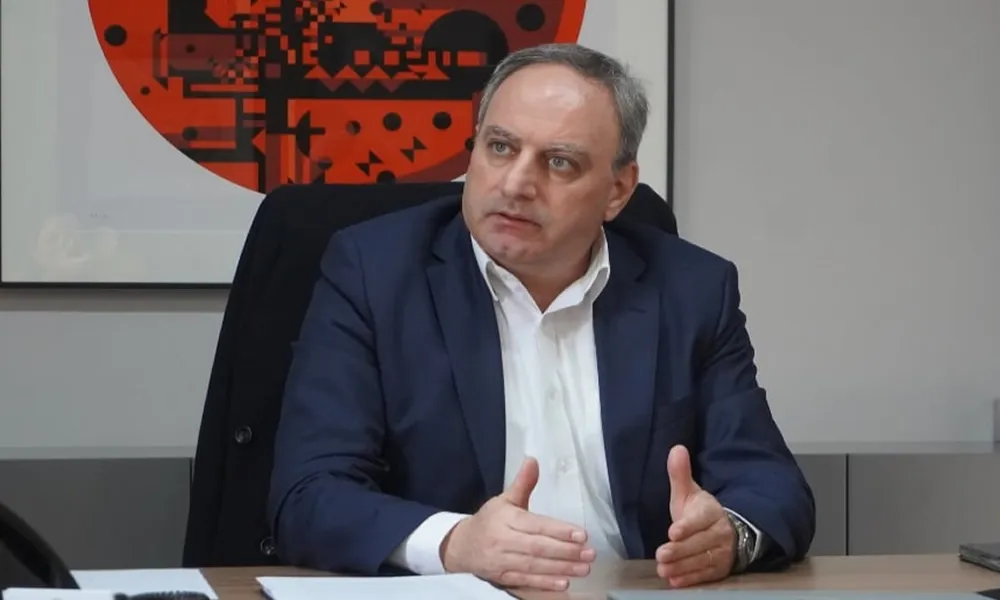

Akel secretary-general Stefanos Stefanou used a commemoration marking the 9 May antifascist victory to warn that fascism and the far right are reasserting themselves in Cyprus and across Europe, driven by the same social and political conditions that enabled the rise of Nazism in the 1930s.
Speaking at a ceremony held at the World War II fallen soldiers' monument near Pasydy headquarters in Nicosia, Stefanou said today's anniversary was an opportunity to examine how fascism came to power in Germany and why similar dynamics are visible again. "Fascism, neo-Nazism and the far right are once again raising their heads, drawing on essentially the same social and political conditions that prevailed in Germany and elsewhere, which allowed the Nazis to enter the political scene, use the tools of democracy and, with the tolerance of a large part of big capital, ultimately seize power, abolish every democratic process, impose a brutal dictatorship and drench Europe and the entire world in blood," he said.
He argued that today's far right is gaining ground through neoliberal policies that he said entrench poverty and generate widespread disillusionment with democratic institutions and processes. "Many people, misled by the populism and cosmetics of the far right, support it, and it acquires social footholds," he said. He also accused centrist and establishment forces of treating the far right as a reservoir of political support rather than confronting it.
Cyprus's own history with fascism
Turning to Cyprus, Stefanou said the far right was gaining ground on the island and that all those who genuinely believe in democracy must resist it. He drew a direct line to Cyprus's own experience, referring to the terror of Eoka B and the role of the Athens junta in Cyprus, which he said brought the 1974 coup and "opened the gates for the Attila invasion, which has since occupied a large part of the territory of the Republic of Cyprus."
"We do not have the right to allow this," he said, "because we are still bearing the consequences of the politics of fascism in Cyprus."
Stefanou also warned that international law and the UN Charter, built on the ruins of the Second World War, are being increasingly violated and sidelined, leading to more conflicts and wars. He concluded by referencing what he described as Israel's genocide against Palestinians in Gaza as a contemporary example of international law being disregarded.
A minute of silence was observed in memory of those who fell in the antifascist struggle. Representatives of diplomatic missions in Cyprus and local government also attended the ceremony.
Source: CNA