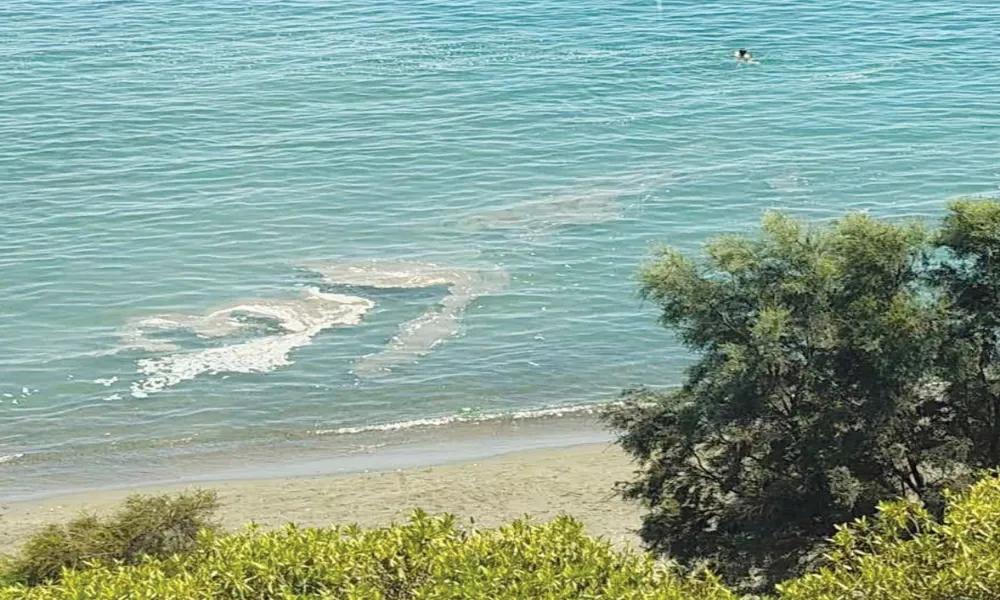

Thousands of bathers in Limassol have once again found themselves facing concerns over possible marine pollution in recent days.
The issue is far from new. Complaints have increased significantly over the past few days, with beachgoers calling for immediate action and solutions from the authorities.
The problem is most commonly reported at weekends, when foam and other residues appear along parts of Limassol's coastline, particularly at Akti Olympion Beach.
The matter is being closely monitored by the Deputy Ministry of Shipping and the Department of Environment, with support from the Limassol Municipality.
Although the Deputy Ministry has only a limited institutional role in such cases, it has taken the initiative to coordinate the various agencies involved, overseeing actions aimed both at tackling and, crucially, identifying the source of the phenomenon.
Limassol Municipality, meanwhile, continues to press the central government for solutions while leasing two pollution-response vessels that are deployed whenever the phenomenon appears.
Despite widespread concern and the visible nature of the problem, routine laboratory tests continue to show excellent water quality, with the sea deemed fully suitable for swimming.
"We need to find out what it is"
Speaking to Politis, Lakis Messimeris, Director-General of the Deputy Ministry of Shipping, said the immediate priority is to determine exactly what beachgoers are seeing.
"We have taken samples and sent them to a specialised laboratory for analysis, both on Saturday and again on Monday morning. This is a separate process from the routine sampling we normally conduct. These samples were taken specifically from the affected area, and the analysis will show exactly what the substance is," he said.
Messimeris explained that the ministry's role is to coordinate prevention, monitoring and response measures.
"We want the public's cooperation and we are determined to find a solution. We have identified a number of possible sources and are investigating them one by one in order to identify and resolve the problem," he added.
Seven measures under way
Messimeris said authorities have intensified efforts on several fronts.
Water-quality sampling in Limassol has been doubled, while teams have been instructed to collect samples immediately whenever the phenomenon is detected, allowing for more accurate analysis before the material disperses.
Authorities are also using drone technology to monitor activity at sea, while Limassol Municipality is supporting operations through the two anti-pollution vessels it leases.
Inspections both on land and at sea have increased substantially, with unannounced checks carried out on various vessels.
In addition, the Cyprus Marine and Maritime Institute (CMMI) is expected to install advanced equipment in the near future, including a permanent water-quality sensor specifically for Limassol.
At the same time, authorities are working with the district local government organisation (EOA) to inspect all infrastructure that may discharge into the sea.
Tougher penalties considered
The Deputy Ministry is also advocating stricter penalties for pollution offences.
Messimeris further highlighted the need for greater use of technology, including sensors on vessels that would allow authorities to monitor and identify illegal discharge locations more effectively.