


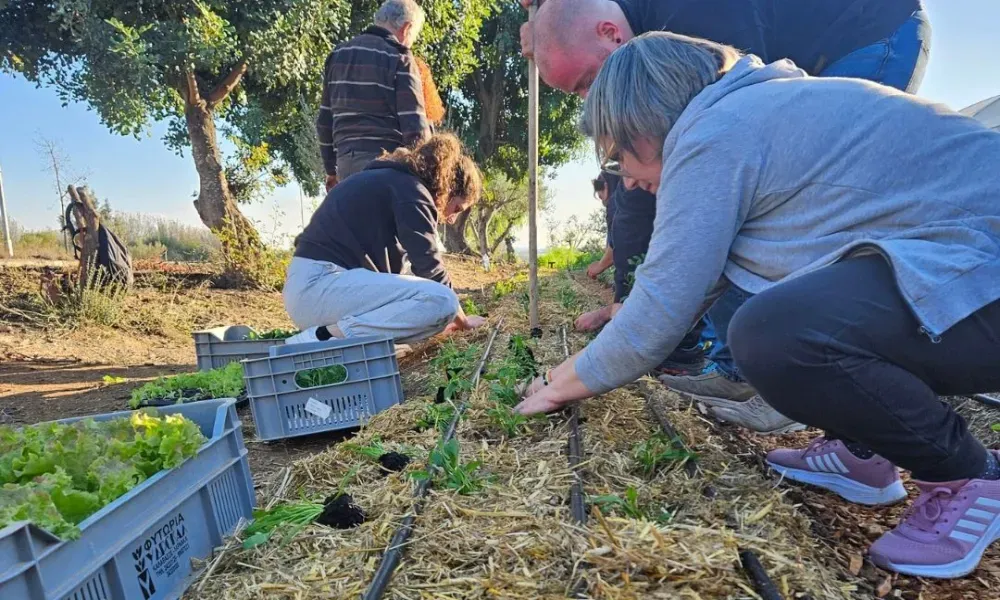
Regenerative farming may sound like a new term in agriculture, but for those already applying it in Cyprus, it offers a practical response to some of the country’s most pressing environmental challenges: water scarcity, degraded soil and increasingly extreme heat.
The issue came into focus during the first Regenerative Agriculture Festival, held on Sunday in Nicosia at the Stelios Ioannou Foundation by the Cyprus Environment Foundation. Speaking to Politis, the foundation’s executive director, Sofia Matsi, explained why this model of cultivation could become especially important for Cyprus and why the shift towards more resilient, environmentally friendly farming practices is gradually becoming a necessity.
A farming model for water-scarce conditions
According to Matsi, regenerative farming is a system that seeks to give back to the environment more than it takes. Its approach is based on the use of natural methods, with the least possible dependence on chemical interventions such as pesticides, and with the main goal of restoring soil health and strengthening biodiversity.
In practice, this includes methods such as soil cover, composting, intercropping and more efficient water management. These techniques, she said, are particularly relevant for a country such as Cyprus, which is already facing water shortages and the effects of climate change.
Soil cover helps retain moisture and reduces the need for additional irrigation, while composting increases organic matter and improves the soil’s ability to hold water. Intercropping can also reduce evaporation and create more resilient micro-environments for crops.
Protection against high temperatures
Rising temperatures are another reason why regenerative farming is seen as a useful adaptation tool. Matsi noted that practices such as soil cover can reduce heat stress on plants, while the choice of crops already suited to Cyprus’ climate is also important.
Carob and olive trees are typical examples of plants that can cope better with local conditions. This does not exclude other crops, such as vegetables, but these require more careful management because of their greater sensitivity to high temperatures.
Cyprus still at an early stage
Although regenerative farming remains at a relatively early stage in Cyprus, some producers have already adopted such practices. According to figures cited by the Cyprus Environment Foundation, around 160 farmers currently apply regenerative farming methods, covering a total area of about 300 hectares. This corresponds to roughly 8% to 9% of farmers.
The wider adoption of this approach, however, still faces obstacles. Matsi acknowledged that many producers remain cautious about changing long-established practices.
Training as a key challenge
For this reason, the Cyprus Environment Foundation is investing in education, offering free training programmes for interested producers. It also plans to create pilot units in Cyprus so that farmers can see the results of these methods in practice.
The first Regenerative Agriculture Festival forms part of this wider strategy. The aim, Matsi said, is to establish it as an annual event, serving both as an information platform and as a bridge between producers, businesses and consumers.
From the field to the market
The aim is not only to increase the number of producers using these practices, but also to create a market for their products through cooperation with supermarkets, hotels and restaurants, strengthening their commercial presence.
On certification, Matsi said there is currently no specific recognition system in Cyprus for regenerative farming products, although efforts are being made in that direction.
Despite the absence of certification, such products are already available on the market, ranging from wine and olive oil to herbs and aromatic plants. At present, she said, they do not show significant price differences compared with conventional products.
For the Cyprus Environment Foundation, the challenge is for regenerative farming to stop being seen as a niche practice and to develop into a broader model of sustainable production that responds to the real needs of Cyprus’ land.