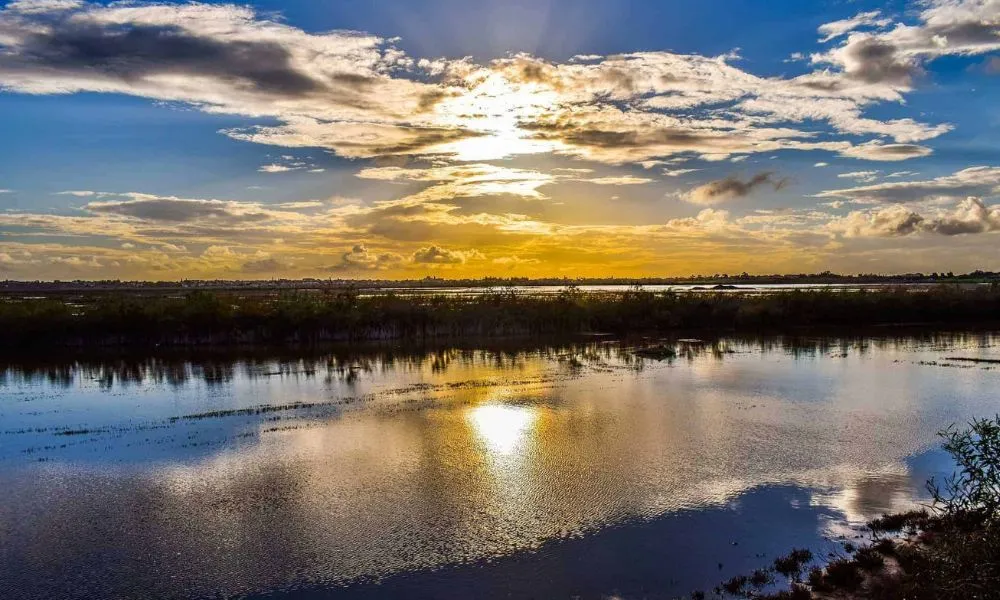

The Municipality of Paralimni–Deryneia has responded to criticism and public discussion surrounding the management of Paralimni Lake, stressing that the debate must be based on factual data and not misinformation.
In a statement, the municipality clarifies that actions involving the controlled release of water from the lake are not a unilateral decision by the local authority, but are carried out by the Environment Department in cooperation with the Game and Fauna Service, the Water Development Department and the Geological Survey Department, following a request by the municipality.
According to the municipality, management of the area is linked to a long history of hydrological interventions. As early as the 1960s, a major infrastructure project was implemented aimed at enriching the wider area’s aquifer, supporting irrigation and addressing public health issues such as malaria and the spread of mosquitoes.
It is noted that the relevant studies began in 1962, while by 1966 a project was completed that included an 11‑kilometre open canal, approximately 40 small dams and a sluice gate regulating water levels, with the objective of operating the system through aquifer recharge and water pumping.
The municipality argues that prolonged retention of water in the lake causes serious environmental and public health impacts, referring to increased salinity, degradation of the aquifer and unsuitability of the water for use. At the same time, it highlights that stagnant water may encourage mosquito populations, posing risks to public health in the areas of Paralimni, Deryneia and Sotira.
Responding to criticism regarding degradation of the wetland, the municipality states that it actively supports the enhancement of the area, citing the creation of a bird‑watching observatory, the organisation of photography exhibitions in collaboration with Lake Photography and cooperation with the Environment Department.
At the same time, it underlines that for years it has been requesting a comprehensive redevelopment study for the lake, as well as land expropriations. It notes that although the area is designated as a Special Protection Zone, it lies on privately owned plots, which, according to the municipality, complicates the implementation of management interventions.
As stated, continuous meetings have been taking place recently with the Environment Department, with the aim of promoting a holistic approach to redeveloping the lake.
The municipality also rejects claims of uncontrolled water removal, arguing that outflows are carried out with daily measurements and on‑site inspections by the competent state services, in order to maintain the required water level and protect bird breeding in the area.
“The area requires a balance between environmental and ecosystem protection, public health, rational water management and respect for private property,” the municipality concludes.