


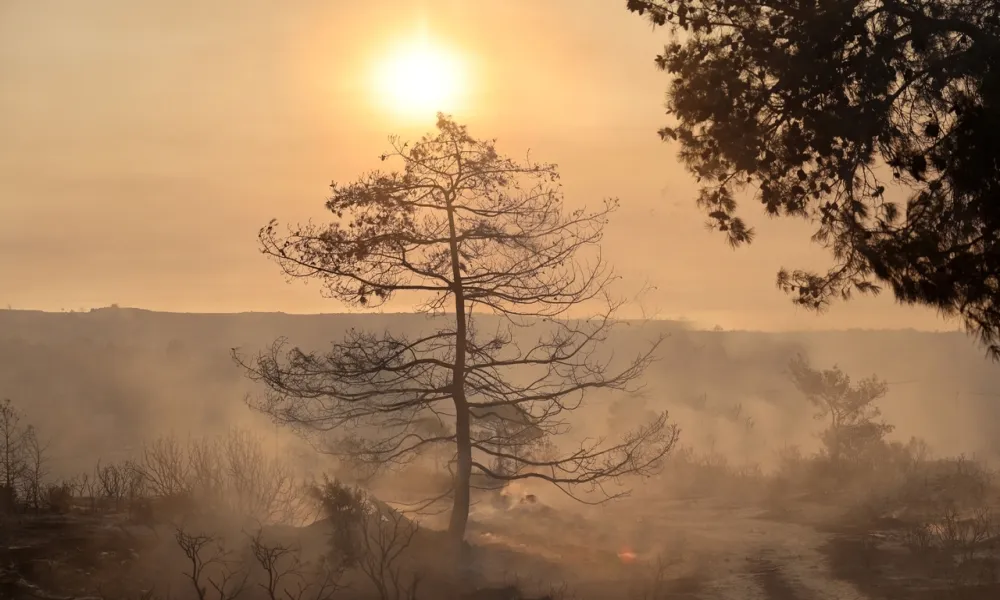

Cyprus is sharpening its focus on fire prevention ahead of the summer season, with the Fire Service carrying out inspections across communities and introducing new operational tools to improve response times. Fire Service chief and acting general fire coordinator Nikos Longinos briefed President Nikos Christodoulides on Tuesday on the state of readiness across all involved services.
Community councils under scrutiny
For the first time, the Fire Service has established dedicated teams across all districts which, from 1 March, visited every community leader to deliver written lists of problems identified in their areas, including locations requiring firebreaks, vegetation clearance and the removal of illegal dumpsites. Longinos told Politis that specific instructions were issued to each community individually, and that all fire hydrants in rural communities have been inspected to ensure water supply is available in the event of a fire.
Following the release of funding by the Interior Ministry to communities last week, clearance work has begun. Longinos said a second round of checks will be conducted within ten to fifteen days, in coordination with District Administration directorates, to verify whether community councils have followed through. "Did they do what we told them or not? It matters, because what we care about is implementation, not just words," he said.
He will hold a meeting with district fire service directors on Wednesday to brief them and issue instructions for the second inspection round.
Illegal dumpsites
Longinos said he met on Monday with the deputy director of the Environment Department, Elena Stylianopoulou, with whom he is in close contact on the dumpsite issue. He said communities and municipalities must manage illegal dumpsites using their own resources, noting that the Environment Department inspects, reports violations and issues out-of-court fines, but does not have the same financial resources available this year as last year, when approximately €1 million was provided to local authorities for clearance on condition that the sites would not reappear. "After the clean-up, it is the responsibility of community leaders to monitor and ensure no new problem emerges. All of us, through collective effort, must reduce every risk," he said.
Brushcutter vehicles and aerial firefighting
Funding has been secured through the Interior Ministry for district administrations to procure brushcutter vehicles, which open firebreaks and play a significant role in containing the spread of fires. These will be positioned at strategic points across the island to eliminate the current two to three hour delay in reaching fire locations. Longinos said he expects the vehicles to be in place by early June.
He also issued operational guidelines to aerial firefighting crews during visits to Paphos and Larnaca airports. All 13 leased and owned aircraft have been operationally ready since 1 April. The British Bases have also been contacted and will make two Chinook helicopters available if needed.
New operations centre transforms response
The recently inaugurated Fire Service Operations Centre, built at a cost of €6.5 million, is changing how the service manages its fleet and responds to incidents. Under the new system, a citizen who calls the Fire Service to report a fire will receive a link on their mobile phone through which they can provide a live visual feed to the Operations Centre. Longinos said this is significant because it allows the service to immediately assess the scale of a fire and dispatch the appropriate number of vehicles from the outset, rather than waiting for the first unit to arrive on the scene before calling for reinforcements. Additional fire stations can also be activated simultaneously to cut off the advance of a fire as quickly as possible.
American training and future prevention
A team of American experts has trained 32 Fire Service officers and non-commissioned officers in fire cause investigation, equipping them to conduct investigations, prepare reports and determine the origin of fires in major incidents.
Asked whether readiness levels are better than last year, Longinos said efforts have been made and priority has been given to closing the gaps identified. He noted that Cyprus records approximately 5,000 fires per year, a figure he said must be reduced through prevention, in line with the European Civil Protection Mechanism's guidance that all countries should now prioritise prevention above all else.