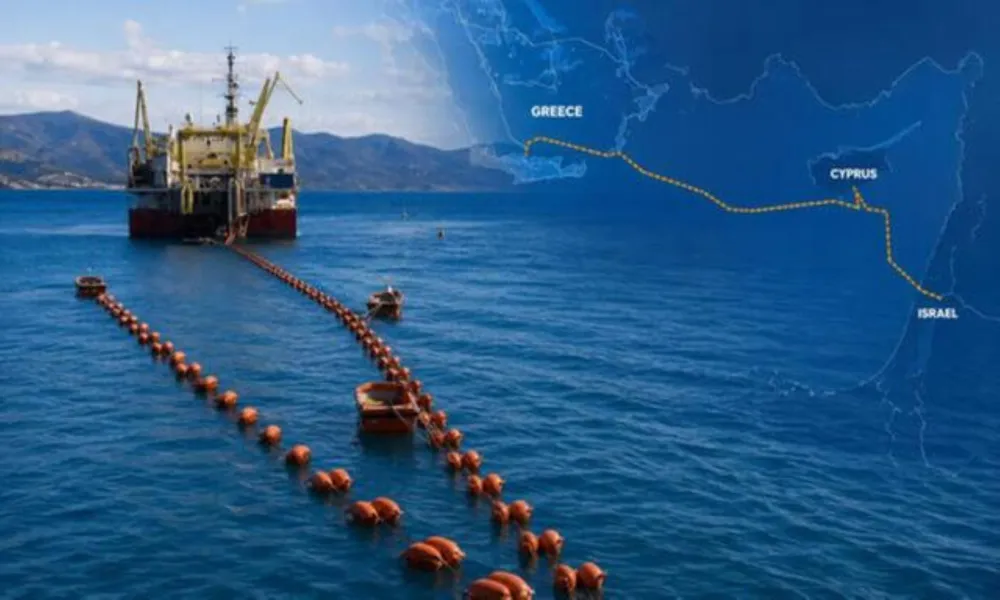

The issuance last Friday of NAVTEX notices by the relevant Greek and Cypriot authorities for bathymetric surveys to be carried out by the French-flagged vessel Abeille Marengo has prompted a series of diplomatic initiatives aimed at preventing interference by Turkey in the survey process.
On Monday, it emerged that France, through a diplomatic note, informed the coastal states concerned, namely Turkey and Egypt, about the planned survey work as part of the electricity interconnection project. At the same time, according to reports in the Greek media, including Proto Thema, the United States also intervened diplomatically.
According to those reports, the United States conveyed through its diplomatic missions in Ankara, Nicosia and Athens the position that "for projects of this kind, no side is justified in raising an objection."
The communication to Ankara was reportedly delivered verbally.
It is recalled that the NAVTEX notices issued by the Hellenic Navy Hydrographic Service and the Larnaca Search and Rescue Coordination Centre were followed by a Turkish counter-NAVTEX.
In Athens, the French diplomatic note prompted questions from opposition parties. Government spokesman Pavlos Marinakis clarified that the French note did not contain coordinates.
"It is the mildest way of conveying messages," he said, adding that the written notification to Turkey did not constitute a request for permission or consent.
"The French company submitted requests for authorisation only to the Greek and Cypriot authorities," he added.
In any case, the issuance of the NAVTEX notices has generated movement after more than two years of stagnation.
Developments appear to support the prevailing assessment that Turkey's response will remain at the diplomatic level.
Economist conference discussion
The latest developments were discussed during a panel at the 22nd Economist Conference in Cyprus.
Konstantinos Filis, director of the Institute of International Affairs and associate professor at the American University of Greece, defended the project's energy and commercial viability.
"It is not a project with only a geopolitical dimension," he said, describing it as an initiative that "will take Cyprus out of energy isolation".
"It is commercially viable from both the investor's and the consumer's perspective," he added, dismissing criticism of the interconnection project as "directed".
Haris Georgiades, president of the Glafcos Clerides Institute, described the GSI as one of the most important political initiatives affecting Cyprus.
"I cannot imagine a more important political initiative than the GSI, which will end Cyprus' isolation and bring energy security and self-sufficiency," he said.
Calling it "a project of peace and regional cooperation", Georgiades stressed that "no attempt to obstruct it can be tolerated".
"There must be strong European and political support, beyond the financial backing already provided," he added.
Former education minister and former Cypriot ambassador to Greece Kyriacos Kenevezos offered a more critical assessment of the Cypriot government's handling of the project.
He argued that the project should not be evaluated solely on economic grounds.
"The elephant in the room is Turkey, and that is what we should be discussing," he said, emphasising the strategic importance of the interconnection project for Cyprus' security.