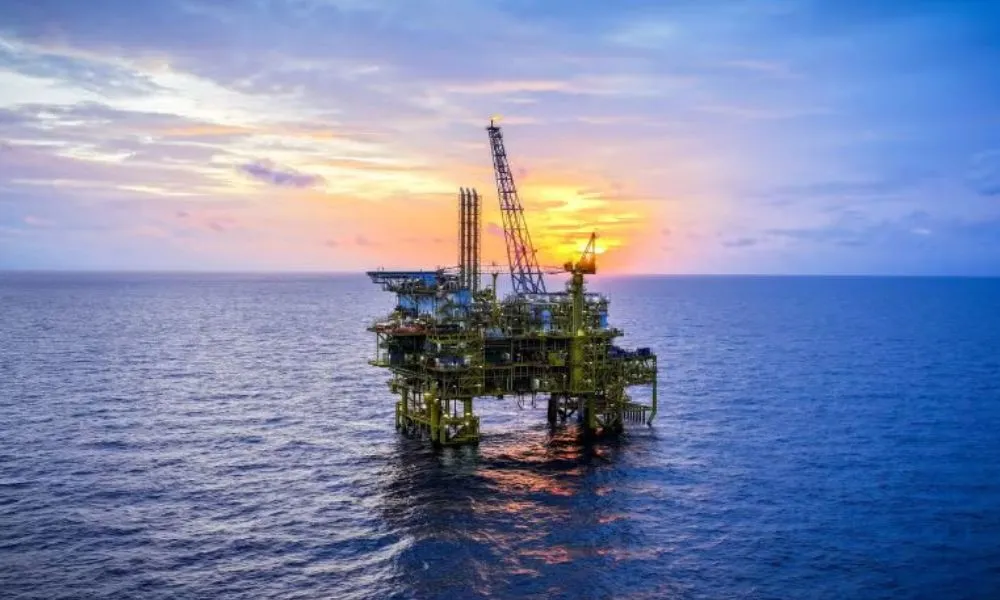

The political priority of natural gas extraction, that Cyprus becomes a producer, outweighed the economic demands of the Italian‑French consortium Eni–TotalEnergies, leading to the Cabinet’s approval of the development and production plan for the 'Cronos' gas field.
The decision comes six days before the elections, creating an image of momentum and positive developments, despite the strong likelihood that the Republic of Cyprus will see limited financial benefit.
The key terms of the gas sale agreement for the 'Aphrodite' field in Block 12 of Cyprus’ EEZ were also approved. Eni–TotalEnergies is expected to proceed shortly with the final investment decision for 'Cronos', while Chevron, BG and NewMed Energy are expected to follow within 2027.
DIKO and DIPA welcomed the development.
“The development, in contrast to the gloom, despair and toxicity cultivated by some on a daily basis, shows what our people can achieve when they assert themselves,” said DIKO leader Nikolas Papadopoulos, congratulating former energy minister Giorgos Papanastasiou and current minister Michalis Damianou for their “decisive contribution to this major national success”.
“The prospect of selling the first Cypriot natural gas to Europe via Egypt strengthens Cyprus’ role as a reliable energy partner in the Eastern Mediterranean and Europe.”
What the decision means
The announcement of the final investment decision by Eni–TotalEnergies will set 'Cronos' on a path to production, with exports targeted for 2028. Economically, however, Cyprus should not expect significant revenues and is taking on additional financial risk. At the same time, there had been a risk that extraction might not proceed at all due to the relatively small size of the 'Cronos' field.
Eni–TotalEnergies plans to use existing infrastructure from the Zohr field to feed gas into its LNG terminal in Damietta, Egypt.
“This is a very significant development in the utilisation of our country’s energy resources. The goal is for the first Cypriot natural gas to be sold in Europe via Egypt in 2028, and we are approving all the relevant agreements,” said President Nikos Christodoulides at the start of the Cabinet meeting.
He added that further announcements are expected soon in cooperation with Exxon. “We are in advanced discussions and will soon be in a position to announce the next concrete steps,” he said.
“The Cabinet’s approval does not mean that the ‘Cronos’ project has been activated. It means that the political and commercial framework has progressed sufficiently for Eni and TotalEnergies to decide whether to commit investment. Cyprus has previously seen discoveries, announcements and regional agreements. What it lacked was a producing field. ‘Cronos’ now serves as the test case for whether Cyprus can convert offshore gas into revenue, exports and strategic advantage,” notes regional business intelligence outlet LevantIntel.
Energy Minister Michalis Damianou said that development in Cyprus’ EEZ marks the country’s transition into an energy producer, strengthening its credibility with investors and licence holders and creating conditions to attract new investment. He added that this lays the foundation for a strong domestic energy industry that will support economic growth and create quality jobs.
He also stressed that the development of 'Cronos' strengthens Cyprus’ strategic position during a period of intense geopolitical developments and enhances cooperation with partners such as Egypt, France and Italy.
Concerns
Charalambos Ellinas, senior associate at the Atlantic Council’s Global Energy Centre, expressed concerns about the development due to the financial risk undertaken by Cyprus and the expected limited revenue.
Regarding risk, he explained that if anything goes wrong during extraction, the cost will be deducted from Cyprus’ share of revenue. The approval of the development plan had been delayed as Nicosia pushed for changes to the terms, which the Eni–Total consortium strongly opposed, arguing that agreed conditions were being altered. The Legal Service had identified clauses that could result in additional costs.
According to information, President Christodoulides raised the issue of changing terms with Italy’s Prime Minister Giorgia Meloni and France’s President Emmanuel Macron, but without success. The relatively small size of 'Cronos' makes extraction more demanding, and the consortium seeks to minimise its own risk. In simple terms, extracting the first molecule of gas requires sacrifices from Cyprus.
On potential revenue, Ellinas noted that the large number of LNG projects under development globally will increase supply and likely reduce prices. He added that current gas prices are elevated due to tensions in the Middle East and disruptions in the Strait of Hormuz, but expects a notable decline by 2028.
In an article in Politis, Ellinas explained that following Egypt’s decision not to use its share domestically, all of the 'Cronos' gas – approximately 5 billion cubic metres annually – will be liquefied at the Damietta terminal and exported to Europe as LNG.
“However, given the low LNG prices expected in the European market after 2028, between $6–8/mmBTU, and transit tariffs for the use of Egyptian infrastructure reaching up to $1.5/mmBTU, Cyprus’ share of profit is likely to be limited,” Ellinas warned.