


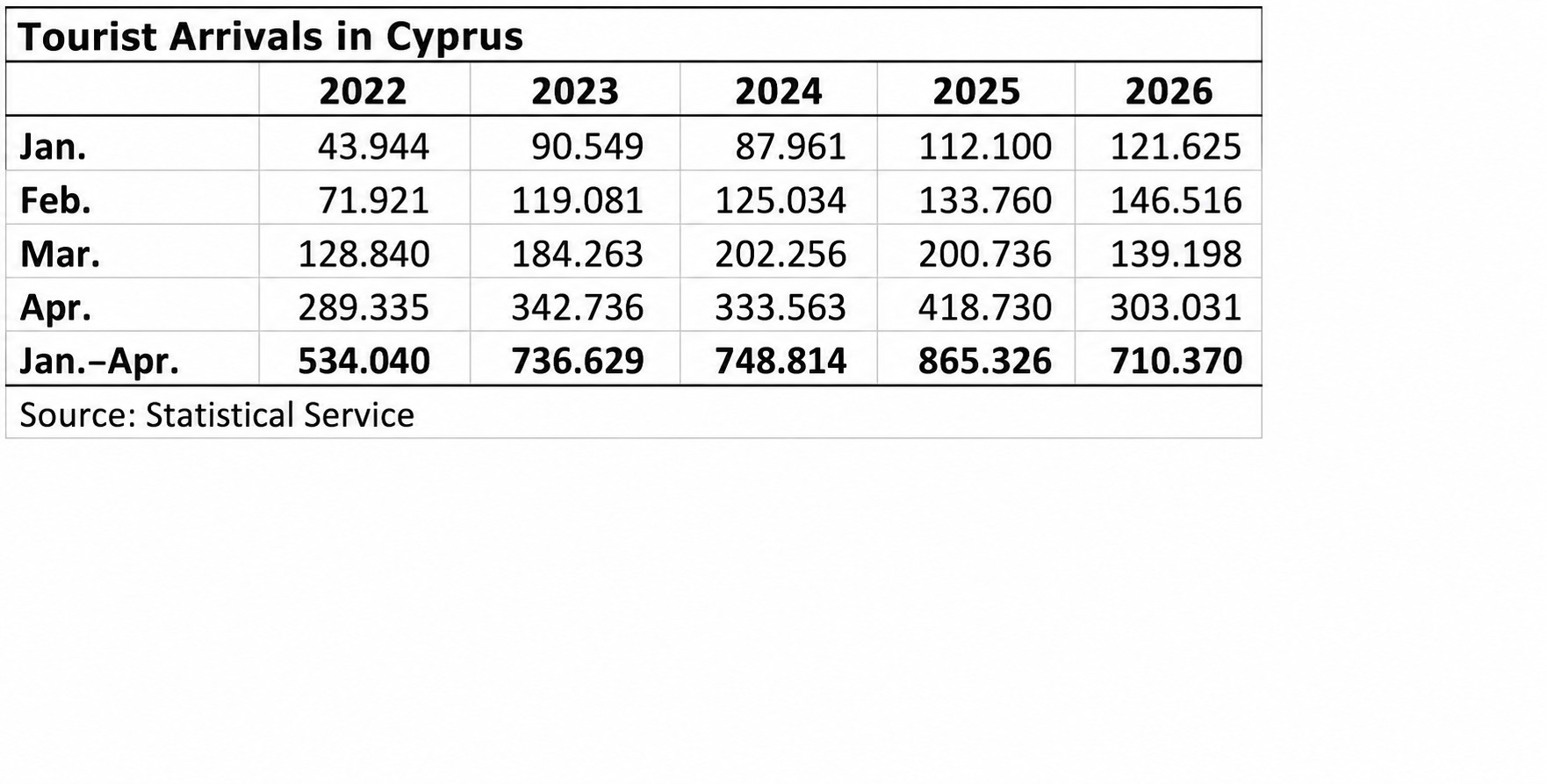
According to figures released yesterday by the Statistical Service, tourist arrivals in April 2026 fell by 27.6% to 303,031 compared with 418,730 in April 2025, following a year‑on‑year decline of 30.7% in March.
Markets
Declines are recorded across all major markets. Arrivals from the United Kingdom, the main source of tourism for April 2026 (39.2% of total arrivals), dropped by 21.8% year‑on‑year to 118,742 from 151,883 in April last year. The UK market continues to concern tourism stakeholders due to travel advisories relating to Cyprus.
Arrivals from Poland, accounting for 8.4% of total arrivals, fell by 12.5% to 25,371. Arrivals from Germany, which represents 8% of the market, dropped by 18.4% to 24,178. Decreases of 12.8% were also recorded from Greece, which accounts for 4.7% of total arrivals.
For the period January–April 2026, total arrivals reached 710,370 compared with 865,326 in the same period of 2025, marking a decline of 17.9%. This is the lowest four‑month level since 2022.
A difficult season
The general director of the Cyprus Hotel Association, Christos Angelides, told Politis that the season is difficult, with many challenges on multiple fronts.
“In addition to the negative image for Cyprus, which we are gradually overcoming, we have to deal with the high level of uncertainty in the region, which is negatively affecting the sector,” he said.
The flow of bookings has improved but is not yet sufficient to offset the gap created by cancellations and the loss of the March–April period, he added in comments to CNA. He also stressed the need for an “aggressive strategy in markets using a combination of tools” (online campaigns, hosting travel agents, journalists and influencers).
“We must do everything at an excellent level for a prolonged period to lift the cloud of uncertainty hanging over Cyprus due to known events and our proximity to developments in the Middle East,” he noted.
There is no need for panic, he said. “We are the industry of joy, life and optimism and must not forget it.”
March and April have effectively been lost, he added, noting that “May is significantly behind expectations and last year’s data.”
Mr Angelides said 2026 will be a year full of challenges that “must be handled with calm without damaging either our reputation or the proper functioning of our hotels.”
Information gathered by the association “through daily calls and research shows weakness in booking flows”, he added.
“We are inevitably entering the period of last‑minute booking competition,” he said.
“We have to compete with heavyweights such as Spain, Turkey, Greece, Tunisia, Egypt and Morocco, which are cheaper destinations with lower operating costs,” he stressed.
Flight times to destinations such as Spain, the Canary Islands and the Balearics are shorter, making tickets cheaper, and routes can be served two to three times daily by the same aircraft.
By contrast, flights to Cyprus can only operate once per day from markets such as Sweden, Poland or the United Kingdom.
Hotel occupancy this year ranges between 40% and 60%, compared with 80% to 85% in previous years.
There is a need for “large joint campaigns with tour operators from now until summer 2027,” he added.
The president of the Cyprus Tourism Enterprises Association (STEK), Akis Vavlitis, confirmed that the year is extremely challenging and warned that if the situation continues, it may soon become unmanageable for the sector.
“Despite pressure from the Cypriot government, travel advisories from the UK and the US have not changed,” he said, noting that all parts of the tourism industry (hoteliers, airlines and tour operators) are suffering in Cyprus and across the EU.
As long as the situation in the Middle East remains unchanged and global uncertainty continues, combined with rising costs and air ticket prices, “I do not see ways to improve the situation in Cyprus,” he added.
At the same time, he stressed that beyond extending employment subsidy schemes for May and June, the state must support the sector in additional ways.
“The government should turn to the EU for support, as Cyprus is the only European country so heavily affected in such a key sector of its economy,” he said.
The president of the Association of Cyprus Travel and Tourist Agents (ACTA), Haris Papacharalambous, also told CNA that there is currently a 'cocktail' of negative factors working against tourism, especially in Cyprus.
There is general concern among travellers, he added, “which is why we are seeing strong reliance on last‑minute bookings to get through the season.”
He also noted a reduction in airline seat capacity to Cyprus, which, combined with lower demand, is affecting ticket prices.
These negative developments, he said, are linked to higher fuel costs and broader political uncertainty, especially in relation to the UK, which remains Cyprus’s key market.
Support scheme
Regarding the employment support scheme for April, information obtained by Politis shows that it was utilised by 207 employer registration numbers, benefiting a total of 15,000 employees.