


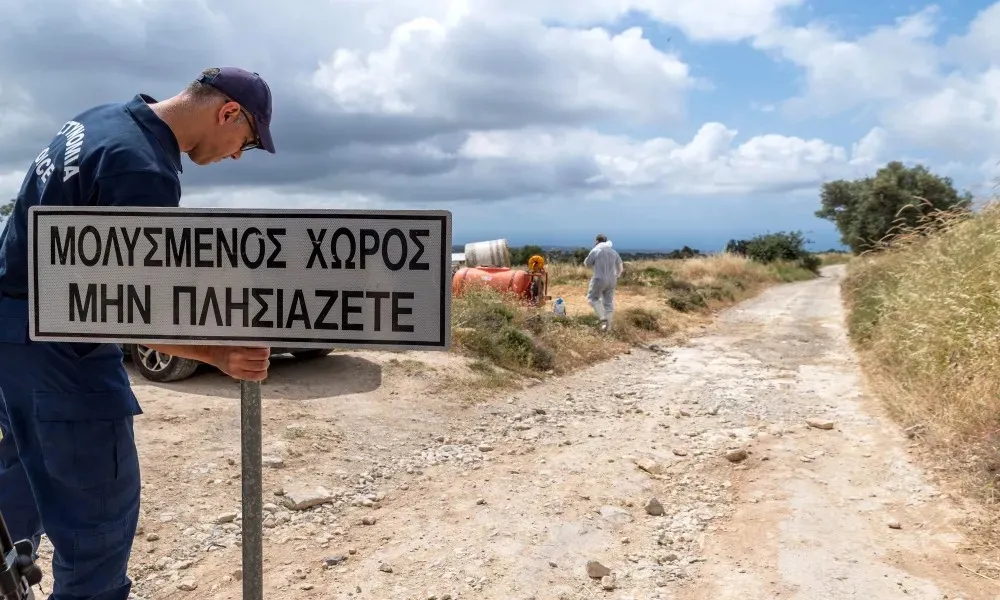
For the first time, the virus has appeared in a mountainous area with particular conditions, at a unit of 66 sheep and goats in the community of Pachna.
This development highlights a number of realities that disrupt state plans to contain the crisis and threaten severe consequences for the livestock sector, and by extension halloumi exports.
So far, 117 infected units have been identified, while losses have reached 11% of adult sheep and goats, 3.5% of cattle and 7.8% of pigs. Reduced milk production has led the government to lower the required percentage of sheep and goat milk in halloumi from 25% to 15%.
Possible spread to Paphos
First, the virus, which has remained active since February, has now moved beyond the districts of Larnaca and Nicosia and, according to scientists, may have spread to all districts, including Paphos.
The situation is expected to become clearer by the end of the month, when sampling and results in Limassol and Paphos are completed by the Veterinary Services. The last sampling in these areas, including Pachna, took place at the end of March and returned negative results, according to the president of the Cyprus Veterinary Association, Dimitris Epaminondas.
Testing returned to these areas after one and a half months because, under protocol, priority had been given to tracing in the initial protection and surveillance zones in Larnaca and Nicosia.
“This development, the case in Pachna, was not good at all. We believed the virus had been contained in Larnaca and parts of Nicosia. Once it appeared in Limassol, it is very likely to be in Paphos as well,” he said.
He added that double vaccination in the infected unit was at an advanced stage, clarifying that vaccination does not eliminate the possibility of infection, but reduces the likelihood of illness and the severity of symptoms.
Limited enforcement
Second, restrictions and decrees related to foot‑and‑mouth disease, including limits on movement, are not being fully observed by all farmers and industry professionals. At the same time, smuggling between the occupied areas and the government‑controlled areas, as well as within the latter, continues, according to information regularly presented to the Scientific Committee.
This raises criticism of the Police, which, both in enforcing the decrees and addressing illegal movement, has not been involved to the required extent.
Professor Dimitris Tsaltas, head of the Department of Agricultural Sciences at Cyprus University of Technology, warned that stronger communication of the seriousness of the situation is needed.
“If some do not stop these practices, we will see the end of livestock farming,” he said, noting that many individuals depend economically on smuggling and are unwilling to comply even if the sector suffers major losses.
He stressed that illegal movements are widely known and questioned why the Police does not react with the same urgency as it would in cases of serious crime.
“This is about animals, not people, but these animals can destroy the country,” he said.
No room for easing measures
A third reality concerns the expectations of livestock groups for relaxation of grazing restrictions in areas previously considered virus‑free, such as Limassol and Paphos.
However, confirmation of the virus in Limassol has effectively removed the possibility of easing measures.
With the virus still active and spreading, any relaxation would amount to signing the sector’s own downfall, according to Mr Epaminondas.
He stated that, based on his position within the Scientific Committee, and in the absence of any clear epidemiological picture and test results, easing measures is not possible.
Professor Tsaltas agreed, stressing that the case in Limassol demonstrates that the virus can spread unpredictably and that strict adherence to measures is essential.
“The measures are strict for a reason. Animals are not culled without cause. They are culled because the virus can come from anywhere,” he said.
Delays in tracing
Another critical factor is the pace of sampling and tracing. According to Professor Tsaltas, the relatively slow implementation of these processes has contributed to the spread to Limassol.
Tracing has involved examining the history of infected units, identifying possible links through transport or animal movement.
He noted that faster processes might have prevented the spread to Pachna, pointing out that in countries that successfully control the virus, responses are significantly quicker.
He attributed delays to limited cooperation from some farmers in providing information, as well as insufficient human resources to support response efforts.
Challenges in mountainous areas
Finally, the geographical nature of mountainous areas such as Pachna makes monitoring and control more difficult.
Unlike organised livestock zones, these regions are harder to police, making it more challenging to establish checkpoints and disinfection controls.
In addition, alongside professional farmers, there are also smaller‑scale or amateur livestock keepers, who may be less familiar with or less willing to adopt strict biosecurity measures.
At the same time, farms in Limassol and Paphos are more dispersed compared to those in Larnaca, which may make transmission less immediate, but also harder to track effectively.
Calls for action
In a separate development, agricultural organisations have written to President Nikos Christodoulides requesting that Cyprus seek an exemption from EU protocols on mass culling.
They also called for a formal complaint against the European Commissioner for Animal Health, Oliver Varhelyi, accusing him of unequal treatment in the management of EU funds for the occupied areas and in handling the foot‑and‑mouth disease situation in the Republic of Cyprus.