

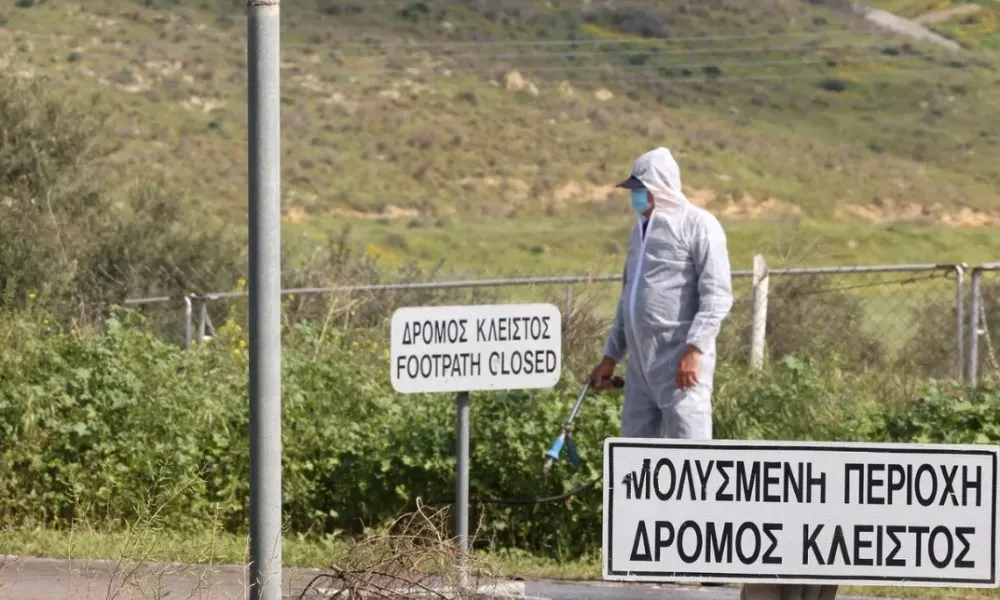
Concerns over violations of decrees and preventive measures against foot‑and‑mouth disease are causing serious alarm within the Veterinary Services and were discussed at a special meeting, where it was decided to inform the public about how to submit complaints.
The continued spread of foot‑and‑mouth disease has been linked to breaches of the relevant decrees or measures, cases in which the police have also become involved. It has been repeatedly stressed – by EU Commissioner for Animal Health Oliver Várhelyi, as well as by the government and scientists – that strict compliance with restrictions by livestock farmers and sector professionals is crucial. A key example cited is the illegal transport of animals, which has already led to the imposition of administrative fines and the filing of police reports that have recently come to light.
The issue is a major concern for the Veterinary Services and, according to information obtained by Politis, a decision was taken following a meeting to create a dedicated section on the official foot‑and‑mouth disease website. The new section informs citizens how they can submit reports to the competent authorities by district when they identify possible breaches of decrees or measures.
Reports may also be submitted anonymously, as highlighted on the website. According to government sources cited by Politis, it was noted during the meeting that in many cases livestock farmers who witness potential violations are afraid to file complaints.
As stated on the website, citizens can contact the competent authorities at the following telephone numbers:
Headquarters: 22 808051
Nicosia: 22 802101 / 22 802050
Larnaca: 24 804071
Limassol: 25 805126
Paphos: 26 806064
Famagusta: 23 803098
Morphou: 22 808051
In recent days, a dedicated option was added to the official foot‑and‑mouth disease website, allowing citizens to find district‑specific information on how to report suspected violations of decrees or measures to the relevant authorities.
At the same time, the Veterinary Services stress that cooperation between citizens, livestock farmers and sector professionals is essential for the effective management of the crisis, and that compliance with biosecurity measures is critical for protecting livestock farming and animal populations.
They also underline that the implementation of measures adopted to combat foot‑and‑mouth disease is vital both for limiting the spread of the disease and for safeguarding the future of production and the primary sector.
Fines of up to €5,000
Among other provisions, the foot‑and‑mouth disease decrees prohibit the movement of animals, animal feed, veterinary medicines, equipment and persons to and from farms, as well as grazing and mass public gatherings of farm owners and farm workers.
Failure to comply with the decrees constitutes an offence under the Animal Health Laws and may result in an administrative fine of up to €5,000.
At the same time, certain activities are permitted in the interest of market continuity and animal welfare, provided a special permit is issued. The competent authority may grant a permit allowing, among other things:
(a) the transport of cloven‑hoofed animals from farms to slaughterhouses;
(b) the movement of pigs from breeding farms to other farms owned by the same owner that are not located in zones where restrictive measures apply;
(c) the movement of piglets from breeding farms to fattening farms owned by the same owner within restricted zones of the same district, provided at least 15 days have elapsed since their first vaccination;
(d) travel to and from farms by owners and farm managers, as well as travel to and from workplaces by farm staff;
(e) the transport of all types of animal feed, including feed not intended for cloven‑hoofed animals, from points of entry into the Republic to approved suppliers and from approved suppliers to farms;
(f) the transport of veterinary medicines from approved suppliers to farms;
(g) the transport of water for the drinking needs of cloven‑hoofed animals;
(h) the transport of wool from farms; and
(i) the import from third countries or movement from other EU member states of cloven‑hoofed animals, as well as the submission of orders for the purchase of such animals from EU member states or third countries.