


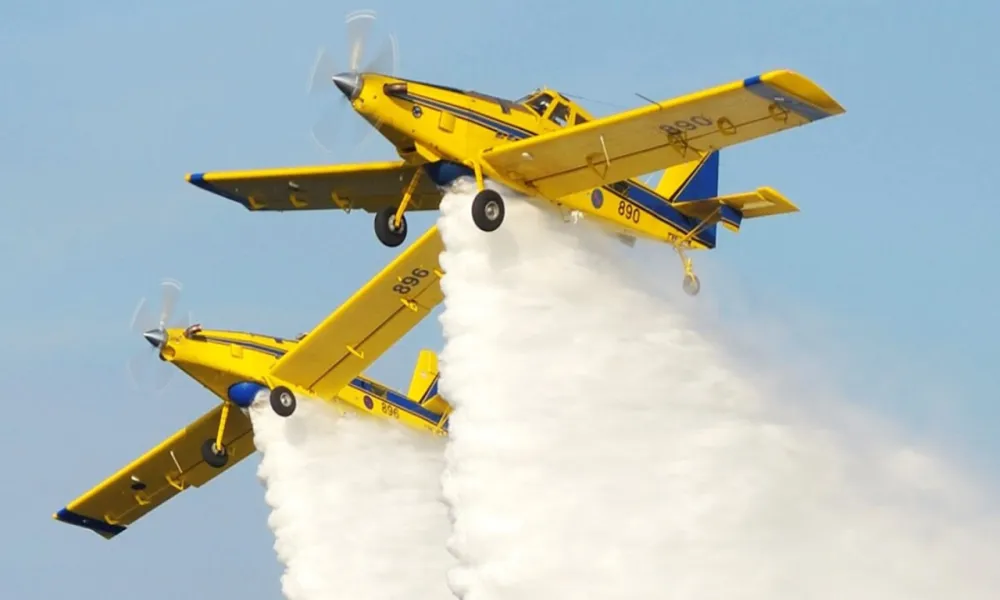
A new EU firefighting hub in Cyprus will host six pre-positioned aircraft and strengthen emergency response across the Eastern Mediterranean, EU Commissioner for Equality, Preparedness and Crisis Management Hadja Lahbib said on Thursday.
Lahbib visited the centre near Paphos during a two-day visit to Cyprus, describing it as part of the European Union’s wider readiness and response mechanism for wildfires.
“This region is on the frontline,” she said, stressing that the hub was not merely a base for aircraft but “a strategic centre for the entire Eastern Mediterranean”.
The Commissioner said wildfires across Europe have become larger, faster and harder to contain because of climate change, noting that Europe is the fastest-warming continent. She also referred to the deadly wildfire in Limassol last summer, describing it as the worst Cyprus had seen in more than half a century.
“No one is immune, and that is why the European Union is taking decisive action,” Lahbib said.
She noted that the EU Civil Protection Mechanism responded to 19 requests for assistance last year, deploying almost 800 firefighters and pilots, along with nearly 60 planes and helicopters.
Focus on prevention and readiness
Lahbib also underlined the importance of prevention, including the protection of healthy, well-managed forests and the reduction of dry vegetation through grazing.
“To prevent better, we must prepare better,” she said, referring to the strengthening of the European Forest Fire Information System, which is supported by Copernicus satellites.
The Commissioner said the EU’s deployment capacity would allow for faster and more effective responses. The Cyprus hub forms part of a wider EU plan to position nearly 800 firefighters from 14 countries in high-risk areas.
After Spain, France, Greece, Italy and Portugal, Cyprus will for the first time host pre-positioned firefighting teams.
The EU is also deploying 18 planes and four helicopters from its rescEU fleet, stationed in 11 member states, Lahbib said.
According to the Commissioner, the new hub in Cyprus will support EU-funded training and exchanges with regional partners, while allowing aircraft to reach fire hotspots in Cyprus, Lebanon or Jordan within hours.
“In firefighting, the first hours often determine everything,” she said.
Lahbib added that the hub strengthens European solidarity and sends a clear message that the EU will be present when needed. Beyond firefighting, she said, it is also part of the Pact for the Mediterranean, supporting climate adaptation, stability and trust between Europe and its southern neighbours.
Ioannou: Shared challenges require a shared response
Interior Minister Constantinos Ioannou said the challenges facing the region are common and require a common response.
He welcomed European Commission President Ursula von der Leyen’s announcement on the creation of a European firefighting centre in Cyprus.
Ioannou said rescEU aerial assets are currently hosted in several member states, but there is no permanent EU operational presence in the Eastern Mediterranean, despite the region’s high climate vulnerability and growing operational needs.
“Recent experience with wildfires has clearly shown that climate-related emergencies are becoming more frequent, more intense and increasingly cross-border in nature,” he said.
The creation of the Cyprus Regional Aerial Firefighting Support Centre, he added, would significantly strengthen operational coverage in the Eastern Mediterranean and the Southern Neighbourhood.
Ioannou said the centre is not intended to redistribute existing capabilities from other member states, but to close a clear geographical and operational gap.
“Cyprus offers a uniquely strategic location at the crossroads of Europe, the Middle East and North Africa, allowing rapid deployment to high-risk wildfire areas across the Eastern Mediterranean,” he said.
The minister added that strengthening preparedness and response capacity in neighbouring countries directly contributes to the protection and resilience of the EU itself, while also supporting regional cooperation and stability.
Discussions are continuing on the appropriate legal, operational and financial framework for the initiative, including the participation of third countries, deployment arrangements and the long-term sustainability of the hub.
Ioannou said governance and funding arrangements should fully reflect the European and regional dimension of the initiative, as well as Cyprus’ role as host country.
Civil Defence says building is ready
Civil Defence spokesperson Panayiotis Liasides told the Cyprus News Agency that the building of the EU Regional Firefighting Centre at the Andreas Papandreou airbase in Paphos is ready.
He said Cyprus is preparing to play a key role in responding to forest fires across the wider Eastern Mediterranean, with the centre expected to allow the authorities to respond with more resources, both for Cyprus and the wider region.
Liasides was speaking on the sidelines of the 3rd Euro-Mediterranean High-Level Workshop on wildfire risks, held in Paphos as part of the Cyprus Presidency of the Council of the European Union.
He said the workshop is an EU initiative, held in cooperation with the President of the Republic, and forms part of the wider implementation of the decision to establish a forest firefighting centre at the Andreas Papandreou airbase.
“The building of the centre is already ready and soon the competent services will be in a position to respond with more resources, not only to the needs of Cyprus but also to those of the wider region,” he said.
Liasides said more than 110 participants from EU, Mediterranean and Middle Eastern countries are attending the workshop, with the aim of strengthening cooperation and coordination.
Due to Cyprus’ geographical position, the aircraft stationed at the centre will be able to respond quickly to fires in surrounding areas, he said. The workshop also gives participating countries the opportunity to identify possible problems, improve coordination and ensure a more effective EU response in times of crisis.
Asked when the EU Regional Firefighting Centre is expected to be inaugurated, Liasides said no date has yet been set. He said the timing will depend on the schedules of the President of the European Commission and the President of the Republic.
Evacuation plans revised
Liasides also referred to Civil Defence planning for the fire season, saying revisions to evacuation plans for every community in Cyprus had been completed by mid-April.
Civil Defence personnel visited all communities, held meetings with local authorities and revised the plans based on the specific characteristics of each area, he said.
Readiness drills have also been scheduled in all districts. Five exercises will take place in May, one in each district, followed by another five exercises in June over two days.
“One day we will hold exercises in three districts at the same time, and on another day in two other districts,” Liasides said.
The aim, he added, is to identify possible difficulties, assess the readiness of services and inform the public about the procedures to follow in an emergency.
Liasides said evacuation should be viewed as part of society’s everyday preparedness. In the event of danger, he said, citizens must follow the instructions of the authorities so they can be moved safely, even for a few hours, until the risk has passed.
Source: CNA