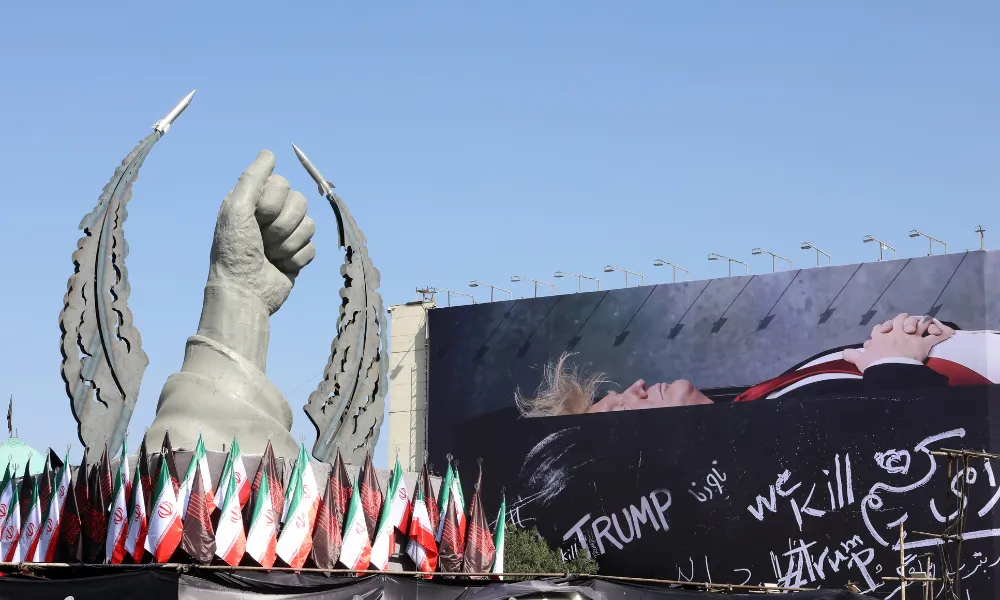

The American military completed its eighth consecutive night of strikes against Iran, the Central Command of the US armed forces (CENTCOM), responsible for the Middle East, announced early on Sunday Cyprus time, hitting coastal surveillance and anti-aircraft defence installations of the Iranian military.
It also targeted forces of the Islamic Revolutionary Guard Corps that launched attacks against members of the American forces in Jordan on 17 July, according to a CENTCOM statement.
Iranian retaliation in Kuwait
The Iranian military announced on Sunday that it attacked two military bases in Kuwait in retaliation for American strikes against Iran, according to state television. The Iranian authorities "launched large-scale attacks with unmanned aerial vehicles (drones) against an ammunition depot of the American armed forces at Camp Udairi, as well as against the Patriot radar system and the air surveillance radar of the Ali Al-Salem air base in Kuwait", according to a post by the state television network on Telegram.
Drone downed near US consulate in Erbil
An unmanned aerial vehicle carrying an explosive charge was shot down near the US consulate in Erbil, the capital of the autonomous Kurdistan region in northern Iraq, sources in the local security forces told Reuters. Based on what is known, this is the fourth time within a week that attack drones heading towards the American consulate in the city have been shot down.
Since the outbreak of the war in the Middle East on 28 February, the oil-rich Iraqi region of Kurdistan, which hosts US military bases, has repeatedly been targeted by attacks attributed both to neighbouring Iran and to Iraqi armed groups considered close to Tehran. Even after a ceasefire was announced in April, forces of Iran or those aligned with it continued to target the exiled Iranian Kurdish opposition, which the Islamic Republic accuses of serving American and/or Israeli interests.
How the international press reads the escalation
The renewed confrontation between the United States and Iran, and the contest for control of the Strait of Hormuz, dominate international coverage, with analysts across continents converging on a common fear: that the conflict no longer has a clear end point.
The risk of the United States becoming entangled in yet another prolonged war is highlighted by Steven Erlanger in The New York Times, in an article entitled "In Iran, Trump risks another American 'forever war'", published on 16 July. Donald Trump, the article argues, risks repeating the pattern of drawn-out American military entanglements, despite his commitment to ending rather than starting wars. The operations have achieved neither regime change nor the termination of Iran's nuclear programme, while creating a new strategic deadlock around the Strait. The absence of a long-term strategy increases the danger of a conflict without a clear end, while Iran's capacity to disrupt shipping makes a viable diplomatic solution harder.
The Guardian, in a report by Patrick Wintour published on 13 July, focuses on the reinstatement of the American naval blockade and Trump's demand to control the Strait of Hormuz. The American President announced that the blockade would cover Iranian ports and oil installations, while demanding payment equal to 20 per cent of the value of cargoes for the protection of transit. The report points out that this position contradicts previous American statements that fees may not be imposed on international sea passages. Tehran accuses Washington of undermining energy security and warns it will resist any attempt at American control, while exchanges of missile and drone attacks have now spread to Gulf countries and the UN warns of catastrophic consequences from a return to generalised hostilities.
The Financial Times reports that American forces carried out a new wave of strikes against Iranian targets after attacks on two tankers, in which one seafarer was killed and eight more were wounded, driving up international oil prices. The paper notes that the operations have shifted the centre of the crisis from Iran's nuclear programme to the control of international shipping and the security of energy supply.
The National, in an opinion piece, examines whether the European-led naval mission for the security of the Strait has run aground. The article argues that European capitals were slow to grasp the consequences of Iran's claim to set the terms of transit. The Franco-British initiative for a naval force has secured support from several European countries and is viewed positively by the Gulf states, while Washington appears more reserved, seeking to retain the leading role in setting the rules of security. A European presence, the piece suggests, could reduce regional dependence on unilateral American operations, but overlapping zones of control and the absence of an agreement with Tehran raise the risk of a military incident.
The South China Morning Post reports that both Washington and Tehran claim to control the maritime passage, after a weekend of attacks on ships and military targets across the region. The paper stresses that the Strait, through which a significant share of global oil and gas exports passed before the war, has become the central object of negotiations, with the uncertainty weighing particularly on Asian economies, which depend more heavily on Gulf energy imports.
From the Russian side, RIA Novosti presents the resumption of the American campaign as evidence that Washington achieved its aims neither through diplomacy nor through its previous strikes. In an analysis by David Narmania entitled "'A sign of vulnerability': The US has begun a new campaign against Iran", the Russian agency argues that the return to attacks, just three weeks after the signing of a memorandum, effectively cancels the previous de-escalation process. The analysis attributes the escalation primarily to the confrontation over the Strait of Hormuz, stresses that Iran retains a significant part of its missile arsenal, and warns that threats to destroy energy and other infrastructure increase the risk of a generalised conflict without ensuring that Tehran returns to negotiations.